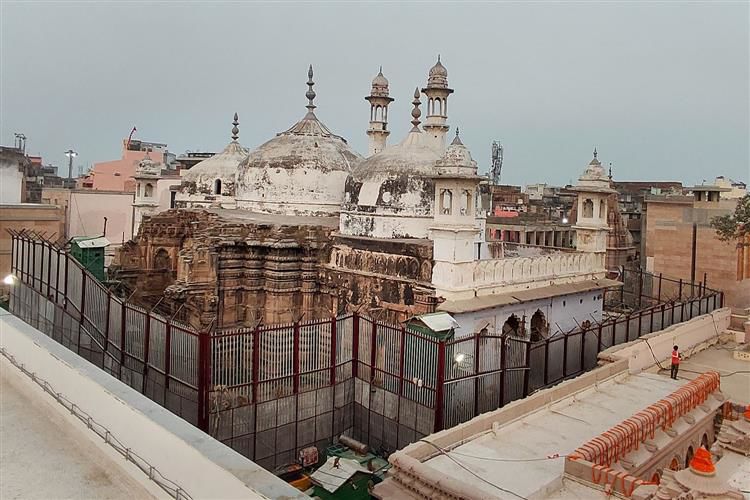
The long-running Gyanvapi dispute will continue to be fought in the courts after both Hindu and Muslim parties declined mediation and indicated that the matter should be resolved through judicial adjudication.
Representatives of both sides appeared before the mediation centre at a Varanasi court as part of the Supreme Court’s “Supreme Court Action for Mediated Adjudication and Disputes Harmonisation Across Nation” (SAMADHAN SAMAROH) initiative. The programme seeks to encourage amicable settlements in pending disputes ahead of a special Lok Adalat scheduled from August 21 to 23.
However, the mediation proceedings did not yield any breakthrough, with both sides maintaining their respective positions and expressing preference for a court verdict.
The development indicates that one of the country’s most closely watched religious site disputes is unlikely to see an out-of-court settlement in the immediate future.
Muslim Side Declines Mediation
According to Hindu side counsel Madan Mohan Yadav, the Muslim side informed the mediation centre that it was not willing to pursue a negotiated settlement and would instead await the outcome of ongoing judicial proceedings.
Yadav said the Muslim parties pointed out that several related matters concerning the dispute are already pending before courts, including the Supreme Court, and therefore preferred that the issue be resolved through the legal process.
“The Muslim side stated that similar matters are pending before the courts and they would abide by whatever verdict is ultimately delivered,” Yadav told reporters after the proceedings.
Hindu Side Reiterates Demand for Restoration of Temple Site
The Hindu parties also declined mediation and reiterated their long-standing position that the disputed site is the original abode of Lord Vishweshwar and forms part of the ancient Kashi Vishwanath temple complex.
According to Yadav, the Hindu side informed the mediator that the dispute concerns what they believe is the original Jyotirlinga site and therefore requires judicial determination rather than compromise.
The Hindu litigants maintained that historical records, archaeological findings and evidence placed before various courts support their claim that a pre-existing temple stood at the site before the construction of the mosque structure during the Mughal period.
Yadav said the Hindu side believes the disputed premises should be restored to facilitate the development of a grand Kashi Vishwanath temple at what they consider the original sacred site.
Part of Supreme Court’s SAMADHAN Initiative
The mediation proceedings were conducted under the Supreme Court’s SAMADHAN SAMAROH initiative, which seeks to reduce litigation through negotiated settlements wherever possible.
As part of the exercise, parties involved in several high-profile religious site disputes across Uttar Pradesh were invited to explore the possibility of an amicable resolution before continuing their legal battles.
However, the deeply contested nature of these disputes has made consensus difficult, with stakeholders preferring judicial adjudication over mediation.
Background of the Gyanvapi Dispute
The Gyanvapi dispute centres on the site adjoining the Kashi Vishwanath Temple in Varanasi.
The Hindu side contends that an ancient temple dedicated to Lord Shiva existed at the location and was demolished during the Mughal era, after which the Gyanvapi mosque structure was erected over a portion of the temple complex. Hindu petitioners have sought recognition and restoration of the site, citing historical accounts, archaeological evidence and religious traditions.
The Muslim side maintains that the Gyanvapi Mosque is a legally recognised Waqf property and disputes the Hindu claims regarding the site’s historical and religious character.
Over the years, the matter has generated multiple legal proceedings involving ownership claims, archaeological surveys and questions concerning the religious nature of the site.
Similar Stand Taken in Other Religious Site Cases
The Gyanvapi matter is among several prominent religious site disputes where mediation efforts have found little traction.
Parties involved in the Sri Krishna Janmabhoomi-Shahi Eidgah dispute in Mathura and the Sambhal Shahi Jama Masjid case have also indicated that they prefer judicial adjudication rather than negotiated settlements.
These cases continue to be closely watched as they involve competing historical claims, questions of religious rights and issues of significant public interest.
With mediation effectively ruled out, the focus now shifts back to the courts where multiple proceedings linked to the Gyanvapi dispute remain pending.
The positions taken before the mediation centre indicate that both parties expect the final resolution to emerge through the judicial process. As a result, the future course of the dispute will depend on ongoing court proceedings, examination of evidence and the eventual verdicts delivered by the judiciary.