How Nitin Nabin decision reflects the institutional priorities of BJP
June 10, 2026
  • Read Ecopy
  • Circulation
  • Advertise
  • Careers
  • About Us
  • Contact Us
Android AppiPhone AppArattai
Organiser
  • ‌
  • Bharat
    • Assam
    • Bihar
    • Chhattisgarh
    • Jharkhand
    • Maharashtra
    • View All States
  • World
    • Asia
    • Europe
    • North America
    • South America
    • Africa
    • Australia
  • Editorial
  • International
  • Opinion
  • RSS @ 100
  • More
    • Op Sindoor
    • Analysis
    • Sports
    • Defence
    • Politics
    • Business
    • Economy
    • Culture
    • Special Report
    • Sci & Tech
    • Entertainment
    • G20
    • Azadi Ka Amrit Mahotsav
    • Vocal4Local
    • Web Stories
    • Education
    • Employment
    • Books
    • Interviews
    • Travel
    • Law
    • Health
    • Obituary
  • Subscribe
    • Subscribe Print Edition
    • Subscribe Ecopy
    • Read Ecopy
  • ‌
  • Bharat
    • Assam
    • Bihar
    • Chhattisgarh
    • Jharkhand
    • Maharashtra
    • View All States
  • World
    • Asia
    • Europe
    • North America
    • South America
    • Africa
    • Australia
  • Editorial
  • International
  • Opinion
  • RSS @ 100
  • More
    • Op Sindoor
    • Analysis
    • Sports
    • Defence
    • Politics
    • Business
    • Economy
    • Culture
    • Special Report
    • Sci & Tech
    • Entertainment
    • G20
    • Azadi Ka Amrit Mahotsav
    • Vocal4Local
    • Web Stories
    • Education
    • Employment
    • Books
    • Interviews
    • Travel
    • Law
    • Health
    • Obituary
  • Subscribe
    • Subscribe Print Edition
    • Subscribe Ecopy
    • Read Ecopy
Organiser
  • Home
  • Bharat
  • World
  • Operation Sindoor
  • Editorial
  • Analysis
  • Opinion
  • Culture
  • Defence
  • International Edition
  • RSS @ 100
  • Magazine
  • Read Ecopy
Home Politics

Strengthening the spine: How the Nitin Nabin decision reflects the institutional priorities of BJP

Nitin Nabin is not an accidental polity-maker. He is a five-term legislator from Patna’s Bankipur/Patna West region who has risen through party and government ranks, holding ministerial portfolios in Bihar and significant organisational roles within the BJYM before assuming larger responsibilities. His journey from a regional cadre organiser to a state minister and now to the national working presidency encapsulates precisely the kind of leadership trajectory that institutions must encourage: long apprenticeship, exposure to federal complexity and demonstrated administrative competence

Adv Karan ThakurAdv Karan Thakur
Dec 21, 2025, 03:00 pm IST
in Politics, Bharat, Analysis
Follow on Google News
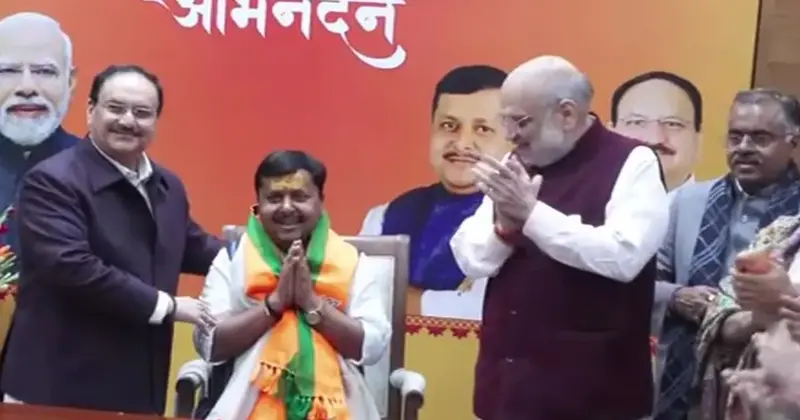
Nitin Nabin takes charge as the Working President of BJP

Nitin Nabin takes charge as the Working President of BJP

FacebookTwitterWhatsAppTelegramEmail

In politics, the most enduring strength is rarely visible in moments of electoral triumph. It is revealed instead in how a party prepares itself during the periods of dominance. The Bharatiya Janata Party’s decision to appoint Nitin Nabin as the Working President must be read in this spirit not as an announcement of ambition, but as an affirmation of institutional discipline. At a time when success could have encouraged ease, the party has chosen structure over spectacle, continuity over noise.

Dr. Shyama Prasad Mukherjee, the ideological fountainhead of the Bharatiya Jana Sangh, once cautioned that “a political organisation survives not by slogans alone, but by the strength of its inner character”. That inner character is tested when power becomes familiar. The BJP today stands at such a juncture: its electoral reach is vast, its governmental footprint expansive and its organisational scale unprecedented in Indian politics. History, however, is unforgiving to parties that mistake momentum for permanence.

Pandit Deendayal Upadhyaya, articulating the philosophy of Integral Humanism, emphasised that institutions must grow organically, not impulsively. “When organisation loses its balance”, he warned, “even good intentions become ineffective”. The BJP’s present decision reflects precisely this concern for balance. By strengthening its organisational spine, the party is ensuring that cadre energy, ideological clarity and administrative coordination remain aligned rather than scattered.

The decision surrounding Nitin Nabin reflects an acute awareness of that historical truth. Large political formations do not falter because they lose elections; they falter when internal systems fail to keep pace with external success. The creation and reinforcement of the Working President’s role is therefore not a matter of hierarchy, but of institutional load-bearing. Leadership must be distributed, responsibilities must be structured and authority routinised if power is to be stable over time. As Pandit Deendayal Upadhyaya warned in his reflections on Integral Humanism, “When organisation loses its balance, even good intentions become ineffective”. The BJP’s present move is, in essence, an attempt to restore and maintain that balance.

Nitin Nabin’s elevation assumes significance on several registers at once. At 45, he became the youngest person to occupy the Working President’s post in the party’s history a symbolic yet substantive nod toward generational renewal rather than mere optics. His appointment is not youth for its own sake; it is youth entrusted with responsibility inside a functioning institutional frame. The party’s choice signals that generational transition will be managed through structured grooming, not impulsive spectacle.

Crucially, Nitin Nabin is not an accidental polity-maker. He is a five-term legislator from Patna’s Bankipur/Patna West region who has risen through party and government ranks, holding ministerial portfolios in Bihar and significant organisational roles within the BJYM before assuming larger responsibilities. His journey from a regional cadre organiser to a state minister and now to the national working presidency encapsulates precisely the kind of leadership trajectory that institutions must encourage: long apprenticeship, exposure to federal complexity and demonstrated administrative competence. These are the qualities that enable a leader to translate youthful energy into disciplined governance rather than episodic mobilisation.

There is a federal subtext to this decision that merits attention. Leadership forged in politically dense states brings with it an instinct for negotiation, alliance management and organisational patience qualities that are frequently undervalued in national calculations dominated by headline politics. By elevating a younger leader from Bihar, the BJP signals that national coherence will be pursued through disciplined coordination rather than enforced uniformity. It is an acknowledgement that India’s political architecture requires managers who can navigate regional complexities while sustaining a central vision.

Equally important is the demographic imperative. India stands at the cusp of a demographic dividend; nearly two-thirds of its population is young, digitally native, aspirational and impatient with inertia. Political parties that fail to provide legitimate institutional avenues for this energy risk ceding it to transient movements or apolitical disengagement. The BJP’s calibrated move placing responsibility in relatively younger hands while anchoring that responsibility within institutional frameworks attempts to channel Gen Z’s dynamism into sustained political participation. It is a subtle strategy: to make the organisation absorb youthful expectations by offering real stakes inside the system rather than confining youth to the periphery of spectacle.

Also Read: Bangladesh: Hindu man Dipu Chandra Das beaten to death over blasphemy claims in Mymensingh amid nationwide unrest

This is not to romanticise the appointment. Institutional reforms are measurable over years, not headlines. The Working President’s effectiveness will be judged by the party’s ability to standardise processes across states, create predictable leadership pipelines and prevent informal power networks from superseding formal roles. The test is whether the office becomes a nerve-centre of coherence absorbing pressure, smoothing frictions and ensuring continuity between the centre and the states rather than a temporary badge of symbolism.

Finally, the Nitin Nabin decision is a modest but important corrective to personality-driven politics. Power that rests too heavily on individuals personalises authority; power that rests on institutions outlasts them. The BJP’s founders understood that ideas persist only when embedded in durable organisation. In choosing to strengthen its internal spine at a moment of outward strength and to entrust that strengthening to a younger leader with substantive regional experience the party reiterates a foundational principle: durable authority is built inward before it is projected outward.

Time will tell whether this decision translates into deeper institutional reform, but as an act of political prudence it deserves recognition. It is a reminder that the quiet work of organisation often invisible, rarely theatrical is the true engine that sustains political power across generations.


Topics: BJPNitin NabinWorking PresidentInstitutional DemocracyPolitical Party
ShareTweetSendShareSend
✮ Subscribe Organiser YouTube Channel. ✮
✮ Join Organiser's WhatsApp channel for Nationalist views beyond the news. ✮
Previous News

AugustaWestland Chopper Scam: Rouse Avenue court grants bail to Christian Michel in ED case, CBI custody continues

Next News

PFI posed grave threat, plotting seize of Southern India, stoke enmity against Hindus & kill RSS-BJP leaders: NIA

Related News

How India keeps cooking gas cheaper than most nations

The LPG Reality Check: Why India still has the world’s cheapest cooking gas

Prime Minister Narendra Modi

BJP’s Victory with Vision: An idea of India that is Indian

Uttar Pradesh CM Yogi Adityanath

From lawlessness to good governance: How Uttar Pradesh rewrote its law and order story under Yogi Adityanath

Change of Guard in Punjab BJP: Challenges, opportunities and the road ahead

BJP meets Governor over Karnataka’s Ladle Mashak Dargah case withdrawal

Karnataka Dargah Dispute: BJP complaints to governor over case withdrawal by govt, alleges insult to Hindu sentiments

Veteran actress, dancer and Padma Shri awardee Mamata Shankar has openly expressed her admiration for the Rashtriya Swayamsevak Sangh (RSS), stating that she strongly supports its ideals, discipline and efforts to preserve India's cultural heritage

Exclusive: BJP and RSS will preserve our culture; I support their ideals and work — Mamata Shankar

Load More

Latest News

West Bengal government drops ‘Dham’ from Digha Jagannath Temple name, upholds Puri’s unique sacred status

PIB debunks viral claim that Kiren Rijiju, Arjun Ram Meghwal and Judges attended Badminton event in London

Fact Check: PIB busts viral London claim, says Rijiju-Meghwal photos are from New Delhi Judges’ Badminton Championship

Now Islamists Eye Keralam’s Ancient Kottiyoor Temple: How Congress, Muslim Family Built Fake ‘Bavalikkettu’ Narrative

Amaravati Gets Major Boost: Andhra Pradesh Cabinet Clears Rs1,299 Crore Central Government Office Complex

PM Narendra Modi and French President Emmanuel Macron

PM Modi’s six-day Europe tour to focus on G7, AI, innovation and strategic partnerships

POJK Burns (This is an AI generated image)

POJK Boils Over: Rs 1 crore bounty on JAAC leaders as anti-government protests intensify

NSE has announced that 10 per cent of its annual CSR corpus will be routed through the Social Stock Exchange

NSE to route 10 per cent of CSR corpus through Social Stock Exchange, sets new benchmark for impact funding

Organisational Secretary of Bharatiya Mazdoor Sangh (BMS), Bojji Surendran addressing the gathering at the 114th Session of the International Labour Conference (ILC) of the International Labour Organization (ILO) in Geneva

114th ILO Session | Innovation must serve humanity and create inclusive growth for all: BMS Org Secretary B Surendran

Mansoor Ahmed and daughter Shamshad Begum arrested for Rs 5.3 cr government job scam

Karnataka Job Scam Busted: Mansoor, daughter Shamshad Begum arrested for Rs 5.3 crore fraud; 40+ aspirants duped

Shamli Conversion Case: Delhi Nikahnama, Name Changes and Pakistan-Based Preacher Videos Under Scanner; Father Awaits Ayush Malik’s Return Home

Shamli Conversion Case: How a Delhi nikahnama, Pakistani cleric’s lectures and an affair changed Ayush Malik’s life

Load More
  • Privacy
  • Terms
  • Cookie Policy
  • Refund and Cancellation
  • Delivery and Shipping

© Bharat Prakashan (Delhi) Limited.
Tech-enabled by Ananthapuri Technologies

  • Home
  • Search Organiser
  • Bharat
    • Assam
    • Bihar
    • Chhattisgarh
    • Jharkhand
    • Maharashtra
    • View All States
  • World
    • Asia
    • Africa
    • North America
    • South America
    • Europe
    • Australia
  • Editorial
  • Operation Sindoor
  • Opinion
  • Analysis
  • Defence
  • Culture
  • Sports
  • Business
  • RSS @ 100
  • Entertainment
  • More ..
    • Sci & Tech
    • Vocal4Local
    • Special Report
    • Education
    • Employment
    • Books
    • Interviews
    • Travel
    • Health
    • Politics
    • Law
    • Economy
    • Obituary
  • Subscribe Magazine
  • Read Ecopy
  • Advertise
  • Circulation
  • Careers
  • About Us
  • Contact Us
  • Policies & Terms
    • Privacy Policy
    • Cookie Policy
    • Refund and Cancellation
    • Terms of Use

© Bharat Prakashan (Delhi) Limited.
Tech-enabled by Ananthapuri Technologies