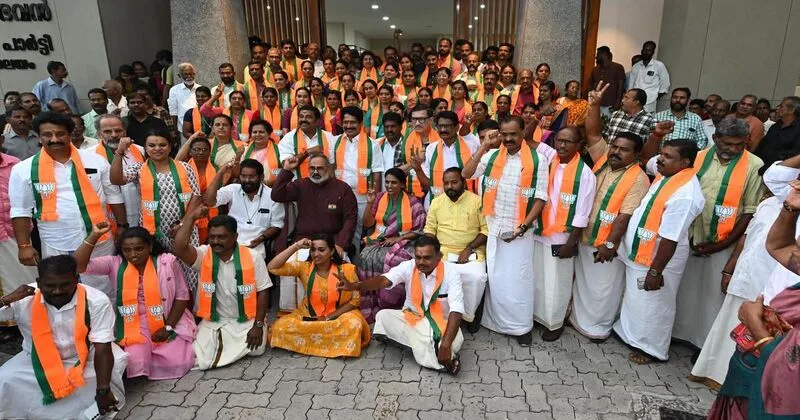
Thiruvananthapuram: The recent local body elections in Kerala, particularly the outcome in the Thiruvananthapuram Municipal Corporation, mark a significant moment in the state’s political trajectory. Long characterised by the bipolar dominance of the Left Democratic Front (LDF) and the Congress-led United Democratic Front (UDF), Kerala’s political landscape is increasingly witnessing the emergence of alternative political formations in urban centres. This article analyses the Bharatiya Janata Party’s (BJP) electoral breakthrough in the state capital, examining its implications for urban governance, voter behaviour, ideological realignments, and the broader evolution of democratic politics in Kerala.
Kerala’s electoral politics has historically been structured around a stable two-front system, with limited space for sustained third-party expansion. Against this entrenched backdrop, the BJP’s performance in Thiruvananthapuram represents more than a routine municipal outcome; it signals a potential shift in urban political preferences and governance expectations. As both the administrative and symbolic capital of the state, Thiruvananthapuram occupies a distinctive position in shaping political discourse, rendering electoral developments in the city particularly significant for understanding broader political trends in Kerala.
Urban Governance and Electoral Choice
The verdict in Thiruvananthapuram reflects a growing emphasis among urban voters on governance-oriented concerns, including civic infrastructure, waste management, public service delivery, transparency, and administrative accountability. The electorate’s response suggests an increasing prioritisation of performance-based politics over inherited ideological loyalties. The BJP’s sustained organisational presence and its articulation of local governance issues appear to have resonated with sections of the urban electorate seeking improved administrative efficiency. This shift points to a broader transformation in urban political behaviour, wherein voters demonstrate a willingness to reassess long-standing political affiliations when governance outcomes are perceived as inadequate. In this context, municipal elections function not merely as local contests but as critical assessments of administrative competence and responsiveness.
Declining Appeal of Polarising Political Formations
An important dimension of the electoral outcome is the limited traction gained by divisive or fringe political groups, including extremist formations. The electorate’s preference for mainstream, constitutional politics underscores a collective aspiration for social stability, civic harmony, and institutional continuity. The Thiruvananthapuram verdict thus reflects a rejection of political narratives rooted in polarisation and radicalism, reinforcing the normative appeal of democratic pluralism and constitutional governance.
As Kerala’s administrative hub, Thiruvananthapuram has often functioned as a political bellwether, with developments in the capital influencing broader political debates across the state. The BJP’s consolidation in the city suggests that urban centres in Kerala may be undergoing gradual ideological and electoral reorientation. This trend appears to be the outcome of long-term organisational efforts, sustained social engagement, and the articulation of an alternative political narrative in regions traditionally considered resistant to such expansion.
Socio-Economic Change and Political Realignment
The city’s demographic profile—marked by a concentration of educated professionals, civil servants, and a growing information-technology workforce—has contributed to shifting political priorities. Issues such as employment generation, infrastructure development, economic growth, and urban competitiveness have assumed increasing importance, particularly among younger voters. In this context, political positions perceived as resistant to market-oriented development or private-sector employment appear increasingly misaligned with contemporary aspirations.
The verdict indicates a generational shift in political consciousness, wherein younger and educated voters exhibit scepticism towards rigid ideological frameworks that are seen as constraining economic opportunity and social mobility. This transformation aligns with broader national patterns of political realignment observed in urban India. Moreover, the national development activities, welfare activities for the lower classes, economic boom, industrial achievements, reforms in the education sector, and the relentless fight against terrorism under Modiji’s leadership are being embraced by the common people and are motivating them to work for a welfare state. Moreover, the national development activities, welfare activities for the lower classes, economic boom, industrial achievements, reforms in the education sector, and the relentless fight against terrorism under Sri Narendra Modiji’s leadership are being embraced by the common people and are motivating them to work for a welfare state.
Ideological Reassessment and Political Discourse
The elections also reflect a wider process of ideological reassessment among sections of the electorate. Questions are being raised regarding the contemporary relevance of both Left and Congress political traditions, particularly in relation to their governance records and adaptability to emerging socio-economic challenges. Simultaneously, concerns related to social cohesion, political stability, national integration, and the management of extremism have entered mainstream political discourse, influencing voter behaviour even in local-level elections.
These intersecting considerations have contributed to a reconfiguration of political narratives, creating space for alternative formations that position themselves as development-oriented, governance-focused, and aligned with broader national policy frameworks. The BJP’s breakthrough in Thiruvananthapuram should be understood as part of a broader and incremental transformation in Kerala’s political landscape rather than as an isolated electoral event. It reflects changing voter priorities in urban contexts, where governance, accountability, economic opportunity, and political stability increasingly shape electoral choice. The growing acceptance of development-centred policy narratives—particularly among educated and younger sections of the electorate—signals a shift in political expectations and evaluative criteria.
As Kerala’s capital charts a potentially new political trajectory, the Thiruvananthapuram verdict stands as a significant indicator of the state’s evolving democratic journey. It also serves as a critical signal to established political formations that long-standing ideological dominance may no longer suffice in an urban electorate increasingly attuned to performance, reform, and future-oriented governance.
On top of all this, the people of Thiruvananthapuram were compelled to rethink their views on corruption, arrogance, political immorality, and the authoritarian attitudes and actions of the ruling class. Above all, there has been growing reflection on the injustice and anti-democratic approaches historically shown towards the culturally rooted Hindu community. There is no doubt that the election results in Thiruvananthapuram point towards the future political direction of Kerala.