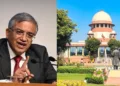
It has been observed for some time that the Supreme Court of India is making intervention in all matters that normally fall outside its jurisdiction. In a way it is taking over the veto-power in a democratic set-up that is normally supposed to be guided and governed by the constitution of India. There is a growing feeling among a large part of the citizenry in the country that the apex court is ‘bossing’ over all the pillars of democracy defined by the constitution.
The constitution of India has defined three pillars of the Indian democracy i.e Legislature, Executive & Judiciary. Besides these three constitutionally recognised pillars of democracy, the ‘media’ is also considered as one of the important pillars of democracy in India, though it hasn’t the constitutional recognition as such. Every pillar has a defined jurisdiction and role and it is presumed that all the pillars will play their role as defined by the constitution and would in no case cross their expounded limits and intervene in the jurisdiction of the others. However, for the past some time, things have come to a pass where such complaints of overstepping one’s jurisdiction have occupied the centre stage of certain important debates.
These debates were witnessed even in parliament, media and among the general discourse of issues in regard to the public governance, polity and administration. Most of these complaints are in respect of the judiciary of the country and particularly the apex court of the country, called the Supreme Court of India. The two houses of parliament and particularly the Rajya Sabha debated this issue a number of times. This was discussed in the house particularly when Jagdeep Dhankar, the former Vice President of the nation was in the chair of the Upper House of the parliament. He called such an intervention a transgression of powers. This issue needs a thorough national debate and discussion in the given circumstances so that the apprehensions are laid to rest, preferably for ever.
The uncalled for observations(sometimes relevant and sometimes irrelevant) of the apex court during the course of the hearing of a particular case also amount to disturbing the socio-political equilibrium of the polity and the public governance. This has also been adding confusion to the public discourse and the available scenario. Then we have also experienced the apex court taking suo moto notice followed by actions on matters which normally don’t fall within its jurisdiction. It mostly includes the issues and actions that pertain to the Executive. Even the powers of the Legislature including that of the Parliament of the country are also threatened in this manner.
The constitution of India was finalised and adopted by the Constituent Assembly of India on November 26, 1949 followed by its implementation with effect from January 26, 1950 -the Republic Day of the nation. The current government at the Centre decided to observe November 26 every year as the Constitution Day (Samvidhan Divas). We observed the constitution day on November 26, last week at the national level. The main function was held in the Central Hall of Parliament(now called the Samvidhan-Sadan) and it was presided over by the President of the Republic, Droupdi Murmu.
The constitution while describing the powers of the President and the Governor gave some leverage to the two positions while taking decisions about certain issues. This leverage is based upon an ambiguity that has been granted to the two positions by the constitution as it was deemed necessary by the Constituent Assembly of India to maintain the required balance. It was after a long discussion and debate in the Constituent Assembly that this timeline ambiguity in relation to the approval of the Bills and other similar documents passed by the respective houses at the Centre and in the States was given to the President and the Governors of the states. It was in fact a special power granted to them by the constitution. The judiciary wasn’t supposed to interfere in this matter and there is no power as such that the Supreme Court could change the constitutional position in this regard.
A two-judge bench of the Apex Court in its judgement in April-2025 set a 3-month timeline for the President and the Governors and granted “deemed assent” to some bills pending with the Tamil Nadu Governor. Unfortunately, the judgement of the two-judge bench of the apex court created a lot of constitutional and political chaos in the minds of the public in relation to the powers and position of the head of the nation/state at the centre and in the states. The situation led the President of India to send a long questionnaire to the Supreme Court of India in regard to the powers of the head of the state as defined and explained in the constitution. The Apex Court was constrained to constitute the constitutional bench of the apex court for adjudication of the whole issue.
In a historic judgement of the Supreme Court of India’s constitutional bench headed by the CJI B.R.Gavai on Presidential and Governor’s powers, the Court stated in its judgement on November 20, 2025 that ‘it cannot set time limits for the President or Governors to act on bills, as this would amount to overreach. The decisions of the Governor and the President under Articles 200 and 201 are not subject to judicial review at a stage before they become law. The Court rejected the idea of “deemed assent”, which would have made a bill law after a specific period of inaction. While it cannot impose timelines, the court can intervene if there is “prolonged, unexplained and indefinite inaction” by a Governor or President to prevent a constitutional crisis’.
The Court’s constitutional bench’s decision was based on the principles of separation of powers and the constitutional intent of Articles 200 and 201, which are designed to provide “elasticity” in decision-making. The main question arises here is what made the two-judge bench deliver a constitutionally erroneous judgement which the constitution bench had to reverse! Judges normally speak about accountability and transparency but unfortunately don’t exhibit the same in their judgements, observations and decisions. Apex court due to its attempts to overreach is setting a bad example and is causing public concern on its position and status as an independent and impartial institution set up by the constitution.
Among all the pillars of democracy, our constitution placed the legislature (Parliament) as a sovereign body due to the fact that it was an elected institution and thus represented the will of the people. In terms of the scheme of the constitution, the Parliament and the Assemblies have been given complete rights to frame laws; and the Parliament reserves the sole right in case of the amendment to the constitution in terms of Article 368. It has been observed many times that the Supreme Court makes an overt or covert attempt to amend the constitution by delivering judgements of the nature to this effect. This is a very serious case of transgression of power by the apex court.
When the elected governments frame laws and draft policies, it is the Executive which implements them on the ground. In the case of the execution of the laws, rules, policies and programmes of the state, the Executive takes actions in accordance with the constitutional sanction. It is here also that the judiciary and particularly the Supreme Court is seen interfering necessarily and unnecessarily. There are varied examples to quote in this context, some of them can be enumerated here: the cases pertaining to the illegal immigrants and infiltrators living in the country, people connected with terrorism and acts of sedition, bulldozer action against the criminals, anti-national elements and mafia, cancellation of visas to foreigners living in the country and matters having serious communal and violent overtones and others.
The constitution clearly specified the role of the judiciary and it is a recognised fact that besides acting as the highest body of the judiciary to hear cases and deliver judgments, the Supreme Court has also a bounden responsibility to assess, revaluate and review the laws enacted by the legislature. When the apex court delivered the judgement in regard to the basic structure of the constitution in the Kesavananda Bharati case in 1973, it didn’t simultaneously define the same. It hasn’t done it till date but has kept options open for the judges to define the basic structure of the constitution as they deemed fit. This has given an overriding power to the Supreme Court to define the constitution, elucidate its fundamental features and make interpretations.
The Supreme Court of India by its judgements, observations, actions and the statements made outside the court has made an attempt to oversee and guide the elected government/s and the executive consistently which is giving a constant notion of dominating others by the apex court. Moreover, the judges of the High Courts and the Supreme Court are selected by the collegium system mechanism that the Supreme Court of India has evolved on the basis of its own judgement. This is a unique system in the world and is in vogue primarily in India.
Keeping in view the public sentiments, concerns of the peoples’ representatives, constitutional scheme of things and the current available scenario in this context, it is imperative for the government to seriously think and act in terms of judicial reforms in the country. It is high time for the reintroduction of the National Judicial Appointments Commission Act of 2015 with a clear intent to execute it by taking recourse to all available constitutional instruments, via media and tools. In view of what has been said above, the question remains: Does the Supreme Court’s bossing also fall within ‘the basic structure of the constitution’….!