When Srikant Tiwari and JK, in The Family Man Season 3, stumble into a Tamil-run hotel in Moreh and ask, bewildered, “How come there are so many Tamilians here?”, they inadvertently touch one of the least-known but most remarkable civilisational stories of Bharat. What appears on screen as a quirky detail is, in fact, a century-long saga of migration, loss, resilience and nation-building—woven into the geography of a small Manipur border town that today serves as Bharat’s gateway to Southeast Asia.
Moreh, the first Bharatiya outpost before the Myanmarese town of Tamu, is more than a trading town. It is a living remnant of a forgotten chapter of Bharatiya civilisation—one that ties the Tamil diaspora of Burma, the trauma of the Ne Win junta and the unfinished aspirations of connectivity in the Indo-Pacific.
The forgotten journey: How Tamils reached Burma
Burma—now Myanmar—was once among Asia’s wealthiest trading hubs. Rangoon, built and modernised under British rule, drew labourers, traders and entrepreneurs from across Bharat: Tamils, Telugus, Bengalis, Odiyas, Gujaratis and Punjabis. Among them, Tamilians were the largest and most industrious group, forming the backbone of Burma’s urban economy.
Under British patronage, these Bharatiyas became indispensable—running trade, accounting systems, banking, teak operations, rubber plantations and transportation. The diaspora prospered, buried their roots deep into Burmese soil and created institutions that reflected Bharatiya values: temples, schools, dharamshalas and cultural sabhas.
But the British departure and Burma’s slide into authoritarianism changed everything.
The 1963–65 disaster: A civilisational cleansing
In 1963, General Ne Win’s Revolutionary Council passed the Enterprise Nationalisation Law, which abruptly seized all major industries—banking, mining, teak trade, import-export and retail. The successful Indian diaspora was suddenly rendered stateless, jobless and home-less. Their properties were confiscated; their businesses wiped out.
The Burmese government ordered Bharat to repatriate its own people—an unprecedented act in modern Asian history. Lal Bahadur Shastri, then Prime Minister, responded by sending ships from Kolkata, Chennai, Vishakhapatnam and Kochi. Each vessel carried nearly 2,000 refugees fleeing a land they considered their own. As ship after ship departed Rangoon’s heaving docks, an ancient Bharatiya trading presence in Southeast Asia collapsed almost overnight.
This episode remains one of Independent Bharat’s least-discussed refugee crises.
A return without a home: Why many walked back towards Burma
The return to Tamil Nadu was not easy. Camps were overcrowded and employment was scarce. Many of the displaced Tamils—particularly those who had lived for generations in Burma—felt culturally and emotionally dislocated in what was technically their “home” country.
Driven by helplessness, thousands attempted something extraordinary: They tried to walk back to Burma.
Their overland route took them through the historic Moreh–Tamu corridor, a path once used by Netaji Subhas Chandra Bose and the INA. Some travelled by boat; others attempted the difficult forested route. The Burmese junta arrested most of them and pushed them back into Bharat.
These displaced families settled in Moreh—accidentally founding one of the most culturally vibrant Tamil communities outside Tamil Nadu.
Rise of the Tamil settlement in Moreh
By the mid-1960s, Moreh saw a steady inflow of these displaced groups. Alongside small populations of Kukis and Meiteis who had lived there since the 1940s, the Tamils soon became the dominant group.
At their peak, they numbered nearly 20,000, creating a dense grid of lanes filled with timber houses, small eateries, provision stores and workshops. Today, around 3,000 Tamils in 300 families remain in Moreh.
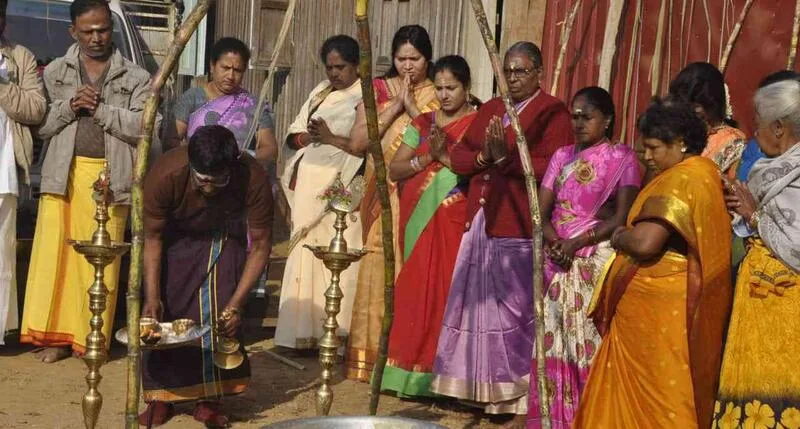
Their institutional anchor became the Tamil Sangam, which continues to manage community welfare, temples, festivals and cultural education.
Cultural citadels on the Border
The Tamil presence in Moreh is not just numerical—it is civilisational.
- Temples as symbols of continuity
The magnificent Sri Angalaparameshwari temple, the second-largest temple complex in the Northeast after Guwahati’s Balaji shrine, stands as the community’s spiritual nucleus. Dedicated craftsmen from Chennai were flown to Moreh for its construction.
Other temples include:
- Sree Veeramma Kali Temple
- Sree Badrakali Temple
- Sree Periyapalayathamman Temple
The community also hosts:
- Tamil Muslim mosque (Tamir-e-Millath Jamia Masjid)
- Tamil Catholic St. George Church
This religious pluralism is striking in a conflict-prone border town, and reflects the inclusive spirit of traditional Tamil society.
Cultural revival
The Tamil Youth Club trains girls in Bharatanatyam, arranges monthly events and conducts the annual Timithi (fire-walking) festival, preserving rituals that might have otherwise faded away in an isolated border town.
Guardians of border trade
Moreh is the gateway of the India–Myanmar cross-border trade, especially since its official recognition as a trading town in August 2018. Despite the power struggles between Kukis and Nagas over control of the area, Tamil traders have retained disproportionate influence over commercial activity.
So central is their role that the community’s leader is colloquially referred to as the “King of Moreh”. The local Vyapar Mandal, almost entirely Tamil, controls trade logistics, warehousing, cross-border supply chains and even informal credit systems that keep commerce alive amid conflict.
In a region where insurgency, ethnic tensions and political volatility are the norm, the Tamil community’s ability to avoid entanglement and maintain economic dominance is a remarkable example of resilience and strategic neutrality.
Ethnic tensions and the 1992 clash
Moreh has never been immune to insurgent pressures. In 1992, tensions escalated when Kuki militants attempted to impose heavy taxes on Tamil businesses. The Tamils, refusing to bow, negotiated an arrangement that invested portions of Tamil trade revenue into local Kuki healthcare, education and infrastructure.
This model of socio-economic diplomacy stabilised relations and is today cited locally as a rare success story of ethnic accommodation in the Northeast.
Legal and geopolitical contestations
Recently, the Tamil community has been fighting attempts by the Manipur government to cede land belonging to the Angalaparameshwari–Muneeswarar temple to Myanmar. One of the temple’s gates already lies within Myanmar territory—reflecting the arbitrary colonial borders that cut across civilisational spaces. The Tamil resistance is, therefore, not only about land. It is about preserving Bharatiya civilisational presence on a frontier long neglected by the national imagination.
The Kanchi Kamakoti Peetham’s spiritual work in Manipur adds another layer of cultural depth to this community’s presence.
Tamil identity in Manipuri pop culture
Tamil cinema enjoys strong viewership in Manipur, especially after Hindi entertainment was banned for years by the Revolutionary People’s Front (RPF). This unusual Tamil–Meitei cultural bond entered mainstream pop culture when The Family Man Season 3 featured Tamil characters and visuals directly inspired by the real Moreh settlement. Representation may be fictional, but the roots are real.
The shock of 2023: When violence reached Tamil homes
Moreh was severely impacted during the 2023 Kuki–Meitei violence. When Kuki mobs targeted Meitei properties after attacks in Imphal, Tamil homes located near Meitei neighbourhoods were collateral victims. Over 45 Tamil houses and shops were burnt—one of the worst instances of Tamil suffering in the Northeast in recent years.
Yet, even amid this chaos, the community did not abandon the town entirely. Their institutions, temples and trade networks remain operational—though diminished.
The civilisational reading: Why Moreh’s Tamil story matters
The story of the Tamils of Moreh is not merely a migration narrative.
It is a lesson in:
1. Civilisational continuity
Borders may shift, empires may fall, but Bharatiya communities carry with them their dharma, culture and entrepreneurial spirit—whether in Rangoon or Manipur.
2. Strategic frontier presence
In the Indo-Pacific era, Bharat’s Act East policy hinges on places like Moreh. The Tamil traders, with their networks across Myanmar, serve as natural cultural ambassadors and connectors.
3. Cultural resilience
Despite refugee trauma, insurgent taxation, ethnic violence and geopolitical flux, the community has preserved temples, arts and customs for more than half a century.
4. Neglected Histories
Mainstream Bharat remembers the Partition, but not the Burmese expulsion of 1963–65. The Moreh Tamils are living reminders of this forgotten tragedy.
Moreh’s Tamils and the idea of Bharat
The Tamil community of Moreh stands as a testament to the civilisational strength of Bharat—resourceful, rooted, adaptive and unbroken by borders or upheavals.
As Bharat asserts itself as a rising civilisational power, stories like Moreh must be reclaimed, retold and re-integrated into our national consciousness. For ultimately, these are not stories of peripheral communities—they are stories of the timeless Bharatiya spirit that has always reached beyond frontiers, from the Cholas in Southeast Asia to the traders of Rangoon to the resilient families of Moreh today.
Their journey—from loss to rebuilding, from Burma to Manipur, from despair to dignity—is not simply a chapter of refugee history. It is a chapter of Bharat’s civilisational niyati.