Over the past year, Bharat’s intelligence agencies have conducted a series of covert operations, successfully dismantling terrorist networks and preventing significant attacks in sensitive regions such as Jammu and Kashmir, Punjab and Delhi. These operations, frequently carried out under the cover of night or through meticulous surveillance, have averted bloodshed on a scale that could have destabilised the nation. Punjab Police, for example, dismantled seven targeted killing networks within a three-week period in November 2025, connecting them to Pakistan’s ISI following Operation Sindoor, during which operatives were prepared for killings but were neutralised prior to executing their plans.
Dismantling ISI-Supported Network
Similarly, in Amritsar, a complex ISI-supported network responsible for orchestrating grenade attacks on police stations to incite communal tensions was dismantled. Key individuals such as Shahzad Bhatti were apprehended, and weapons along with grenades were recovered, thereby preventing widespread disorder in Gurdaspur. These interventions exemplify a proactive approach, whereby intelligence tips from central agencies were efficiently transmitted to State forces, transforming potential disasters into mere footnotes of success.
NIA Conducts Raids in J&K & Punjab
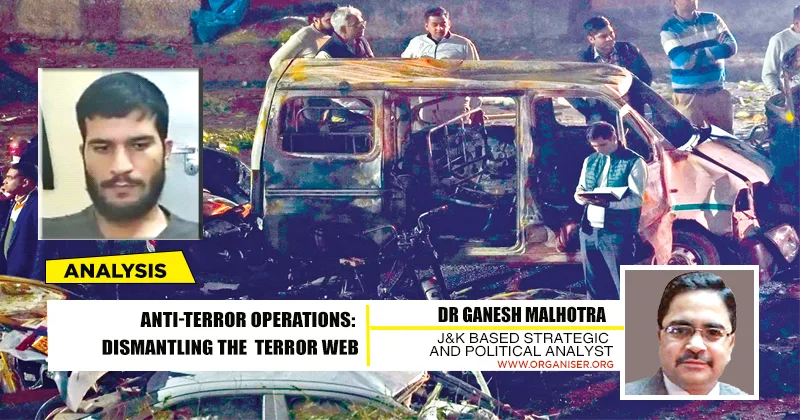
In late November 2025, the National Investigation Agency (NIA) raided locations in Jammu and Kashmir and Uttar Pradesh as part of an investigation into the Delhi blast, revealing connections to wider networks seeking to destabilise urban areas. Delhi Police Special Cell took similar action on December 1, 2025, apprehending three individuals affiliated with a Pakistan-supported network linked to Shehzad Bhatti, who was coordinating arms smuggling and explosive shipments into the city. Earlier, in October 2025, the Special Cell dismantled an ISIS network named ‘Saut-ul-Ummah,’ apprehending two terrorists involved in plotting coordinated explosions at high-profile events. These thwarted efforts reflect a recurring pattern: intelligence operations intercepting digital communications and human intelligence providing information about weapon depots, such as the 350 kg of explosives, AK-47 rifles, and timers recovered by J&K Police in Faridabad with assistance from the Intelligence Bureau, quantities sufficient to target multiple locations.
In Ludhiana, Punjab, a Pakistan-ISI affiliated cell planning a grenade attack was dismantled, with operatives apprehended during their preparations and their weapons seized prior to any attempt at violence.
Defeating Ghazwa-e-Hind Doctrine
Challenging terrain and cross-border infiltration keep Jammu and Kashmir at the centre. J&K Police disrupted transnational supply lines by combining local expertise with central info to remove an inter-State terror module linked to proscribed groups in a major operation. ATS and partners busted an Al Qaeda in Indian sub-continent (AQIS) cell spreading ‘Ghazwa-e-Hind’doctrine in Gujarat, Uttar Pradesh, and Delhi in July 2025, while J&K forces stormed Poonch hideouts and seized IEDs and grenades. A September 2025 exposé of an arms-opium smuggling network and 2.5 kg of IEDs found in Punjab’s border areas led to the deactivation of a JeM module in Andhra Pradesh, UP, and Maharashtra. Based on Jammu fidayeen squad data, officials increased Delhi-Punjab security by deploying AI cameras and snipers to guard Red Fort and important infrastructure before Independence Day 2024 to prevent post-celebration attacks. These examples show a persistent rhythm: from hideout raids in Baramulla to preemptive arrests in Kathua, agencies have cut off terror’s oxygen, averting catastrophic attacks like earlier.
These results are due to extraordinary coordination between intelligence agencies, State police, and central forces, which transformed compartmentalised operations into a symphony of shared vigilance. The Intelligence Bureau, Research and Analysis Wing, and NIA provide real-time intelligence to ground teams through national Multi-Agency Centres (MAC) and State MACs (SMACs) in J&K. Punjab DGP Gaurav Yadav credited national and state officials for dismantling the seven modules, highlighting common crackdowns on desperate ISI bids after Operation Sindoor. Joint command centers monitor drone feeds, satellite imagery, and thermal sensors under the Comprehensive Integrated Border Management System (CIBMS) along the LoC.
Punjab Police Border Range DIG Sandeep Goyal noted cooperation with Delhi, Haryana, and state intel. In Delhi, NIA raids crossed J&K and UP, and Special Cell used interstate networks to catch Bhatti’s syndicate. J&K’s multi-dimensional strategy includes CAPFs, Army, and local police patrolling together and NIA investigating cash trails under enlarged UAPA authorities. Financial crackdowns freeze terror funding, while AI-driven social media surveillance reduces radicalisation. IB reports to J&K and local police led to that big explosives haul in Faridabad, stopping a pan-India plot through vertical and horizontal collaboration. Punjab’s Ludhiana strike also collaborated to stop the grenade attempt, illustrating that intel and boots-on-ground blur borders.
Reconstructing Security Architecture
Tech integration has enhanced liaison. Delhi Police’s 600-700 AI facial recognition cameras saw suspects daily at Red Fort and fed real-time data to headquarters’ C4I systems. Drones patrol vital routes and tunnels in J&K, while Big Data Analytics analyses the internet. Result? Preemptive achievements like October’s JeM module takedown across States show how fragmented intelligence can now prove fatal. Now backed by the Central Government, State Police like J&K Police’s transnational module bust combine grassroots and high-tech sources. Collaboration has reduced terrorists’ operations windows from weeks to hours.
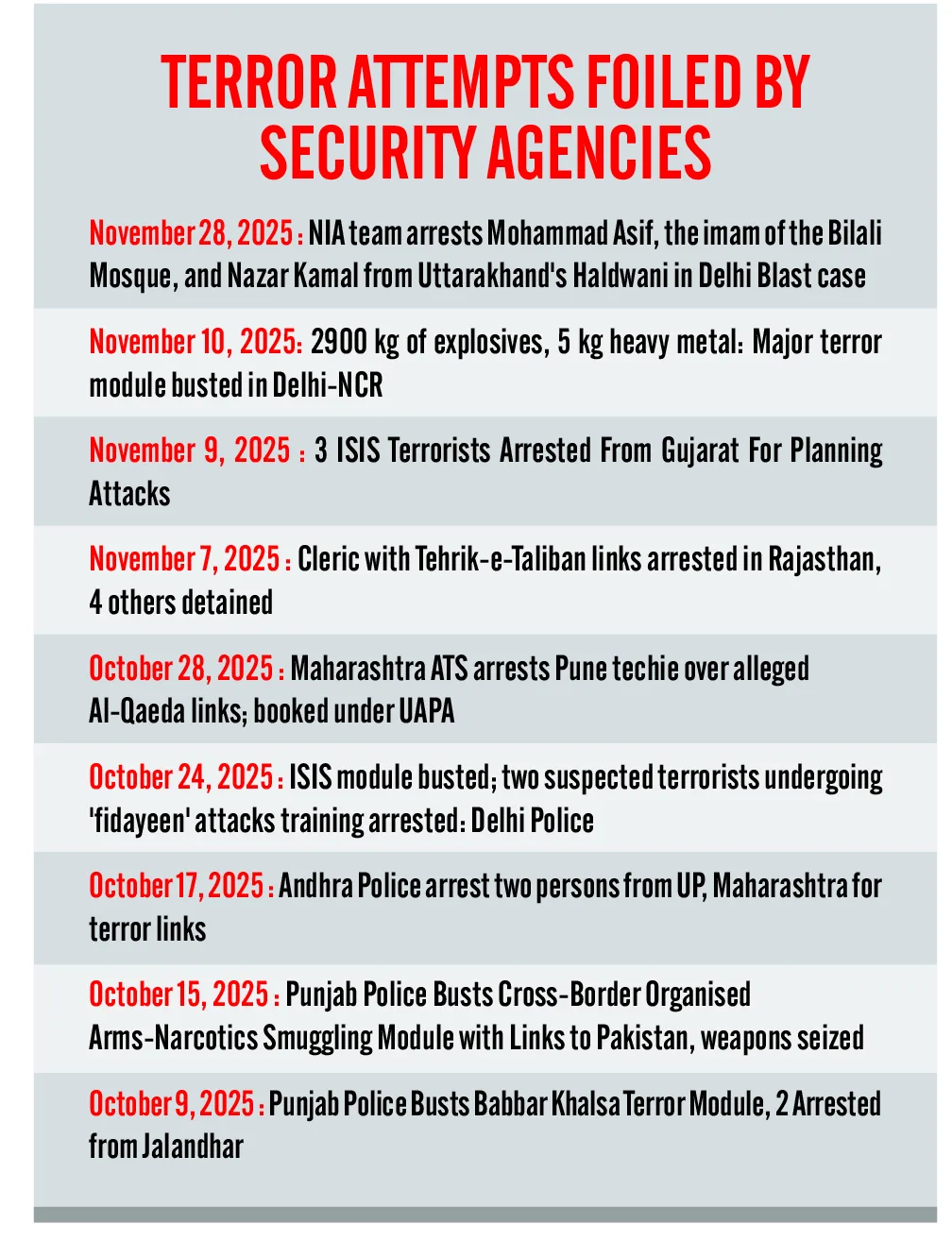
Joint operations have become the primary tool for eliminating threats, frequently in multi-phased attacks that destroy ecosystems. In Punjab, three weeks of relentless raids post-November 2025 busted targeted killing cells, with DGP Yadav noting agencies’ alertness foiled cross-border desperation. The Gurdaspur grenade plot unfolded similarly: first module hit a police station, but intel-triggered arrests of Bhatti’s layers—two modules down, third in sights—halted escalation. Delhi’s Special Cell operation on December 1 targeted three mid-supply chain operatives linked to Punjab handlers.
J&K Police, IB, and locals searched a warehouse and found 350 kg of explosives ready for J&K strikes. The plot may have repeated past killings but ended in handcuffs. An Army-J&K Police raid in Poonch found IED manufacturers, while Gujarat’s ATS neutralised AQIS in a July sweep across States. Punjab received armament networks, JeM cells, and 2.5 kg IEDs from joint border ops including canine units, tech, and human intel in October. After the Delhi blast, NIA’s November J&K-UP operations investigated blast links to larger plots. An organised attack took grenades and operatives from Ludhiana’s Pak-ISI section.
Delhi’s 25,000 troops, snipers, and view-cutters acted to Jammu fidayeen alerts after Independence Day 2024, tracking Kathua movements and explosives consignments. Transnational operations destroyed outlawed group linkages in J&K’s inter-state module bust. From IS modules to opium-arms pipelines, agents destroyed many networks in six months to November 2025, recovering weapons and arresting kingpins. Thousands avoided casualties; communal cohesion kept amid premeditated conflict. Intelligence-led, force-multiplied ops target the dread beast’s head, body, and tail.
India’s security architecture is being reconstructed by this intelligence-led strategy, which is creating a robust framework where prevention is prioritised above response. MHA’s multi-layered J&K approach, which includes improved grids, financial chokepoints, and AI sentinels that produce preemptive wins, demonstrates how agencies have reduced the footprint of terror by emphasising actionable intelligence over reactive firefighting. Module busts in Punjab are a reflection of ISI annoyance following the Sindoor, when diligent nets crushed desperate offers. Economic centres are protected by Delhi’s urban protections, which range from module arrests to explosive investigations.
It strengthens deterrence on a national level. Coordinated intelligence sharing via MAC/SMACs eliminates blind spots, from LoC tunnels to Punjab borders. Joint operations have neutralised hybrid threats such as drones, IEDs, and fidayeen, while UAPA amendments enable prosecutions. In J&K, troop thinning concerns from 2024 yielded to smarter deployments, intel filling gaps. The Faridabad seizure alone defeated a mega-plot; scaled up, it blankets the country. Public safety improves: fewer blasts mean thriving tourism in Kashmir, stable Punjab harvests, and safer Delhi events.
Critics blame ‘intelligence failures’ following isolated occurrences, but the ledger reveals that foiled plans outnumber headlines. The shadow of Operation Sindoor lingers, preventing open warfare while forcing intelligence to the front lines. AI, biometrics, and cyber-watches transform dangers into opportunities. For a billion-plus people, this paradigm—coordinated, joint, and proactive—heralds long-term peace, transforming vulnerability into vigilance.