Red Terror: Manipulations and mutilation by Maoists
June 24, 2026
  • Read Ecopy
  • Circulation
  • Advertise
  • Careers
  • About Us
  • Contact Us
Android AppiPhone AppArattai
Organiser
  • ‌
  • Bharat
    • Assam
    • Bihar
    • Chhattisgarh
    • Jharkhand
    • Maharashtra
    • View All States
  • World
    • Asia
    • Europe
    • North America
    • South America
    • Africa
    • Australia
  • Editorial
  • International
  • Opinion
  • RSS @ 100
  • More
    • Op Sindoor
    • Analysis
    • Sports
    • Defence
    • Politics
    • Business
    • Economy
    • Culture
    • Special Report
    • Sci & Tech
    • Entertainment
    • G20
    • Azadi Ka Amrit Mahotsav
    • Vocal4Local
    • Web Stories
    • Education
    • Employment
    • Books
    • Interviews
    • Travel
    • Law
    • Health
    • Obituary
  • Subscribe
    • Subscribe Print Edition
    • Subscribe Ecopy
    • Read Ecopy
  • ‌
  • Bharat
    • Assam
    • Bihar
    • Chhattisgarh
    • Jharkhand
    • Maharashtra
    • View All States
  • World
    • Asia
    • Europe
    • North America
    • South America
    • Africa
    • Australia
  • Editorial
  • International
  • Opinion
  • RSS @ 100
  • More
    • Op Sindoor
    • Analysis
    • Sports
    • Defence
    • Politics
    • Business
    • Economy
    • Culture
    • Special Report
    • Sci & Tech
    • Entertainment
    • G20
    • Azadi Ka Amrit Mahotsav
    • Vocal4Local
    • Web Stories
    • Education
    • Employment
    • Books
    • Interviews
    • Travel
    • Law
    • Health
    • Obituary
  • Subscribe
    • Subscribe Print Edition
    • Subscribe Ecopy
    • Read Ecopy
Organiser
  • Home
  • Bharat
  • World
  • Operation Sindoor
  • Editorial
  • Analysis
  • Opinion
  • Culture
  • Defence
  • International Edition
  • RSS @ 100
  • Magazine
  • Read Ecopy
Home Bharat

Red Terror: Manipulations and mutilation by Maoists

For decades, Maoists have projected themselves as the “voice of the oppressed tribal communities.” But on the ground, it is the tribals who suffer the most under their violent dominance. From extortion and forced recruitment to the killing of villagers who refuse to cooperate, Maoists have emerged as the biggest obstruction to tribal dignity, development and democratic rights

Raktim PatarRaktim Patar
Dec 3, 2025, 08:30 pm IST
in Bharat, Opinion
Follow on Google News
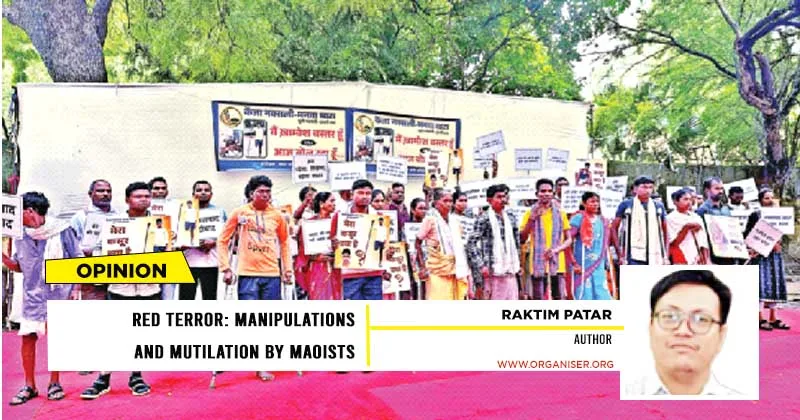
For decades, tribals lived under the fear of
Maoist terrorism often becoming victim of this violence

For decades, tribals lived under the fear of Maoist terrorism often becoming victim of this violence

FacebookTwitterWhatsAppTelegramEmail

For more than five decades, India has been confronted with Naxal terrorism – a prolonged and violent ideological insurgency that has carved deep wounds across the tribal belts of central and eastern India. The most tragic aspect of this conflict is that the people who suffer most are the very ones whom Maoists claim to protect: the communities living in the forests of Chhattisgarh, Jharkhand, Odisha, Maharashtra, Andhra Pradesh, and parts of West Bengal. These communities, rich in culture and resilient in tradition, have been trapped in a conflict they never chose, exploited in the name of Jal, Jangal, Jameen, while being systematically denied the basic dignities of development and peace.

The contradiction at the heart of Maoism is that although it claims to defend tribal identity and resources, its survival depends on keeping tribals backwards, isolated, and vulnerable. Maoist groups violently oppose roads, schools, healthcare, and communication networks – institutions that could uplift tribal families because development undermines their control. Roads are not just infrastructure; they are pathways for welfare schemes, access to hospitals, movement of markets, and mobility for tribal youth. For this reason, Maoists routinely plant IEDs, threaten construction workers, and attack contractors. Villages in Dantewada, Sukma, and Bijapur have seen repeated incidents where road-building teams were ambushed, equipment was burnt, and labourers were killed, forcing entire projects to halt.

Education faces a similar assault. Maoists have destroyed over 300 school buildings in Bastar since 2005, turning many into bunkers or training camps. One of the earliest and most devastating incidents occurred in Dantewada, where Maoists blew up the Tadmetla school. Their justification was that the building could have been used by security forces, but the real fear was that education would empower children, expand their aspirations, and reduce the appeal of violent ideology.

Healthcare, too, becomes a target. Mobile medical vans, vaccination teams, and ASHA workers frequently operate under threat. Maoists have abducted or killed health workers in Dantewada, accusing them of being “informers,” a term weaponised to justify brutality.

On April 6th, 2010, the Maoist massacre of 76 CRPF personnel, led by slain Maoist Madvi Hidma in Dantewada’s Mukram forests, marked one of the deadliest attacks in India’s anti-Naxal history. Villagers in the region were subsequently terrorised and labelled collaborators, forcing them into silence.

Madvi Hidma, despite being a tribal himself, became one of the most ruthless architects of tribal misery in Bastar. Born in the remote village of Puvarti in Sukma district, Hidma rose through the Maoist ranks by enforcing a reign of terror primarily over the very communities he claimed to fight for. His so-called “people’s liberation” depended on keeping tribal families in permanent fear, ensuring they never cooperated with the administration or dared to dream of development.

Under his command, hundreds of tribal families across Sukma, Konta, and Dantewada were displaced from their ancestral hamlets. Villagers who refused to provide food, shelter, or young recruits were dragged to Jan Adalats – kangaroo courts where Hidma’s cadres publicly executed or mutilated them to set fearsome examples. For years, entire hamlets slept in forests at night, too scared to stay in their own homes.

Incidents like this and others collectively show that Maoists do not target state institutions alone; they target tribal progress. Their violence disrupts education, healthcare, livelihoods, political representation, and democratic participation. The tribals remain caught in the crossfire – controlled, threatened, and deprived.

The question then arises: why are tribals so vulnerable to Maoist manipulation? Part of the reason lies in decades of geographic and administrative isolation. Many tribal hamlets are deep within forests, historically lacking state presence. Into this vacuum entered Maoist groups, who initially posed as protectors against exploitation. Young boys were recruited into the ranks, often forcibly, while young girls faced captivity and exploitation. Numerous operations in Dantewada, Sukma, and Malkangiri have rescued children as young as twelve serving as scouts, couriers, or even armed combatants. These children had no ideological conviction; they were victims of fear and lack of alternatives.

Yet much of this suffering remains invisible or distorted in urban discourse. Many left-leaning intellectuals and activists romanticise Maoist violence as resistance. From the comfort of metropolitan cities, they speak in glowing terms about revolution, tribal purity, and anti-state struggle, while enjoying well-paid academic jobs, air-conditioned homes, modern healthcare, highways, and secure neighbourhoods. They oppose building roads in Dantewada while driving their own cars on expressways. They argue that tribals do not need modern schools while sending their own children to elite institutions. They call the state “oppressive” for entering forests but rely heavily on that very state for their salaries, security, and privileges. Their solidarity is ideological, not experiential.

This urban left ecosystem also practices selective outrage. When Maoists are killed, they mobilise protests. When tribals are executed by Maoists, suspected informers, farmers, political workers, students, there is silence. The tribals killed by Maoists in Dantewada are not mourned, not written about, and not remembered. But their deaths form the true, bloody cost of this ideological war. Despite these challenges, tribal communities continue to aspire for development.

The tragedy of Naxal terrorism lies not just in its violence but in how it hijacks tribal futures. Maoism, especially in regions like Dantewada, has repeatedly demonstrated that it fears empowered tribals far more than it fears the state. Because an empowered tribe does not need Maoist “protection.” An educated tribe does not need Maoist ideology. A politically aware tribe does not need Maoist leadership. India must recognise this. The true path forward is not through guns or ideology but through development rooted in dignity. When forests echo with the sounds of schools reopening, roads being built, markets flourishing, and villages thriving, Dantewada and other regions will finally break free from the shadow of Maoist terror. The future must belong to tribal voices, not to those who claim to speak for them while silencing them in the name of revolution.


Topics: Maoist TerrorNaxal terrorismMaoist massacre of 76 CRPFMaoistModi government
Raktim Patar
Raktim Patar
Author [Read more]
ShareTweetSendShareSend
✮ Subscribe Organiser YouTube Channel. ✮
✮ Join Organiser's WhatsApp channel for Nationalist views beyond the news. ✮
Previous News

Sanchar Saathi vs. Manufactured Panic: Why Congress’ ‘Snooping’ charge crumbles under facts

Next News

Gaumukh Tapovan: When nature becomes spiritual guide

Related News

The Modi era is presented as a transformative phase in Indian politics, governance, and national identity, reflecting the aspirations of a rapidly evolving India

Modi Yug: How twelve years of governance reshaped India’s aspirations, identity & development trajectory

Cache of arms and explosives recovered by Odisha Police from Rayagadha forest

Odisha: Major Maoist dump unearthed in Rayagada Forest; Arms, explosives and Maoist literature seized

12 years of Modi Government: A new era of nation building

A large crowd of Bangladeshis residing in West Bengal gathers at the Hakimpur border crossing in the Basirhat subdivision of North 24 Parganas district to cross over to Bangladesh

Unnatural Demographic Change: Securing Bharat against the silent invasion

A representative image

Ayushman Bharat Crosses 90 Cr ABHA Accounts: How Modi govt is building the world’s largest digital health ecosystem

Congress is accused of opposing the Great Nicobar Project for political reasons despite its strategic, economic and national security significance for India

Great Nicobar Project: Does Congress prioritise politics over national interest?

Load More

Latest News

Rani Durgawati

Remembering Rani Durgavati: A woman can be a mother, an empress and an embodiment of an immortal resolve

Karan Singh Kept in Dark: Sheikh Abdullah Never Informed J&K’s Sadr-e-Riyasat of Syama Prasad Mookerjee’s Death (This image is generated by AI)

Syama Prasad Mookerjee Death Mystery: Karan Singh says Sheikh Abdullah never informed him

On the occasion of Dr Syama Prasad Mookerjee’s State-Level Balidan Diwas , Chief Minister Shri Mohan Charan Majhi and others at an event organized at Jayadev Bhawan on June 23, 2026

“Article 370 abrogation fulfilled Dr Syama Prasad Mookerjee’s dream,” says Odisha CM Majhi at Balidan Divas programme

Prakash Raj in Fresh Controversy as Court Issues NBW in Voter Registration Case (This image is generated by AI)

Karnataka: Prakash Raj faces legal scrutiny over alleged multiple voter IDs; Bengaluru Court issues NBW

The fall of Keir Starmer highlights a broader crisis in British governance, where leadership changes have failed to reverse long-term national decline

From Brexit to Starmer: Why Britain’s crisis lies beyond changing leaders in Westminster

Tribute to Rani Durgawati on her Martyrdom Day

Rani Durgavati Martyrdom Day: Immortal Warrior rani, defender of Tribal Pride, national honour & Sanatan values

President Droupadi Murmu confers the Padma Shri on former civil servant R.V.S. Mani on June 23, 2026.

Former MHA official RVS Mani honoured with Padma Shri for contributions to internal security

Tamil Nadu: Temple funds only for temple property; TVK govt concedes before Madras High Court

Keralam’s former Industries Secretary, Mohammed Haneesh IAS (Right Side)

Keralam Cashew Scam: Former Industries Secretary Md Haneesh apologises before High Court after contempt proceedings

Tamil Nadu: Assembly Speaker directs all bureaucrats to strictly follow warrant of precedence after Mayor-MLA row

Load More
  • Privacy
  • Terms
  • Cookie Policy
  • Refund and Cancellation
  • Delivery and Shipping

© Bharat Prakashan (Delhi) Limited.
Tech-enabled by Ananthapuri Technologies

  • Home
  • Search Organiser
  • Bharat
    • Assam
    • Bihar
    • Chhattisgarh
    • Jharkhand
    • Maharashtra
    • View All States
  • World
    • Asia
    • Africa
    • North America
    • South America
    • Europe
    • Australia
  • Editorial
  • Operation Sindoor
  • Opinion
  • Analysis
  • Defence
  • Culture
  • Sports
  • Business
  • RSS @ 100
  • Entertainment
  • More ..
    • Sci & Tech
    • Vocal4Local
    • Special Report
    • Education
    • Employment
    • Books
    • Interviews
    • Travel
    • Health
    • Politics
    • Law
    • Economy
    • Obituary
  • Subscribe Magazine
  • Read Ecopy
  • Advertise
  • Circulation
  • Careers
  • About Us
  • Contact Us
  • Policies & Terms
    • Privacy Policy
    • Cookie Policy
    • Refund and Cancellation
    • Terms of Use

© Bharat Prakashan (Delhi) Limited.
Tech-enabled by Ananthapuri Technologies