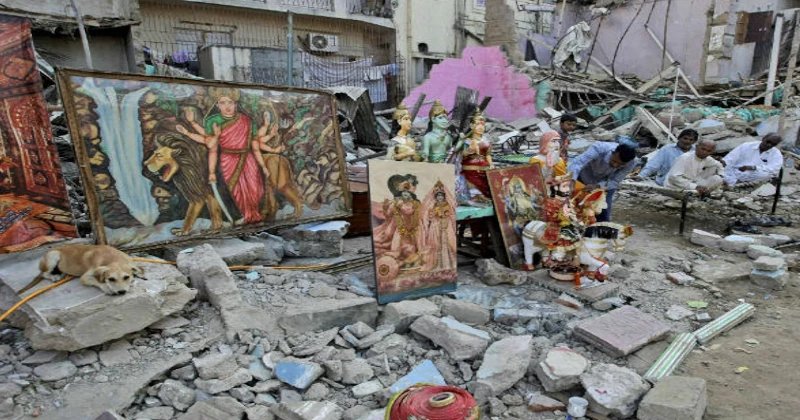
When the first dataset entry was logged on January 1 2023, it appeared to be an isolated act of vandalism a desecrated statue, an overturned diya, a broken mandir gate. Three years later, those scattered incidents had escalated into a dataset of 4,901 documented hate crimes against Hindus across continents. Hidden beneath this massive number is a devastating truth, 781 of these incidents were direct attacks on Hindu religious representations mandirs, murtis, sacred symbols, ritual implements, festival spaces, and consecrated land.
Far from being meaningless acts of destruction, these incidents collectively reveal a disturbing and global pattern: when hostility against Hindus emerges, it strikes first and often most brutally at the sacred.
The Hinduphobia Tracker documented 𝟒𝟗𝟎𝟏 cases of hate crimes against Hindus between 01 January 2023 and 17 November 2025.
Out of this, 𝟕𝟖𝟏 cases were categorised as Attacks on Hindu Religious Representations, i.e., 𝟏𝟓.𝟗%.
This thread reveals shocking patterns.🧵 pic.twitter.com/1PAvLh7WWp
— Hinduphobia Tracker (@hinduphobia_tr) November 18, 2025
Across the world, attacks on religious symbols are often the clearest indicators of communal hostility. They are precise, symbolic, and designed to intimidate. Hindu religious representations mandirs, murtis, flags, ritual objects form the core of Hindu identity and communal life. To attack them is to send a message not merely to a person, but to a civilisation.
Between 2023 and 2025, 781 attacks targeted these sacred representations alone. That is one attack every 33 hours, somewhere in the world.
Of these, 615 an overwhelming 78.7 per cent took place in India itself, the birthplace of Hindu civilisation. This statistic is not just numerically significant; it is psychologically devastating. The land considered the natural home of Hindu civilisation has become the largest site of recorded hostility toward Hindu sacred spaces.
India recorded:
- 332 cases of desecration: Broken murtis, defiled murtis, damaged sacred flags
- 242 mandir attacks: Arson, vandalism, forced entry, destruction of garbhagrihas
- 41 incidents of ritual interference and attempts to humiliate worshippers
- Dozens more involving encroachment, intimidation, sanctum violation, and symbolic humiliation
Inside India, the violence is not evenly distributed. Certain states reveal concentrated patterns that cannot be dismissed as coincidence.
Uttar Pradesh: 169 attacks
No other state comes close. mandirs were vandalised in both small villages and urban centres. Several incidents involved deliberate sabotage during festivals when crowds were thinnest and vulnerabilities highest.
West Bengal: 65 cases
Many of these occurred during Durga Puja and Ram Navami processions moments of heightened visibility for Hindu cultural presence. The symbolism is unmistakable.
Madhya Pradesh: 66 cases
A mix of rural desecrations and targeted vandalism of ancient mandirs shows a simmering hostility beneath the surface.
Bihar: 43 incidents
Over half of these involved direct mandir attacks, many carried out in broad daylight.
Gujarat: 34 cases
A striking number involved deliberate breaking of murtis in roadside shrines symbols of everyday Hindu life. But the most alarming ratios come from:
- Assam: two-thirds of all incidents are mandir attacks
- J&K: same proportion
- Bihar: 56 per cent mandir attacks
These numbers suggest not random crime, but symbolic targeting designed to humiliate and intimidate. If India shows the highest volume, Bangladesh shows the most focused targeting.
Of 112 incidents:
- 82 are mandir attacks: A staggering 73.2 per cent
- 75 involve desecrations: 67 per cent of the total
Mandirs in Bangladesh are often the heart of dwindling Hindu communities spaces for ritual, cultural life, and communal belonging. When these are attacked, the message is not merely of vandalism. It is a message of domination.
In multiple cases, attackers chose late-night hours when no one was present. In others, they targeted festivals Janmashtami, Saraswati Puja, Durga Puja moments of joy that became moments of terror.
The overwhelming concentration leaves little doubt, Bangladesh’s Hindu minority faces a crisis of cultural survival. Only 10 incidents were recorded in Pakistan but seven were mandir attacks. Activists warn that the real number is far larger:
- Complaints are discouraged
- Law enforcement often sides with attackers
- Local clerics exert pressure to remain silent
- Media outlets avoid coverage
- Victims fear retaliation
Several Hindu activists who attempted to document mandir attacks faced threats or were forced to flee. In this climate of coercion, the dataset represents not reality, but what could be documented without risking lives.
In countries where Hindus are growing minorities:
- United States: 12 recorded incidents
- Canada: 11 recorded incidents
These include:
- Attempted arson at mandirs
- Breaking of murtis
- Genocidal graffiti (“Death to Hindus”, “Hindu mandirs must burn”)
- Vandalism connected to foreign extremist groups
- Defacement of mandirs with anti-India political slogans
The diaspora has long warned that Hinduphobia is rising in academic, political, and extremist circles. The data now proves it manifests physically, not merely online. Across regions, attacks on Hindu religious representations cluster around two categories:
- 421 desecrations: 54 per cent
- 362 mandir attacks: 46 per cent
- Combined, over 70 per cent of global Hinduphobic incidents target the sacred heart of Hindu identity.
The intentionality is unmistakable. The attackers’ aim is not theft. It is insult. It is humiliation. It is intimidation. It is the desire to send a message that Hindu belief, space, and presence are vulnerable. The report draws chilling parallels between current patterns and centuries of targeted assaults on Hindu sacred sites.
Medieval campaigns saw the destruction of:
- Somnath multiple times by Mahmud of Ghazni
- Kashi Vishwanath demolished under Aurangzeb
- Keshavdeva mandir, Mathura converted and repurposed
In the colonial era:
- Hindu festivals were labelled “disturbances”
- Processions were restricted
- mandir lands were seized under administrative reforms
- murtis were removed to British museums
- Rituals were policed
This historical continuity is crucial. Hindu sacred spaces have long been targeted to symbolise domination. The present-day attacks form part of that same long arc of symbolic violence. Beyond physical damage, the report documents dozens of cases involving attacks on living Hindu practice:
- Interrupting aarti
- Mocking devotees during pujas
- Playing Abrahamic religious chants to drown out Hindu rituals
- Entering sanctums without permission
- Throwing garbage or footwear into mandir premises
- Blocking processions
- Defiling flowers, kalash, or prasad
These incidents do not merely damage objects; they attempt to shame the community in its moment of worship. This is violence aimed at the psyche, not just the structure.
The authors repeatedly emphasise that the dataset is a conservative minimum. Underreporting is extensive:
- Rural desecration cases in India often go unfiled
- Police stations push for “compromises”
- Media avoids “sensitive” stories
- Victims fear retaliation
- In Pakistan and Bangladesh, reporting can be life-threatening
If the recorded number is this high, the hidden number is far larger. The true global scale of attacks on Hindu sacred spaces is unknown and likely staggering.
(The story is based on the twitter thread and report by Hinduphobia Tracker)