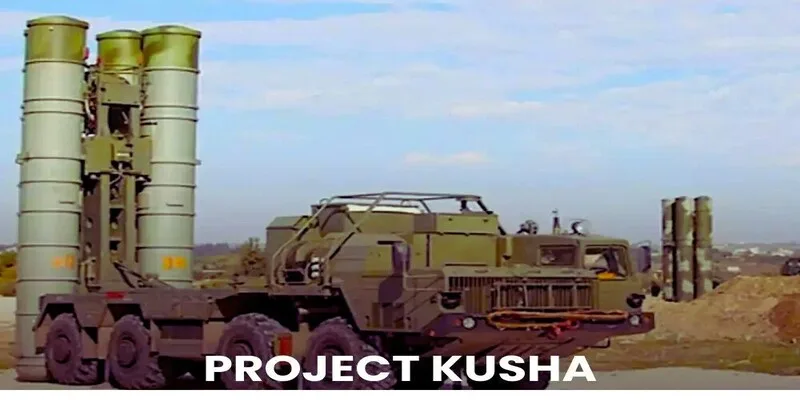
India defence research ecosystem is upgrading slowly and steadily. It comes from the workshops and labs of the Defence Research and Development Organisation (DRDO), where a new chapter in air defence is unfolding Project Kusha.
Worth of Rs 21,700 crore, this indigenous long-range air defence system is being designed to track, intercept and neutralise threats hundreds of kilometres away. At its heart lies the M3 interceptor missile, capable of striking targets up to 400 km away whether it’s a high-speed jet, a ballistic missile or even a hypersonic weapon.
For many years India depends on imports to secure its skies. Now that thought process is shifting. Project Kusha is a conscious move away from dependency, where an affirmation that India can develop, test and refine its own sophisticated defence systems. The project trials are set for 2027, but its significance has already taken flight.
Power of Smart Design
When engineers at DRDO Hyderabad-based Research Centre began conceptualising Kusha’s M3 interceptor, their goal was clear to build a missile that’s lighter, faster and smarter. The outcome of weapon is that weight scales at only 1,673 kilograms more than 200 kilograms lighter than the Russian 40N6E missile used in the S-400 system.
This difference isn’t only in number, it’s about speed. With lighter weight there is faster movement, simpler transport and quicker readiness in the times of crisis. For front-line soldiers, this system has several benefits like more missiles can be transported in one convoy and deployment is smoother even on difficult terrain such as the Line of Actual Control (LAC).
The missile’s sleek 500 mm diameter makes it to fit into standard launch tubes, and its thrust vectoring nozzle provides control at high speeds. It can strike targets traveling at Mach 5.5, five times the speed of sound. What makes this feat possible is a mix of new-age materials like carbon-carbon composites and advanced Gallium Nitride (GaN) electronics. These choices don’t just improve performance, they reduce production costs and weight, a rare balance in modern defence engineering.
The M3 is capable of switching among various seeker heads to detect and attack a range of targets from enemy planes to drones or missiles. This flexibility ensures that Kusha will continue to remain effective as technology and wars change.
Building Strength with Aatmanirbhar Bharat
One of Kusha’s greatest achievements is outside its technical brilliance, it’s the tale of self-sufficiency. Bharat Electronics Limited (BEL) will produce over 500 units by 2032. Each interceptor will cost between ₹40–50 crore almost half-price of its imported counterpart.
This is not only about being frugal. It’s about generating employment, fostering expertise and maintaining key systems in Indian hands. Each made in India component fortifies the nation’s defense economy and minimizes dependence on foreign supply chains.
When combined with India’s own Uttam AESA radar technologies, Project Kusha will provide a national defence shield a networked defence system that is able to track multiple threats simultaneously. This system won’t only safeguard airbases or cities but also serves as a deterrent, silently protecting strategic assets on land and sea.
Around the world only a few nations like the United States, Russia and China possess long-range air defence systems of this calibre. The U.S. has its Patriot PAC-3, Russia fields the S-400 and China rely on the HQ-19. India with Project Kusha, is now preparing to join this league.
India depended on the imported S-400 system for advanced air defence. These imports usually comes with problems of low customization, exorbitant price tags and long delivery times. Project Kusha is India’s response to these limitations. Creating a homegrown system, where country has complete authority over upgrades, tweaking and production speed.
The M3 interceptor being light in weight and highly mobile, may even surpass the 40N6E missile in deployment flexibility and effectiveness. For a geographically complex country like India from deserts to high mountains, such flexibility is crucial. In the coming years, India may not only defend its skies but also become a reliable exporter of defence technology to friendly countries.
Why It Matters for India Future
India confronts complex security concerns from unfriendly borders to dynamic aerial threats and the strategic ambiguity in the Indo-Pacific. Such times call for dependence on foreign systems as a strategic vulnerability. Project Kusha fills this void with accuracy.
It is meant to integrate with other systems such as Akash and S-400 to form a seamless, multi-layered canopy. The 95 per cent success rate of the M3 in simulation against ballistic trajectories indicates that DRDO research is not only ambitious but also effective.
Outside of defence, the project represents India’s scientific infrastructure. The Research Centre innovations in sensors, radar and materials translate into civilian technologies, enriching the overall innovation ecosystem. Kusha is not just about protection it’s also about progress.
With Project Kusha moving toward trials, it is a testament to India emerging technological self-reliance. It is a reflection of a silent but a steadfast faith that India can defend its borders with instruments bred within its own land, by its own hands and in its own minds.
This is what “Aatmanirbhar Bharat” really means and is not a call for isolation, but for empowerment. By developing Kusha, India is not merely creating missiles, it is forging its own destiny. When the first M3 interceptor takes off for actual trials, it will not be a test of engineering alone, it will be a celebration of India’s progress in dominating the skies.