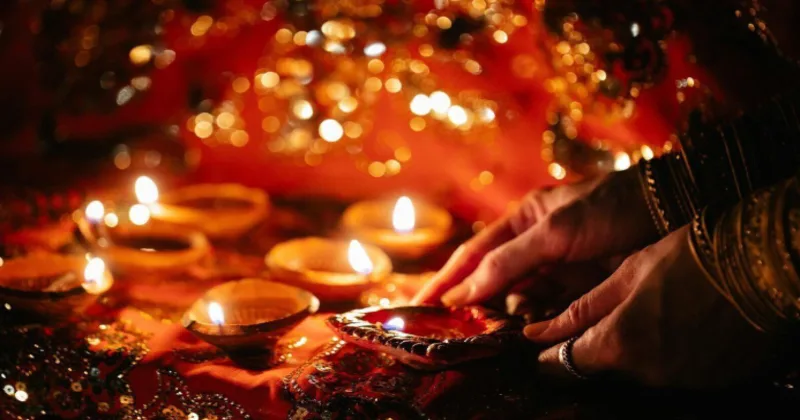
Every year, as the lamps of Deepawali begin to flicker across Bharat, the country’s spirit is renewed in light and devotion. Deepawali is not merely a festival; it is a civilizational moment, a reaffirmation of Dharma over Adharma, of light over darkness, and of truth over falsehood. Yet, in recent years, this celebration of joy and faith has become an ideological battleground. From campaigns against firecrackers to selective bans on Hindu festivals, and from economic guilt-tripping of Hindu consumers to lectures on “secularism,” Deepawali today faces cultural scrutiny unimaginable even a few decades ago.
Diwali, known as Deepavali, the “row of lamps” is celebrated across Bharat in diverse forms, yet its unifying essence is unmistakably Hindu. In the north, it marks the homecoming of Maryada Purushottam Sri Ram to Ayodhya after vanquishing Ravana. In Gujarat, it is associated with the worship of Goddess Lakshmi, the embodiment of prosperity. In Bengal, it coincides with Kali Puja, symbolising the destruction of demonic forces. In the south, it commemorates the slaying of Narakasura by Sri Krishna. Among Sikhs, Jains, and Buddhists too, Diwali finds reflections of Guru Hargobind Ji’s release from captivity, Bhagwan Mahavira’s nirvana, and Emperor Ashoka’s conversion to Dhamma.
What does this diversity tell us? It tells us that Deepawali is not a festival confined to one sect or region. It is the civilizational heartbeat of Bharatvarsha, expressing the eternal truth of Sanatana Dharma, that light, both spiritual and moral, must dispel darkness within and around us. When a Hindu lights a diya, he is not performing a mechanical act; he is participating in an unbroken tradition stretching back millennia. That single flame embodies the memory of Rama’s victory, the wisdom of Mahavira, the power of Kali, and the compassion of Krishna. To celebrate Deepawali, then, is to declare allegiance to Dharma and continuity with our civilizational past.
In the last decade, however, Deepawali has been subtly targeted in the name of ‘environmentalism’, ‘animal rights’, and ‘secular sensitivity’. This selective outrage raises a pressing question: why does environmental activism in India so often target Hindu festivals? The answer lies not in genuine concern for the environment, but in the cultural bias that has long characterised our intellectual discourse. Over decades, a section of India’s elite has treated Hindu customs not as expressions of faith and heritage, but as relics of superstition, something to be reformed, modernised, or suppressed. The ecological argument has merely become a convenient new weapon in this old civilizational battle.
Considering the data, studies show that the air quality in major Indian cities deteriorates during Deepawali, but only for about 24 to 48 hours. Yet the same environmental lobbies remain largely silent during New Year fireworks, Christmas illuminations, or political rallies that generate massive plastic and fuel waste. The carbon footprint of one lavish wedding or a film industry award show often exceeds that of an entire neighbourhood’s Deepawali celebrations, but these seldom attract activist wrath. Then there are other festivals for instance, Eid al-Adha, where large-scale animal sacrifice raises serious questions about waste management and water contamination, or Christmas markets in Europe, where electricity consumption skyrockets. These, however, are rarely framed as “environmental crises.” Why? Because selective morality often masquerades as activism when it targets Hindu practices, while silence prevails in the face of others, a silence born of political correctness and ideological bias.
Let us be clear; Hinduism has always emphasized balance with nature. The same tradition that reveres the Ganga as a mother and the Tulsi plant as divine does not advocate reckless pollution. The issue is not environmental concern per se but the selective moral policing of Hindu cultural expressions. The vilification of Hindu festivals as “polluting,” “noisy,” or “superstitious” reflects a colonial hangover where anything rooted in native faiths was portrayed as backward.
Let come to an important economic and cultural question: Why should Hindus consciously buy firecrackers, diyas, sweets, and other goods from Hindu shops and artisans?
The answer lies in the very philosophy of ‘Swadeshi’; the idea that economic activity is not value-neutral but an extension of one’s ethical and civilizational consciousness. When we light a lamp on Deepawali, we not only worship Lakshmi but also invoke her blessing for the prosperity of our community. Supporting Hindu businesses is not an act of exclusion; it is an act of civilizational solidarity. Let us recall that the firecracker industry, particularly in places like Sivakasi, Tamil Nadu, employs thousands of Hindu workers, many of them from traditional artisan families. Yet, over the years, unfair bans and negative campaigns have crippled these small enterprises, while imported Chinese fireworks or politically connected big firms often escape similar scrutiny. When a Hindu chooses to buy from a Hindu shopkeeper, he is ensuring that his Deepawali Lakshmi flows within the Samaj, within the ecosystem that sustains temples, local traditions, and cultural activities. Every rupee spent becomes an instrument of empowerment, helping families educate their children, sustain their rituals, and preserve cultural heritage. This economic self-awareness is not new. From Lokmanya Tilak’s Ganeshotsav to Mahatma Gandhi’s Swadeshi Andolan, the connection between cultural assertion and economic self-reliance has always been central to the Hindu worldview.
Critics often claim that encouraging Hindus to buy from Hindu shops violates “secularism.” But what kind of secularism are we talking about? The Bharatiya concept of secularism, ‘Sarva Dharma Sambhava’ is not about rejecting religion but about respecting all faiths equally. In contrast, Western-style secularism seeks to expel religion from public life. Unfortunately, postcolonial India adopted the latter model selectively, leading to a situation where Hindu identity is expected to remain invisible, while minority identities are celebrated openly. Buying from a Hindu shopkeeper on Deepawali is no more ‘communal’ than a Muslim supporting businesses during Eid or a Christian buying gifts from co-religionists during Christmas. It is a natural expression of cultural affinity and economic reciprocity. Secularism cannot mean that only Hindus must erase their cultural instincts while others may preserve theirs. In fact, genuine secularism in India must recognize that Hindus, as the civilizational majority, have the right to protect and nurture their cultural and economic ecosystems just as others do. It is not an act of exclusion but of self-preservation.
At its heart, Deepawali is about ‘Prakash’ of light. But light, in the Hindu understanding, is not mere illumination; it is Jnana, knowledge. The Upanishads declare: “Tamaso Ma Jyotirgamaya”, Which means, “Lead me from darkness to light.” Darkness here means ignorance, self-alienation, and moral confusion. Light is self-awareness, Atma Jnana, and cultural confidence.
When a society loses its connection to its roots, it becomes easy prey to intellectual colonization. When Hindus forget why they celebrate Deepawali, they begin to see their own traditions through the lens of their detractors. Therefore, rediscovering the true spirit of Diwali means reclaiming pride in our heritage, confidence in our economy, and clarity in our values.
This Deepawali, let us celebrate not in guilt but in gratitude. Let us light our homes, our hearts, and our markets with confidence. Let us buy diyas from Hindu potters, sweets from Hindu halwais, and firecrackers from Hindu shopkeepers; not because we hate anyone else, but because we love our own civilization and wish to see it flourish.