India conducts 85 percent of its digital transactions via UPI: RBI Governor Sanjay Malhotra
June 9, 2026
  • Read Ecopy
  • Circulation
  • Advertise
  • Careers
  • About Us
  • Contact Us
Android AppiPhone AppArattai
Organiser
  • ‌
  • Bharat
    • Assam
    • Bihar
    • Chhattisgarh
    • Jharkhand
    • Maharashtra
    • View All States
  • World
    • Asia
    • Europe
    • North America
    • South America
    • Africa
    • Australia
  • Editorial
  • International
  • Opinion
  • RSS @ 100
  • More
    • Op Sindoor
    • Analysis
    • Sports
    • Defence
    • Politics
    • Business
    • Economy
    • Culture
    • Special Report
    • Sci & Tech
    • Entertainment
    • G20
    • Azadi Ka Amrit Mahotsav
    • Vocal4Local
    • Web Stories
    • Education
    • Employment
    • Books
    • Interviews
    • Travel
    • Law
    • Health
    • Obituary
  • Subscribe
    • Subscribe Print Edition
    • Subscribe Ecopy
    • Read Ecopy
  • ‌
  • Bharat
    • Assam
    • Bihar
    • Chhattisgarh
    • Jharkhand
    • Maharashtra
    • View All States
  • World
    • Asia
    • Europe
    • North America
    • South America
    • Africa
    • Australia
  • Editorial
  • International
  • Opinion
  • RSS @ 100
  • More
    • Op Sindoor
    • Analysis
    • Sports
    • Defence
    • Politics
    • Business
    • Economy
    • Culture
    • Special Report
    • Sci & Tech
    • Entertainment
    • G20
    • Azadi Ka Amrit Mahotsav
    • Vocal4Local
    • Web Stories
    • Education
    • Employment
    • Books
    • Interviews
    • Travel
    • Law
    • Health
    • Obituary
  • Subscribe
    • Subscribe Print Edition
    • Subscribe Ecopy
    • Read Ecopy
Organiser
  • Home
  • Bharat
  • World
  • Operation Sindoor
  • Editorial
  • Analysis
  • Opinion
  • Culture
  • Defence
  • International Edition
  • RSS @ 100
  • Magazine
  • Read Ecopy
Home Bharat

India conducts 85 percent of its digital transactions via UPI: RBI Governor Sanjay Malhotra

India’s Unified Payments Interface (UPI) now accounts for 85 percent of all digital payment transactions, marking a global benchmark in secure, inclusive, and scalable digital public infrastructure

Shashank Kumar DwivediShashank Kumar Dwivedi
Oct 19, 2025, 03:30 pm IST
in Bharat
Follow on Google News
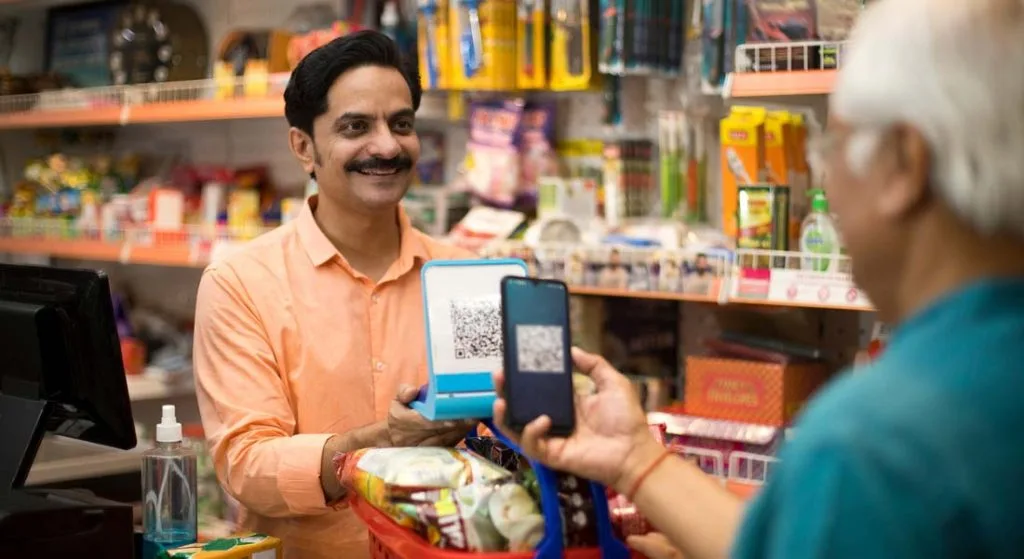
A representative image

A representative image

FacebookTwitterWhatsAppTelegramEmail

India’s homegrown Unified Payments Interface (UPI) has revolutionised the nation’s digital economy, now facilitating 85 percent of all digital transactions in the country, according to Reserve Bank of India (RBI) Governor Sanjay Malhotra. Speaking at a high-level dialogue organised by the RBI on the sidelines of the World Bank and IMF Annual Meetings in Washington, Governor Malhotra said India’s success with Digital Public Platforms (DPPs) offers a model of inclusive, secure, and scalable digital transformation for the world.

“About 85 per cent of the digital payment transactions in India today take place through UPI. Nearly 20 billion transactions are made using UPI every month, representing a value of over USD 280 billion,” Malhotra said, underscoring UPI’s role as a critical Digital Public Platform driving financial inclusion and economic resilience.

UPI: The cornerstone of India’s digital payment revolution

Since its inception in 2016, UPI has fundamentally reshaped India’s payment ecosystem, enabling real-time money transfers between bank accounts with unprecedented speed, reliability, and convenience. What began as a government-backed innovation has today become a global symbol of digital empowerment.

Governor Malhotra highlighted that the Unified Payments Interface is not merely a financial tool but a social and economic equaliser, empowering millions of small vendors, micro-enterprises, and rural citizens to participate in the formal economy.

“Small vendors and micro enterprises can now accept digital payments, build transaction histories, and access formal credit at much lower costs,” Malhotra said. “UPI is a powerful catalyst accelerating financial inclusion and promoting equitable growth.”

According to the RBI, UPI’s success demonstrates how digital trust infrastructure, when built as a public good, can drive both innovation and inclusion simultaneously, without relying on profit motives or monopolistic control.

India’s digital public platforms: A global case study

Addressing the session titled “Forging Economic Resilience through Digital Public Platforms,” Malhotra presented India’s broader Digital Public Platform (DPP) ecosystem, which includes Aadhaar (digital identity), UPI (real-time payments), and DigiLocker (data sharing infrastructure) among others.

“In the true spirit of Vasudhaiva Kutumbakam, the world is one family, India is fully committed to international collaboration around such platforms to accelerate digital transformation globally,” he affirmed.

He explained that Digital Public Platforms (DPPs) have emerged as a powerful catalyst for inclusive growth, innovation, and public service delivery, particularly during periods of global economic uncertainty. By combining open technology architecture with transparent governance, India has built one of the world’s most trusted digital ecosystems, offering lessons for other developing economies.

‘Built as public good, not for profit’

Governor Malhotra mentioned that India’s guiding philosophy has been to develop core digital infrastructure in the public sector, not as a profit-driven enterprise but as a public good with clear guardrails to ensure trust, privacy, and inclusivity.

“For us, the guiding principle has been to build such platforms in the public sector as a public good with suitable guardrails, and without a profit motive,” he said. “Public and private sector entities can then leverage these platforms to rapidly develop applications across credit, health, social protection, agriculture, and several other domains.”

This open-access approach has encouraged fintech startups, government agencies, and private innovators to build on shared infrastructure, resulting in one of the world’s most dynamic fintech ecosystems.

Digital inclusion beyond borders: MOSIP for the world

In addition to India’s domestic digital success, Governor Malhotra introduced the Modular Open-Source Identity Platform (MOSIP), a globally shareable model developed by India to help other nations build their own secure digital identity systems.

“This free, secure, and scalable platform allows countries to design their own national digital ID systems,” he said. “As many as 27 countries are either adopting or considering MOSIP-based systems to deliver essential services quickly and directly to their citizens.”

MOSIP, originally developed in collaboration with global partners and Indian technologists, is now helping countries in Africa, Asia, and Latin America to implement cost-effective, transparent, and citizen-centric digital identity frameworks.

UPI’s expanding global footprint

UPI’s influence has already crossed borders, with countries like Singapore, UAE, Bhutan, Nepal, France, and Sri Lanka integrating or collaborating with India to enable cross-border UPI transactions. These partnerships are helping build a global digital payment network that prioritises transparency, interoperability, and affordability over profit.

Analysts note that this model can help developing economies leapfrog traditional banking systems, bringing millions into the formal financial sector through mobile-led innovation.

The spirit of Vasudhaiva Kutumbakam

Echoing the theme of India’s G20 Presidency, Governor Malhotra reiterated that digital inclusion must be global, not confined to national boundaries.

“We believe that the benefits of DPPs should be available to the whole world, in the spirit of Vasudhaiva Kutumbakam, the world is one family,” he said.

He added that India stands ready to share its expertise, software frameworks, and governance models to help nations strengthen their digital resilience, reduce transaction costs, and improve service delivery.

UPI by the Numbers

85 percent of all digital transactions in India are now made via UPI.
Over 20 billion transactions processed monthly.
Transaction value exceeds USD 280 billion per month.
UPI adoption in over 7 crore small merchants nationwide.
Accepted in 10+ international markets through collaborations.

A model for the digital world

India’s success with UPI and its Digital Public Infrastructure demonstrates that financial inclusion and innovation can coexist when technology is developed as a public utility rather than a private commodity.

Governor Malhotra’s remarks reaffirm that India’s digital journey, rooted in trust, scale, and public ownership could serve as a global blueprint for inclusive digital transformation, especially for emerging economies seeking to strengthen financial systems without deep capital investment.


Topics: RBI Governor Sanjay Malhotrafintech revolutionUPIUnified Payments Interfacedigital public infrastructuredigital payments India
ShareTweetSendShareSend
✮ Subscribe Organiser YouTube Channel. ✮
✮ Join Organiser's WhatsApp channel for Nationalist views beyond the news. ✮
Previous News

The Hidden Epidemic: Surge in counterfeit drugs across India

Next News

Life Management Through Vedic Knowledge: Yog Darshan of Maharishi Patanjali

Related News

Delhi expands ICT infrastructure in schools, upgrade 376 ICT labs, add 31 new digital labs in government schools

The Platform Revolution: How India’s BFSI sector will serve its next 400 million

Representative image

The Platform Revolution: How India’s BFSI sector will serve its next 400 million

French President Eammanuel Macron speaks at the AI Impact Summit, 2026

AI Impact Summit: French President Macron praises the UPI revolution; Hails how digital tool transformed lives in India

Representative Image

Republic Day 2026: Space, AI, UPI and startups signal India’s capability leap

Representative image

IMF praises UPI as world’s largest payment system, highlighting Modi govt’s digital vision outpacing Congress critics

Load More

Latest News

India delivered a historic performance at the inaugural World Yogasana Championships, finishing at the top of the medal tally with an astounding 114 medals, including 102 golds

World Yogasana Championships: India scripts historic triumph with 114 medals and 102 gold medal wins

Protest erupts in POJK

Why is PoJK protesting? JAAC ban, anti-Pakistan slogans and public anger against Pakistan Army — Read here

India slams Pakistan over its Fatna al Hindustan narrative

India tears Pakistan at UN over ‘Fitna al Hindustan’ narrative; Exposes Islamabad as an ‘organised factory of hate’

India's Permanent Representative to United Nations Ambassador Harish Parvathaneni

India & Afghanistan are “civilisational states”: Indian Envoy at UN reaffirms health, education & humanitarian aid

Bulldozer action on houses linked to drug traffickers in Rourkela's Meenapada area

Odisha: Major crackdown on drug traffickers in Rourkela; Bulldozers demolish houses of Farida, Imran & other accused

Prime Minister Narendra Modi with Agri Minister Shivraj Singh Chouhan

India’s Agricultural Revolution: Rising output, record procurement and expanding farmer support since 2014

Remembering Birsa Munda on his death anniversary

Birsa Munda Death Anniversary: Revisiting the life & enduring legacy of India’s legendary tribal icon Dharti Aaba

A massive 200-kg Shivling recovered from the waters of the Ganga in Varanasi

Hidden Beneath the Ganga for 2,500 Years? 200 kg Shivling discovery draws thousands of devotees in Kashi

A representative image

Four years of Jan Samarth: How India’s digital credit gateway has processed over Rs 3 lakh crore in loan applications

The Ganesha idols are the historical evidence of the Temples of learning at Qutub Complex, part of the broken remains from the 27 Nakshatra Vidya Mandirs that were destroyed by invaders

Why is it important to reclaim the Hindu heritage of the ‘Qutub Complex’?

Load More
  • Privacy
  • Terms
  • Cookie Policy
  • Refund and Cancellation
  • Delivery and Shipping

© Bharat Prakashan (Delhi) Limited.
Tech-enabled by Ananthapuri Technologies

  • Home
  • Search Organiser
  • Bharat
    • Assam
    • Bihar
    • Chhattisgarh
    • Jharkhand
    • Maharashtra
    • View All States
  • World
    • Asia
    • Africa
    • North America
    • South America
    • Europe
    • Australia
  • Editorial
  • Operation Sindoor
  • Opinion
  • Analysis
  • Defence
  • Culture
  • Sports
  • Business
  • RSS @ 100
  • Entertainment
  • More ..
    • Sci & Tech
    • Vocal4Local
    • Special Report
    • Education
    • Employment
    • Books
    • Interviews
    • Travel
    • Health
    • Politics
    • Law
    • Economy
    • Obituary
  • Subscribe Magazine
  • Read Ecopy
  • Advertise
  • Circulation
  • Careers
  • About Us
  • Contact Us
  • Policies & Terms
    • Privacy Policy
    • Cookie Policy
    • Refund and Cancellation
    • Terms of Use

© Bharat Prakashan (Delhi) Limited.
Tech-enabled by Ananthapuri Technologies