In 2025, the rivalry between the United States and China seems to be moving into a more serious, structural phase. What started as occasional trade disputes has now evolved into a complex confrontation that includes trade, supply chains, technology, finance, and security. This rivalry is not just about the two countries; it may reshape the global order, challenge rising powers like India, and speed up the movement towards a more multipolar world.
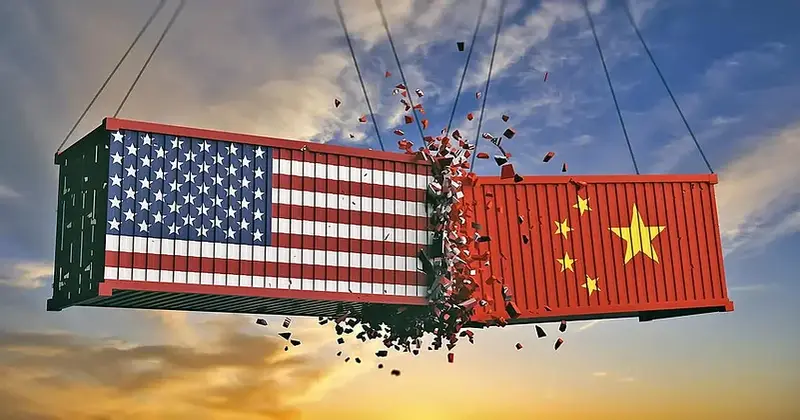
Trade and economic strategies lie at the heart of the tension. Recently, China enacted broad export controls on rare-earth materials and related technologies, effective from December 1. Foreign firms now need licenses even for using small amounts of Chinese-sourced rare earths. The United States reacted with strong rhetoric and proposed 100 per cent tariffs on Chinese imports starting November 1. Both countries have also introduced fees for each other’s ships, raising the costs of maritime trade. The WTO has warned that bilateral trade could fall by as much as 80 per cent if tensions escalate, though that is a hypothetical scenario. In September 2025, China’s exports to the U.S. dropped by 27 per cent year-on-year, while its overall exports increased by 8.3 per cent as China shifted focus to markets in Southeast Asia, Latin America and Africa.
These actions highlight a larger trend: the growing emphasis on national security in trade. What used to be typical tariff negotiations is now framed in security terms. The U.S. has historically used export controls on semiconductors and China is following suit with rare earths, reflecting the U.S. Foreign Direct Product Rule. Both sides are using essential components in high-tech supply chains as tools of competition.
However, trade is just one part of the rivalry. The competition in technology is intensifying alongside economic pressure. A recent study shows that tensions between the U.S. and China in science and technology are already limiting knowledge sharing in areas where China is nearly at U.S. levels, especially in foundational research. Analysts of global supply chains observe that U.S. imports are moving toward “China+1” partners, particularly ASEAN countries. These new supply chains are still connected to Chinese networks, limiting actual decoupling. In finance, countries are looking for alternatives to dollar-based systems. For example, some are engaging with China’s CIPS payment system and exploring cross-border digital currencies to lessen vulnerability to U.S. sanctions.
Geopolitically, the U.S. and China are competing for influence over maritime routes, alliances and defense strategies. The introduction of reciprocal port fees serves not only as an economic measure but also as a signal of the struggle for control over sea lanes. China’s diplomatic efforts continue; in April 2025, Xi Jinping visited Vietnam, Malaysia and Cambodia to strengthen its influence in Southeast Asia. The competition for strategic locations from Indo-Pacific ports to infrastructure projects in Latin America and Africa will only grow.
What does this indicate for the global order? The older model of U.S.-led unipolarity faces challenges. Although the U.S. maintains military and institutional strength, its ability to uphold a rule-based global system is being tested by increasing resistance and fragmentation. Many analysts are now referring to “ordered polycentrism” as a new governance model, where multiple centers of influence coexist and interact through overlapping institutions. The U.S.-China rivalry might cause a shift in global influence: rather than a single power, we could see several key players such as Washington, Beijing, New Delhi, Brussels, and possibly Moscow with each commanding their own spheres of influence.
In this shifting landscape, India holds a critical position. With some of the highest growth rates among large economies and a favorable demographic situation, India is frequently cited as one of the poles in the foreseen multipolar order. However, India’s strategic options are not limitless. Traditionally, it has taken a measured, non-confrontational stance in the U.S.-China rivalry. Furthermore, it faces structural challenges like the Chinese supply chains are still embedded in Indian manufacturing and China remains a significant trading partner. On a bilateral level, India must navigate tensions over its border with China while balancing Washington’s expectations for strategic cooperation.
As the U.S.-China rivalry grows, India might boost its bargaining power if it acts wisely. It could secure better deals from both sides, such as in arms transactions, technology exchanges, or supply chain partnerships. New Delhi can also serve as a hub for companies looking to reduce reliance on China. It could provide alternative locations for manufacturing and design, especially in areas where India excels, like software and green energy. Nevertheless, India risks being caught in the middle: if open trade norms break down and decoupling intensifies, India’s export opportunities in contested markets might diminish. Additionally, India may face pressure to choose sides or commit to security deals.
In relative terms, middle powers such as South Korea, ASEAN nations, Brazil and South Africa might also find their influence growing. They can act as swing states in supply chains, provide alternative manufacturing sites and negotiate favorable terms with both blocs. However, their ability to exert leverage depends on whether these countries have the institutional strength, economic sophistication, and political independence to do so. Some may be too reliant on one side to act as truly independent players.
Looking ahead, the situation could unfold in different ways. In a pessimistic scenario, the U.S.-China conflict could become entrenched, leading to significant decoupling, divided standards in technology and trade, competing economic blocks, and ongoing security tensions. This would disrupt supply chains, raise costs and split the global economy.
A more moderate forecast could involve periods of de-escalation, where negotiations occur amid crises in rare earths, semiconductor exports, or regional disputes. In this case, the rivalry would remain a significant issue but not an absolute divide. The order would still be contested, yet global institutions, multilateral development banks and trade agreements would continue to play mediating roles.
Even under a moderated scenario, a return to the pre-2018 state of highly integrated globalization seems unlikely. The new reality will likely involve partial re-globalization, characterized by segmented networks, multiple value chains and strategic circuits in key sectors. The WTO’s warning that a breakdown in U.S.-China trade could lower global real GDP by 7 per cent highlights the significant stakes.
Other nations are not without power: their bargaining strength could grow if they combine economic progress with institutional effectiveness and strategic independence. However, this is not guaranteed; they must invest in their capabilities, pursue flexible foreign policies and avoid overreliance on any bloc.
Ultimately, the U.S.-China rivalry is not merely a bilateral issue; it represents a critical juncture for the global order. If mismanaged, it could fracture economic systems, splinter financial networks and undermine multilateral norms. If approached with caution, it could pave the way for a more diverse, multipolar world which would be chaotic and contested, but potentially more resilient than a fragile unipolar system. The decisions made by middle powers like will play a crucial role in determining the direction we take.