
Bharat Manthan: Churning on restoring development
October 3, 2026
  • Read Ecopy
  • Circulation
  • Advertise
  • Careers
  • About Us
  • Contact Us
Android AppiPhone AppArattai
Organiser
  • ‌
  • Bharat
    • Assam
    • Bihar
    • Chhattisgarh
    • Jharkhand
    • Maharashtra
    • View All States
  • World
    • Asia
    • Europe
    • North America
    • South America
    • Africa
    • Australia
  • Editorial
  • International
  • Opinion
  • RSS @ 100
  • More
    • World Hindu Congress 2026
    • Op Sindoor
    • Analysis
    • Sports
    • Defence
    • Politics
    • Business
    • Economy
    • Culture
    • Special Report
    • Sci & Tech
    • Entertainment
    • G20
    • Azadi Ka Amrit Mahotsav
    • Vocal4Local
    • Web Stories
    • Education
    • Employment
    • Books
    • Interviews
    • Travel
    • Law
    • Health
    • Obituary
  • Subscribe
    • Subscribe Print Edition
    • Subscribe Ecopy
    • Read Ecopy
  • ‌
  • Bharat
    • Assam
    • Bihar
    • Chhattisgarh
    • Jharkhand
    • Maharashtra
    • View All States
  • World
    • Asia
    • Europe
    • North America
    • South America
    • Africa
    • Australia
  • Editorial
  • International
  • Opinion
  • RSS @ 100
  • More
    • World Hindu Congress 2026
    • Op Sindoor
    • Analysis
    • Sports
    • Defence
    • Politics
    • Business
    • Economy
    • Culture
    • Special Report
    • Sci & Tech
    • Entertainment
    • G20
    • Azadi Ka Amrit Mahotsav
    • Vocal4Local
    • Web Stories
    • Education
    • Employment
    • Books
    • Interviews
    • Travel
    • Law
    • Health
    • Obituary
  • Subscribe
    • Subscribe Print Edition
    • Subscribe Ecopy
    • Read Ecopy
Organiser
  • Home
  • Bharat
  • World
  • Operation Sindoor
  • Editorial
  • Analysis
  • Opinion
  • Culture
  • Defence
  • International Edition
  • RSS @ 100
  • Magazine
  • Read Ecopy
Home Bharat

Bharat Manthan: Churning on restoring development

'Bharat Manthan-2025’, organised by Dr. Syama Prasad Mookerjee Research Foundation on September 28, 2025, at Vigyan Bhawan, New Delhi, brought together policymakers, security experts, academics, and survivors. Across five sessions, participants discussed the issue of Naxalism and strategies for building a Naxal-free future

Ravi MishraRavi Mishra
Oct 12, 2025, 09:00 pm IST
inBharat, Special Report
Follow on Google News
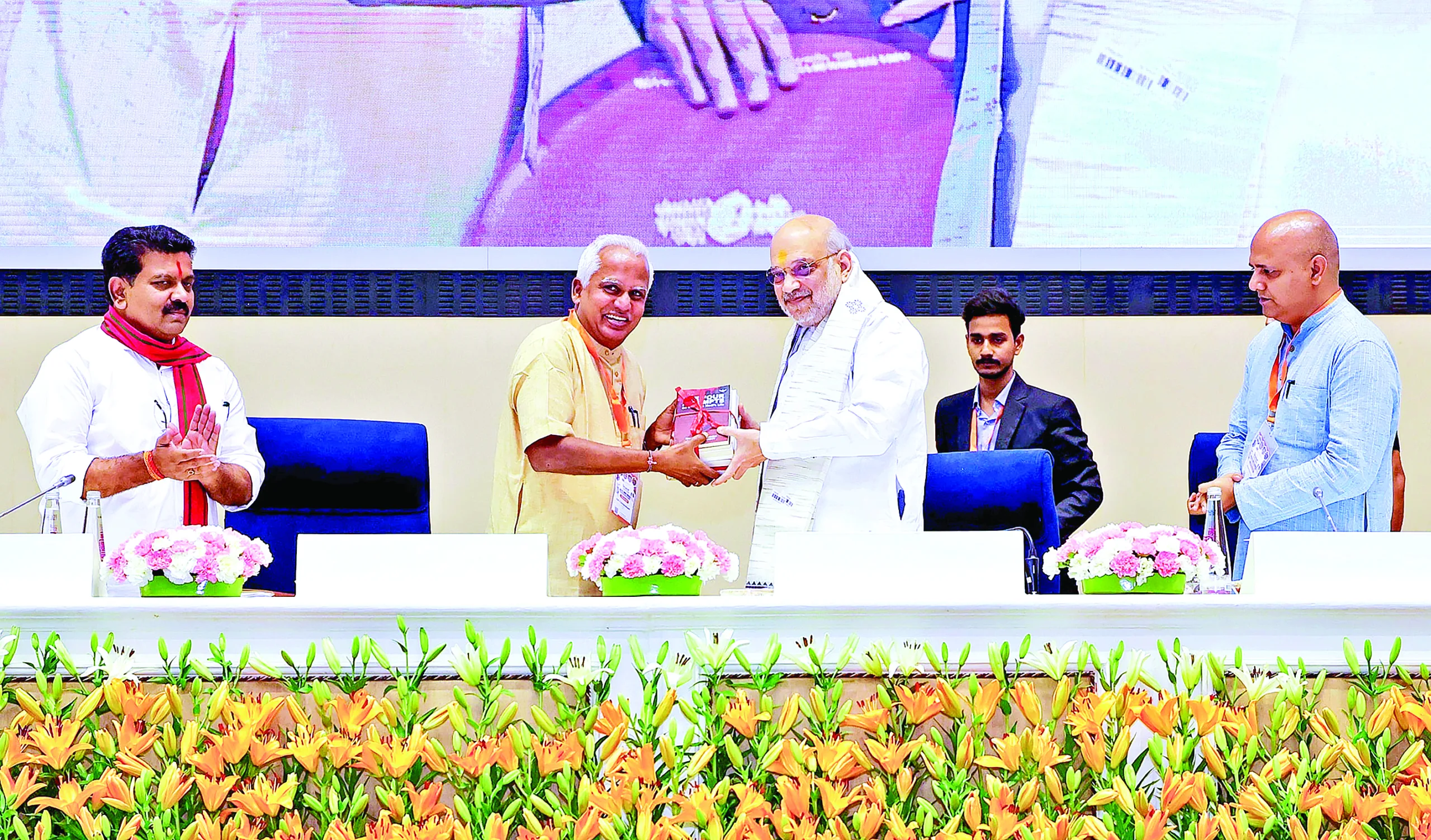
At valedictory session of ‘Bharat Manthan-2025’, SPMRF Treasurer Prof. P. Kanagasabapathi, Vice President, TN BJP; Secretary & Trustee, SPMRF, felicitating Union Home Minister Amit Shah. Also present were Vijay Sharma, Minister of Home Affairs and Jail, Government of Chhattisgarh (standing extreme left), and Binay Singh, Director, SPMRF (standing extreme right)

At valedictory session of ‘Bharat Manthan-2025’, SPMRF Treasurer Prof. P. Kanagasabapathi, Vice President, TN BJP; Secretary & Trustee, SPMRF, felicitating Union Home Minister Amit Shah. Also present were Vijay Sharma, Minister of Home Affairs and Jail, Government of Chhattisgarh (standing extreme left), and Binay Singh, Director, SPMRF (standing extreme right)

Facebook
Twitter
WhatsAppTelegramEmail

“Bharat will be free from Naxalism by March 31, 2026. The fight against Naxalism will not end until Bharatiya society understands those who provide ideological, legal, and financial support to Naxalism. Internal security and the protection of the nation’s borders have always been a core part of our ideology. Three key objectives have been central to our party’s mission: internal and external security of the country, cultural nationalism, and the revival of all aspects of Bharatiya culture,” said Amit Shah, Home Minister, while addressing the valedictory session of ‘Bharat Manthan-2025: Naxal Mukt Bharat – Ending Red Terror Under Modi’s Leadership’ in New Delhi on September 28 at Vigyan Bhawan, New Delhi, organised by Dr Syama Prasad Mookerjee Research Foundation.

He further informed that 17 per cent of the country’s territory was encompassed by the Red Corridor, affecting a population of 120 million. Earlier, 10 per cent of the population was living under the scourge of Naxalism. Shah said that in comparison, the other two hotspots—Kashmir, with 1 per cent of the country’s territory affected by terrorism, and the North East, with 3.3 per cent of the territory grappling with unrest—were less extensive. He said that when Narendra Modi became Prime Minister in 2014, the Modi Government began working on the three aspects of dialogue, security, and coordination. As a result, by March 31, 2026, armed Naxalism will be eradicated from the country.
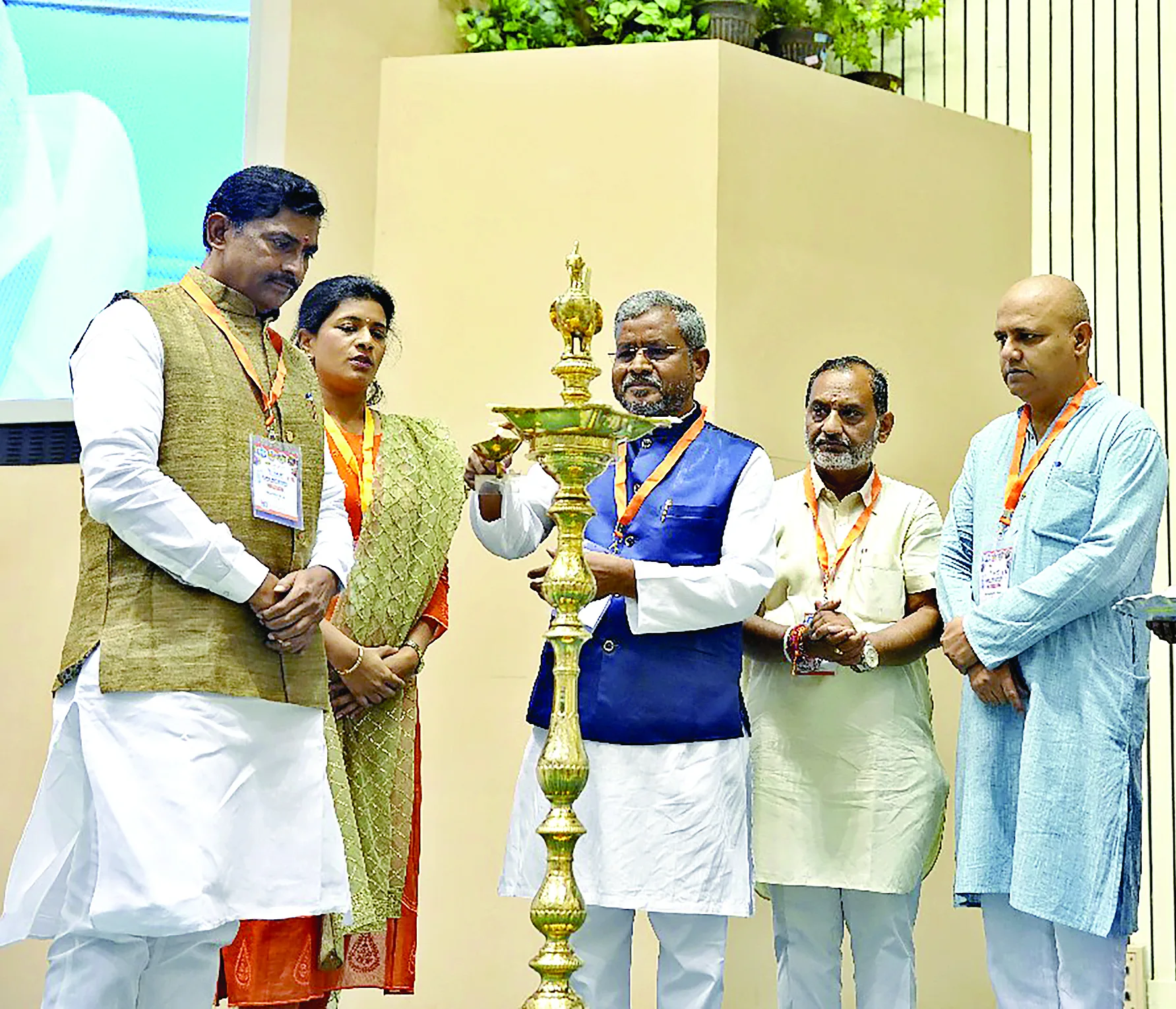
From left to right: Senior BJP Leader Murlidhar Rao, Snigdha Reddy DK, Former Jharkhand Chief Minister Babulal Marandi, Binay Singh (Director, SPMRF), and other dignitaries during the lamp-lighting ceremony

There were a total of five sessions in this day-long conference. Before the inaugural session, “From Victim to Victor – Surviving and Defeating Maoist Terror”, Prof Yashpal extended a formal welcome to Murlidhar Rao, Senior BJP Leader, while Babulal Marandi, former Chief Minister of Jharkhand, also graced the occasion.

Snigdha Reddy DK moderated the session titled “From Victim to Victor.” She noted that the discussion featured two distinguished leaders—Babulal Marandi Ji, whose own family had been victims of a terror attack, and Murlidhar Rao Ji. Their experiences and journeys were presented to the audience, underscoring the significant human cost of conflict and the resilience of communities affected by Naxal violence.

She posed her first question to Babulal Marandi, asking on what grounds the story of Naxalism had emerged and what its causes were. In response, Marandi explained that Naxalism was not only a matter of internal security but also carried a broader ideological goal. He highlighted how Naxals targeted regions deprived of development—areas lacking roads and electricity—where they exploited grievances by convincing people that corruption was the reason for the absence of progress even after decades of Independence. Murlidhar Rao, senior BJP leader, recounted an incident from 1996, highlighting the atmosphere of fear that prevailed at the time when even the police was apprehensive of Naxals. He recalled that there were concerns he might join another party, become an MLA, and later a minister, which made him a potential target due to his strong stance against Naxalism. The Superintendent of Police had cautioned him about the risks of opposing them. The second session titled “Countering the Red Corridor: Strategy Action and Narratives”, featured Kuldiep Singh, Former DG CRPF & Security Advisor, Government of Manipur and Praveen Vashishtha, IPS, Special Secretary (Internal Security), MHA, Government of India. The session was moderated by Pathikrit Payne, Senior Research Fellow, SPMRF.

While addressing the gathering, Kuldiep Singh recounted 2010 incident in Chhattisgarh, pointing out that Bengal had been one of the initial centres of Naxal activity. He explained that during the second phase in 1991, when the government granted mining rights, Naxalism was still active in urban areas but gradually began to evolve into militarisation. Praveen Vashishtha addressed the session on the theme “Whole-of-Government Approach.” He underlined that countering Naxalism requires a multidimensional strategy comprising security measures, development initiatives, provision of entitlements, and perception management. He stressed the importance of reducing public grievances, generating employment opportunities, and neutralising criminal elements.

The third session titled “Securing a Naxal-Free Future” featured P. Sundarraj, IG (Naxals), Bastar, Chhattisgarh and Yogesh Singh, Vice Chancellor, University of Delhi. The session was moderated by Abhishek Tandon, Associate Professor, University of Delhi P. Sundarraj highlighted that Bastar has over 60 per cent forest cover, with two-thirds of its population being tribal. He noted that while the region has been under discussion for years, it has undergone significant transformation, though attention remains focused on Bastar due to its unique challenges. The area’s dense forests and limited connectivity have been exploited by Naxals to mislead urban populations and target city residents. Prof. Yogesh Singh addressed the session on the topic “Why Campuses are the Target (Reference to Urban Naxals and Global Nexus Conspiracy).” He highlighted that in 2005, the film Hazaaron Khwaishein Aisi was shot at Hindu College and appeared to glorify Naxalism. He emphasised that such use of Bollywood and popular culture have been a tool to promote Naxalism.

In the session four, “Where were our Human Rights?” Filmmaker Vipul Shah, who directed a film on the Bastar Naxal story, shared his observations from the research conducted for the project. He noted that under the initiative of Amit Shah, developments that had not occurred over 60 to 70 years were achieved within just 10 years. He emphasised that when leaders not only think but also act decisively, transformative change becomes possible. Six victims of Naxal violence were invited to share their experiences, beginning with Umesh Kumar Panda Ji. He recounted that his father was taken into the forest and shot at a time when communication had been completely cut off. The family sought Government employment and a pension for their mother.

Binay Kumar Singh, Director, SPMRF, presented vote of thanks and concluded the session. He recalled, that in 1979, Vinod Kumar Jha, an ABVP member from Bihar studying at NIT Warangal (then Regional Engineering College), was brutally killed by Naxalites. The man behind his murder, Nambala Keshava Rao, also known by his alias Basavraju, was himself an alumnus of the same institution. Rao went on to become the General Secretary of the banned Communist Party of India (Maoist), one of the most influential figures in India’s Naxalite movement, until his death in an encounter with security forces in May 2025. Many eminent personalities and security experts attended this one day event.


Topics: Bharat Manthan-2025: Naxal Mukt BharatNaxalismModi governmentNaxal violenceincident in ChhattisgarhVictim to Victor
Ravi Mishra
Ravi Mishra
Ravi Mishra is a Delhi based journalist, covers politics, strategic and security affairs. He is currently working with Organiser Weekly as Assistant Editor. [Read more]
Share
Tweet
SendShareSend
✮ Subscribe Organiser YouTube Channel. ✮
✮ Join Organiser's WhatsApp channel for Nationalist views beyond the news. ✮
Previous News

RSS at 100: The saviour and survivor

Next News

Sangh and Swaraj: Debunking fake narratives

Related News

Prime Minister Narendra Modi while addressing the BRICS Summit on September 12

18th BRICS Summit: Setting the agenda for global south

AI-generated Image

Modi’s Politics of Performance: Kerala railways funding jumps from Rs 372 cr to Rs 3,795 cr; exposes Left-Congress

National Bamboo Mission (AI-generated Image)

From Forest Weed to Economic Seed: How India’s Bamboo revolution is transforming livelihoods and green growth

The Rs 10,998-crore Varuna Elevated Corridor will ease Varanasi traffic and boost connectivity while preserving Kashi’s heritage

From ancient Kashi to modern connectivity: How Modi government’s Varuna Elevated Corridor will transform Varanasi

The Ford Foundation vacated its long-standing New Delhi office at Lodhi Estate after its lease expired

Unmasked: How the Ford Foundation spent decades bankrolling anti-India agendas before its eviction from Lodhi Estate

(AI-generated Image)

India’s New Industrial Revolution: Jefferies sees a new era of industrial growth under PM Modi

Load More

Latest News

Shivaji Park locals expressed anger against CJP protest

CJP’s Shivaji Park show fizzles in Mumbai: Low turnout, clueless crowd, angry residents and strong counter-protest

Former chief election commissioner Navin Chawla

From emergency indictment to election commission: The Navin Chawla record that Congress would rather not discuss

RSS All-India contact chief (Sampark Pramukh) Ramlal ji

Women farmers must be at forefront of policymaking: RSS functionary Ramlal ji

AI Generated Representative Image

Swachhata Hi Seva 2026: How Bharat’s festivals are rediscovering their green dharma

27th National Conference of Akhil Bharatiya Poorva Sainik Seva Parishad Begins at Kaneri Math

27th National Conference of ABPSSP focusses on Agniveer rehabilitation & social security

PM Modi's Mann ki Baat completes 12 years

12 years of PM Narendra Modi’s radio program ‘Mann Ki Baat’: Serves as a public platform inspiring millions of Indians

Tamil Nadu: DMK faces legal heat as leaders face arrests, ED probe ahead of October 6 bypolls

Flydubai Attack: UAE condemns ‘Terrorist Act’; Israel thanks Captain Smit, Pro-Palestine leaflets found with Oman pilot

Tamil Nadu: ED arrests Unique Exports proprietor, associate over Rs 1,417 crore Ponzi scheme targeting 35,759 investors

Tamil Nadu: Evangelists target rural workers during VB-G RAM G work, Hindu groups seek probe

Load More
  • Privacy
  • Terms
  • Cookie Policy
  • Refund and Cancellation
  • Delivery and Shipping

© Bharat Prakashan (Delhi) Limited.
Tech-enabled by Ananthapuri Technologies

  • Home
  • Search Organiser
  • Bharat
    • Assam
    • Bihar
    • Chhattisgarh
    • Jharkhand
    • Maharashtra
    • View All States
  • World
    • Asia
    • Africa
    • North America
    • South America
    • Europe
    • Australia
  • Editorial
  • Operation Sindoor
  • Opinion
  • Analysis
  • Defence
  • Culture
  • Sports
  • Business
  • RSS @ 100
  • Entertainment
  • More ..
    • Sci & Tech
    • Vocal4Local
    • Special Report
    • Education
    • Employment
    • Books
    • Interviews
    • Travel
    • Health
    • Politics
    • Law
    • Economy
    • Obituary
  • Subscribe Magazine
  • Read Ecopy
  • Advertise
  • Circulation
  • Careers
  • About Us
  • Contact Us
  • Policies & Terms
    • Privacy Policy
    • Cookie Policy
    • Refund and Cancellation
    • Terms of Use

© Bharat Prakashan (Delhi) Limited.
Tech-enabled by Ananthapuri Technologies