“Mata bhumih putro aham prithivyah”
(The Earth is my mother and I am her child) — Atharva Veda, Bhumi Sukta
The sage who composed these words in the Bhumi Sukta was not writing an environmental manifesto. In the Indian worldview, nature was never a resource waiting to be exploited, it was resource to be honoured.
The river was a mother, the tree a dwelling of deities, the soil itself sacred enough to be touched with the forehead before a dance performance began. Festivals grew out of this relationship. They followed the harvest, the monsoon, movement of the sun and the phases of the moon.
Along the path of rapid urbanisation, that relationship frayed. Plaster of Paris replaced clay, thermocol replaced bamboo, plastic garlands replaced marigolds. The celebration remained, but its footprint grew heavier and the very rivers and ghats that held ritual meaning began to bear its burden.
A national campaign with civilisational roots
The latest expression of this return is Swachhata Hi Seva 2026, launched on 17 September 2026. The campaign carries the theme “Swachhata Mein Sahbhag, Swachh Bharat: Viksit Bharat”, placing shared responsibility for cleanliness at its centre. Within it the component titled “Swachh Parv, Harit Parv” focuses specifically on clean and green festivities.
The campaign promotes source segregation, the principle of Reduce, Reuse and Recycle, circular economy practices and Waste-to-Wealth initiatives. Stripped of modern vocabulary, these ideas would have sounded perfectly familiar to an Indian household a century ago.
Nothing was wasted then, old cloth became a quilt, the quilt became a mat and the mat finally became a cleaning rag. Leaves served as plates and returned to the earth. Circular economy is less a new theory than an old habit that needs reviving.
The significance of the campaign lies in its linkage of cleanliness to the larger vision of Viksit Bharat. A developed nation is not only one with highways and data centres, it is one whose citizens take ownership of shared spaces. When that ownership extends to the most emotionally charged moments of public life, the festivals, the change becomes cultural rather than merely administrative.
Ujjain: Where nirmalya becomes nirman
The Mahakaleshwar Temple in Ujjain, one of the twelve Jyotirlingas. Between 75,000 and 100,000 devotees pass through its doors every day and most carry flowers. The result is around 5 to 6 tonnes of floral waste daily.
In Hindu tradition offerings made to the deity known as nirmalya, carry a sanctity even after worship. They cannot simply be thrown onto a garbage heap. For generations, the respectful course was to immerse them in rivers, at today’s scale it has contributed to their pollution.
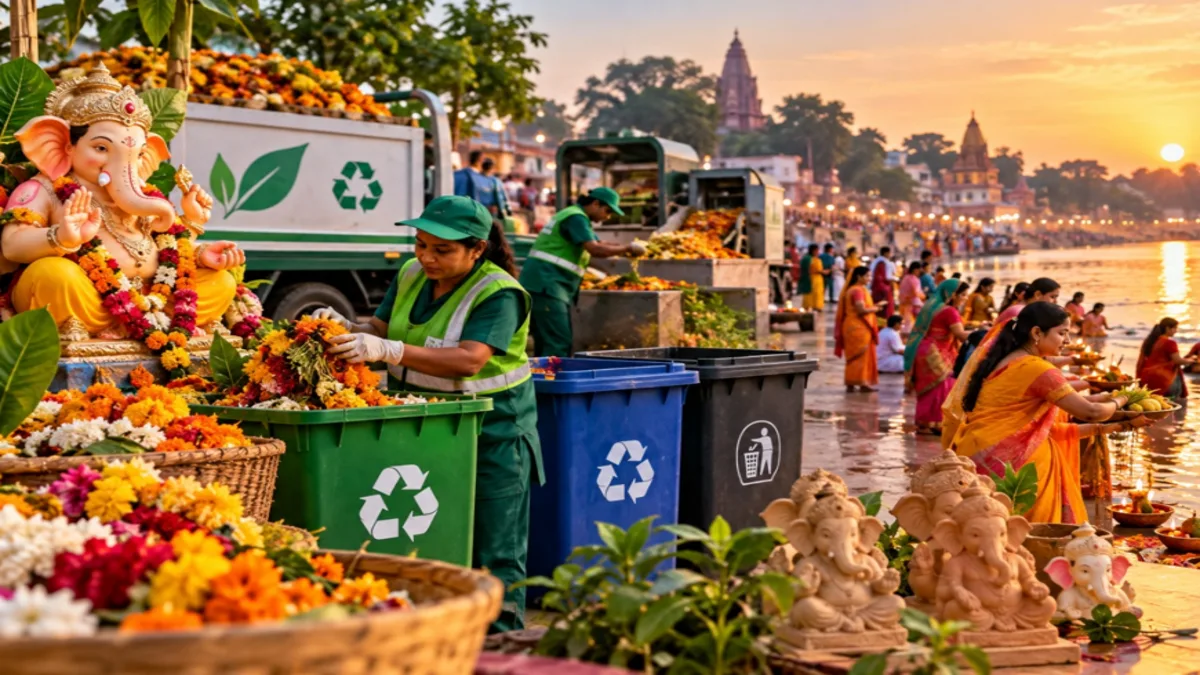
Ujjain has found a better answer. Dedicated vehicles called ‘Pushpanjali Econirmit’ collect the used flowers and carry them to a processing plant, where they are turned into compost, briquettes and biofuels. The sanctity of the offering is preserved because it is transformed into something useful rather than discarded.
The human story is women of the Shiv Arpan Self-Help Group took on the work of converting floral waste into products and in 2024 they produced more than 30 million incense sticks along with other eco-friendly goods. Discarded flowers became a livelihood.
This is Nari Shakti in its most practical form, rooted in local enterprise and dignified work and it reflects the spirit of Antyodaya, where the benefits of change reach those who need them most. The flower that was offered to Mahakal returns, in a sense, as fragrance for the next prayer.
Bappa’s return to clay
Ganesh Chaturthi is perhaps the festival where the tension between devotion and environmental care has been most visible. The idol enters the home as a beloved guest and departs for visarjan with the promise of returning next year. For decades, the departure of bappa left water bodies choked with non-dissolving idols and toxic paints.
Maharashtra, the heartland of the festival has shown how the balance can be restored. In 2024, Navi Mumbai created 136 artificial ponds for idol immersion. Their locations were circulated through social media and WhatsApp, so devotees could find them easily. The ritual remained complete, while natural water bodies were spared.
The Brihanmumbai Municipal Corporation approached the problem at its source by supplying around 500 tonnes of free clay to sculptors. This was a quietly powerful intervention.
It supported artisans, many of whom come from families that have shaped idols for generations, while nudging the entire supply chain away from Plaster of Paris. The Maharashtra Pollution Control Board added a digital layer through the Eco-Bappa mobile application, promoting eco-friendly idols and decorations.
The most hopeful signs come from classrooms. The Pimpri Chinchwad Municipal Corporation held an idol-making and decoration competition for students, encouraging the use of clay, papier-mâché, natural fibres and recycled materials.
In Thane, nearly 500 students learned to shape Ganpati idols from shadu clay, the traditional riverbed clay long used by Maharashtrian artisans. A child who has shaped Bappa with her own hands from the earth is unlikely to grow up seeing the festival and nature as opposing forces.
Beyond Maharashtra, the ideas spread in their own local flavours. In Digboi, Assam, the Ganesh Puja of 2023 was built around bamboo, which was used for idols, entrance gates and traditional decorations, including the Japi headgear and Khorahi baskets.
The festival of the western coast merged naturally with the material culture of the Northeast, a reminder that Bharat’s unity lies in shared faith expressed through diverse traditions.
Delhi offered another inventive answer in the form of idols made from coconut bark and clay, embedded with seeds. Once immersed, the idol dissolves into the soil and the seeds grow into plants. It is hard to imagine a more fitting end for a deity so closely associated with new beginnings.
When seva continues after visarjan
Cleanliness in Indian tradition has always carried the meaning of seva, service offered without expectation. After the visarjan in 2023, more than 900 Swachh volunteers, including over 500 students, gathered at Versova Beach in Mumbai. They cleared around 80,000 kilograms of waste and collected approximately 7,400 Plaster of Paris idols left along the shore.
The scale of what was recovered is a sobering reminder of why change is needed. Yet the response itself is encouraging. Hundreds of young people chose to extend the festival into an act of service, treating the beach as worthy of the same respect as the pandal.
Durga Puja: Artistry without the plastic
Durga Puja has always been as much a celebration of craft as of devotion. Pandals rise as temporary temples, often astonishing in their design. In 2023, many organisers moved away from thermocol and plastic towards bamboo, wood, coconut shells, cloth, jute, coir, hay, straw, cane and paper.
Soluble clay idols of the goddess were encouraged and some pandals in Delhi used bamboo and cotton as their main materials. These are not compromises. They are a homecoming. Bengal’s craftsmen worked with jute, straw and clay long before synthetic materials arrived. The traditional clay idol, built layer by layer over a frame of straw and bamboo, it was designed to return to the river without harm.
Blue and green bins were placed at crowded locations, cleanliness drives were run at night, and non-plastic decorations were promoted. Flowers and organic material collected after the Puja were sent for composting. Prasad and refreshments were served on paper plates, banana leaves, shell leaves and clay plates. The banana leaf, in particular is a reminder that some of the most sustainable solutions have been part of Indian dining for centuries.
Diwali: Cleaning was always the first ritual
Diwali may be the one festival where cleanliness was never an add-on. Long before the lamps are lit, homes are scrubbed, cupboards emptied and old things sorted, in the belief that Lakshmi enters only a clean home. The “Swachh Diwali, Shubh Diwali” campaign builds directly on this instinct, encouraging waste segregation, the 3Rs, locally made products and cleaner celebrations.
In Mira Bhayandar, Maharashtra, a pre-Diwali sanitation drive saw Safai Mitras cleaning public spaces, washing statues of national heroes and freedom fighters, tending green areas. The act of cleaning a freedom fighter’s statue before the festival of lights carries its own symbolism with the nation heroes, too, deserve a place in the festive preparations.
In Rajasthan and the Andaman and Nicobar Islands, citizens are encouraged to take household waste from Diwali cleaning to nearby Reduce, Reuse and Recycle centres. In Delhi’s Navjeevan Vihar, the ‘Swap Before You Shop-Gift Revival Mela’ in 2023 allowed residents to exchange unused gifts through a categorised pool and 50 gifts changed hands in under two hours on a single day.
In Melaghar, Tripura, women from Self-Help Groups crafted earthen diyas, keeping money within the local economy and supporting the spirit of Aatmanirbharta. The humble clay diya, made by a local potter, has always been a better symbol of Diwali than any imported decorative light.
Delhi’s Deep Mahotsav, Swachh Utsav and Voter Utsav went further, turning fabric scraps into streamers, discarded cardboard into selfie frames and used ice-cream sticks into hanging decorations.
The afterlife of a festival with cleanliness
The most thoughtful examples are those that consider what happens after the lamps go out. In Guwahati, banana leaves used in the Diwali celebrations were collected and sent as feed for elephants, a gesture that would have delighted any devotee of Ganesha.
In Jhalrapatan, Rajasthan, Nirmalaya Vahan vehicles gather garlands and puja material from temples and send them for composting. In Indore, which has built a national reputation for cleanliness, special cleaning began as early as 4 am after the festival. Under the ‘Clean Up to Clean Air’ initiative, sprinkler vehicles watered trees and plants carrying the message ‘Swachhata Se Swachh Vayu Ki Aur’.
Chhath: The festival that never forgot nature
If any festival embodies the ancient bond between worship and nature, it is Chhath Puja. Devotees stand in water and offer arghya to the setting and rising sun. There is no idol, no elaborate pandal, only the sun, river, bamboo basket and seasonal produce.
In Patna, the Municipal Corporation organises zero-waste Chhath at designated ghats. Separate bins are installed, dedicated vehicles collect waste, wet waste is processed into compost and a plastic ban is enforced.
A month-long Information, Education and Communication campaign prepares devotees in advance. The approach rests on a simple understanding, a festival that worships the river cannot leave the river soiled.
Tradition as the solution, not the problem
A certain strand of commentary has long treated Hindu festivals as environmental problems to be managed, occasionally even as practices to be curtailed. The examples from Ujjain to Patna tell a different story. The solutions are coming from within the traditions themselves.
Clay instead of plaster, bamboo instead of thermocol, leaf plates instead of plastic, compost instead of dumping. They are being led by temple administrations, municipal bodies, self-help groups, artisans and schoolchildren, not by outsiders lecturing devotees.
Bharat festivals do not need to shed their colour or scale to become sustainable. They need to reconnect with the ecological wisdom that shaped them in the first place. The Bhumi Sukta’s vision of the earth as mother is not an abstraction, it is visible in a Thane classroom where children mould Bappa from riverbed clay, in the Ujjain workshop where women turn offerings into incense and on the Patna ghat where devotees face the rising sun on a clean bank.
The diyas will keep glowing, the dhak will keep sounding and the chants will keep rising. What is changing is what remains afterwards. When a festival leaves behind compost instead of garbage, a livelihood instead of litter and a sapling instead of a sunken idol, it fulfils its purpose more completely than before. In the end, that is what Swachh Parv, Harit Parv truly asks of us, to celebrate as children of the earth and to leave our mother a little better than we found her.