Six Years After 370: Kashmir rises with pride, rejects terror
October 2, 2026
  • Read Ecopy
  • Circulation
  • Advertise
  • Careers
  • About Us
  • Contact Us
Android AppiPhone AppArattai
Organiser
  • ‌
  • Bharat
    • Assam
    • Bihar
    • Chhattisgarh
    • Jharkhand
    • Maharashtra
    • View All States
  • World
    • Asia
    • Europe
    • North America
    • South America
    • Africa
    • Australia
  • Editorial
  • International
  • Opinion
  • RSS @ 100
  • More
    • World Hindu Congress 2026
    • Op Sindoor
    • Analysis
    • Sports
    • Defence
    • Politics
    • Business
    • Economy
    • Culture
    • Special Report
    • Sci & Tech
    • Entertainment
    • G20
    • Azadi Ka Amrit Mahotsav
    • Vocal4Local
    • Web Stories
    • Education
    • Employment
    • Books
    • Interviews
    • Travel
    • Law
    • Health
    • Obituary
  • Subscribe
    • Subscribe Print Edition
    • Subscribe Ecopy
    • Read Ecopy
  • ‌
  • Bharat
    • Assam
    • Bihar
    • Chhattisgarh
    • Jharkhand
    • Maharashtra
    • View All States
  • World
    • Asia
    • Europe
    • North America
    • South America
    • Africa
    • Australia
  • Editorial
  • International
  • Opinion
  • RSS @ 100
  • More
    • World Hindu Congress 2026
    • Op Sindoor
    • Analysis
    • Sports
    • Defence
    • Politics
    • Business
    • Economy
    • Culture
    • Special Report
    • Sci & Tech
    • Entertainment
    • G20
    • Azadi Ka Amrit Mahotsav
    • Vocal4Local
    • Web Stories
    • Education
    • Employment
    • Books
    • Interviews
    • Travel
    • Law
    • Health
    • Obituary
  • Subscribe
    • Subscribe Print Edition
    • Subscribe Ecopy
    • Read Ecopy
Organiser
  • Home
  • Bharat
  • World
  • Operation Sindoor
  • Editorial
  • Analysis
  • Opinion
  • Culture
  • Defence
  • International Edition
  • RSS @ 100
  • Magazine
  • Read Ecopy
Home Bharat

Six Years After 370: Kashmir rises with pride, rejects terror, and embraces peace in a new era of unity and resolve

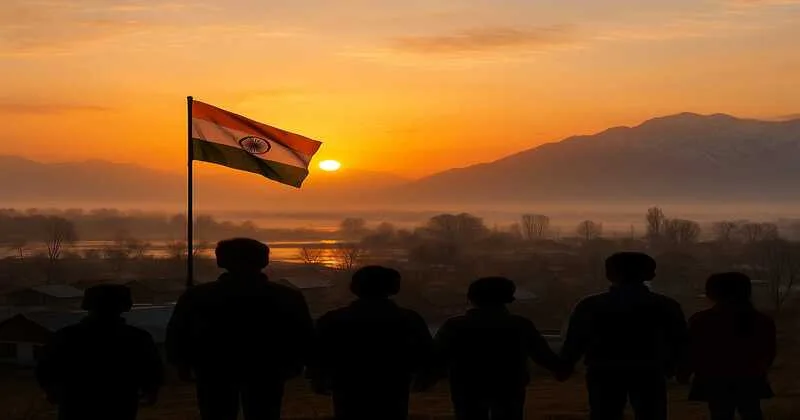
On the sixth anniversary of the abrogation of Article 370, Kashmir is witnessing a profound transformation from fear to defiance of terror. Once a region manipulated by separatism, it now stands united with India, rejecting Pakistan-sponsored militancy and embracing peace

Dr Vishnu AravindDr Vishnu Aravind
Aug 5, 2025, 07:00 am IST
inBharat, Jammu and Kashmir
Follow on Google News
Representative Image

Representative Image

Facebook
Twitter
WhatsAppTelegramEmail

On the sixth anniversary of the historic abrogation of Article 370, the winds of change blowing across J&K have never been clearer. What once was a region paralysed by fear, manipulated by external forces, and routinely rocked by separatist protests, is today witnessing a powerful transformation, one that marks the beginning of a new era of peace, pride, and development.

The scars of terror still linger, but the response to the recent Pahalgam massacre, in which 26 innocent tourists were brutally gunned down, stands in stark contrast to the past. For the first time in 35 years, Kashmir observed a complete shutdown not in protest against the Indian state, but against Pakistan sponsored terrorism. Loudspeakers from mosques called on people to join the shutdown and express solidarity with the victims. Markets in Pahalgam remained closed, and people took to the streets in anguish and outrage, not to support militants or separatism, but to condemn the barbarity unleashed on unarmed civilians.

What unfolded across the Valley was a heartfelt uprising, not against India, but against those who bring death and destruction in the name of religion. Protesters marched with tricolours in hand, shouting “Hindustan Zindabad” and “I am Indian”, making it clear that the soul of Kashmir was no longer held hostage by Pakistan-sponsored terror outfits. Locals opened their homes and hotels for stranded tourists, offering free accommodation for fifteen days, a gesture of humanity that reinforced the values of unity and brotherhood in the region.

Also Read:  Pahalgam Terror Attack: Indian security officials trace roots of culprits to Pakistan with solid evidence

The emotional response in Pahalgam echoes the broader change that the abrogation of Article 370 has enabled. The constitutional change on August 5, 2019, which ended J&K’s special status and brought it fully under the Indian Constitution, is now being seen not only as a political move but as a civilisational shift. For decades, Pakistan used Article 370 as a shield to nurture separatism, radicalisation, and unrest. The article’s removal dismantled this shield, stripping Pakistan and its terror proxies of their ideological justification.

A Transformation Going Beyond Borders PoJK Villagers Rise Against Terror

This transformation has not been limited to the Indian side of the border. In a significant development in Pakistan-occupied Jammu and Kashmir (PoJK), a Janaza-Ghaib (funeral in absentia) for Lashkar-e-Taiba (LeT) terrorist Tahir Habib, eliminated in the Indian Army’s Operation Mahadev, turned into an open rebellion against terrorism. Habib, a former Pakistan Army soldier and category ‘A’ LeT operative, played a key role in the April 22 Pahalgam massacre. But when Lashkar commander Rizwan Hanif tried to hijack the funeral proceedings in Khai Gala, he was forcefully driven away by local villagers.

The people of Khai Gala, long victims of terror indoctrination, rejected Lashkar’s attempt to claim ownership of the funeral. Armed militants were shamed and sent back, not with guns but with the moral defiance of an awakened public. This act of resistance in Pakistan’s backyard marks a decisive shift in regional sentiment, the very kind of shift that the abrogation of Article 370 was intended to trigger.

Operation Sindoor and Indus Treaty Move Signal New India’s Strategic Shift in Kashmir

India’s firm and calibrated response, including military operations like Operation Mahadev and Operation Sindoor, have also changed the dynamics on the ground. These missions have not only eliminated high-value terror operatives but have instilled fear among their handlers in Pakistan. Operation Sindoor, launched in response to the Pahalgam massacre, became a definitive message, that the new India will not tolerate terror with impunity. It was a reminder that the era of appeasement is over.

Notably, this anniversary also coincides with India’s bold move to cancel the Indus Waters Treaty of 1960, a move that sends a clear signal to Pakistan: terror and diplomacy cannot run parallel. The abrogation of Article 370 was the beginning of this assertive policy. The cancellation of the treaty is its logical extension, reflecting India’s resolve to deal with its adversaries from a position of strength.

The abrogation’s long-term impact is now visible across the political, economic, and social fabric of J&K. No longer caught in the crosshairs of ambiguous autonomy, the Union Territory has witnessed unprecedented investment, increased administrative integration, and greater access to central schemes. More importantly, it has allowed the Indian state to dismantle the twin towers of separatism and radicalisation that had long prevented the region’s full integration.

Full Circle of Sovereignty as India Seals Constitutional Integration of Kashmir

The timeline since abrogation speaks volumes. After J&K was placed under President’s Rule on December 20, 2018, the Centre moved swiftly. On August 5, 2019, Union Home Minister Amit Shah introduced the proposal in Parliament, explaining how the government had the authority to nullify Article 370. The Rajya Sabha passed it with 125 votes in favour, followed by 370 votes in the Lok Sabha. The President’s assent followed soon after.

Legal challenges were swift but unsuccessful. The Supreme Court, after several rounds of hearings between 2019 and 2023, upheld the abrogation on December 11, 2023. The court also directed that Assembly elections in Jammu and Kashmir be conducted by September 30, 2024, ensuring full democratic restoration.

From the signing of the Instrument of Accession by Maharaja Hari Singh in 1947 to the Supreme Court’s landmark verdict in 2023, India’s journey with Jammu and Kashmir has come full circle. The abrogation of Article 370, once seen as politically impossible, has proven to be a turning point in reclaiming not just territory, but trust.

Today, as Kashmir observes a shutdown in memory of innocent lives lost, not in defiance of India, but in defiance of terror, the message is clear. A new Kashmir is taking shape. One where India is not seen as an occupier, but as a protector. One where the people rise not with stones in their hands, but with slogans of unity on their lips. One where even PoJK hears the echoes of resistance, not against India, but against the real enemies of peace.

The sixth anniversary of the abrogation of Article 370 is not just a constitutional milestone. It is a moment of national transformation. Kashmir has spoken, and it has chosen peace, pride, and progress.

 

Topics: After 370Lashkar-e-TaibaPoJKJ&KMaharaja Hari SinghOperation SindoorOperation Mahadev
Dr Vishnu Aravind
Dr Vishnu Aravind
Dr Vishnu Aravind is a researcher, political commentator and writer based in New Delhi, with a PhD from Jawaharlal Nehru University (JNU). His areas of interest include international politics, Indian foreign policy, electoral politics, election analysis, political developments, and cultural affairs. [Read more]
Share
Tweet
SendShareSend
✮ Subscribe Organiser YouTube Channel. ✮
✮ Join Organiser's WhatsApp channel for Nationalist views beyond the news. ✮
Previous News

Bangladeshi origin Muslims are doing love and land jihad in Assam: CM Himanta Biswa Sarma

Next News

‘The Kerala Story’ is not just a story!

Related News

Pakistani LeT militant linked to Pahalgam Attack, Hashim Moosa killed in Budgam encounter | Operation Korag

A decade after the Surgical Strikes, India’s counter-terror response has evolved from Uri and Balakot to Operation Sindoor

10 years of surgical strikes: From Uri to Balakot and Operation Sindoor, how India’s counter-terror response evolved

Suicide attack in Khyber Pakhtunkhwa leaves 16 killed and 30 injured

Khyber Pakhtunkhwa: 16 killed, 30 injured as suicide attacker rams against joint check post in Dera Ismail Khan

India slams Pakistan at UNGA

India slams Pakistan’s “hypocritical homily”; Exposes Shehbaz Sharif as puppet of the Army; Reaffirms J&K sovereignty

Indian diplomat Kshitij Tyagi slams Pakistan at UNHRC

India Slams Pakistan at UNHRC: Theatrics can’t hide economic crisis & repay loans; Exposes terrorism & minority abuse

Operation Sindoor: Pakistan Repairs Sargodha Runway Again After 16 Months

Sixteen months after Operation Sindoor, Pakistan still repairs Sargodha Airbase runway: Reports

Load More

Latest News

Representative Image- Indian Railways

Indian Railways’ decade of safety tech: 15 initiatives from KAVACH 4.0 to AI, drones and predictive track monitoring

A representative image

Rs 1200 crore PM-RKVY support for 10 states as centre pushes ‘Team agriculture’ for rabi season

Former Prime Minister Lal Bahadur Shastri with Bharatiya Jawans

Red Shadow against Lal Bahadur : from ‘Shastri Vrat’ to ‘Tashkent’

Tamil Nadu: Western Ghats Lit Fest 2026 to celebrate ‘Bharat Rising’ in Coimbatore on October 24–25

From Bombs to Ballots: How Nanoor’s sea of women is rewriting Bengal’s violent political history

Birth Anniversary of Mahatma Gandhi: Examining Hind Swaraj through the lens of the Thirukkural

The RSS has the strength to make India great — Gandhi

Lal Bahadur Shastri Jayanti: The “Shastri Vrat” – Epitome of simplicity and commitment

(Left) Rashtriya Janata Dal (RJD) MP Manoj Jha, centre, advocate Prashant Bhushan, left, and All India Students' Association (AISA) National President Neha Bora address a press conference calling for a protest at Jantar Mantar on October 2 to demand the resignation of Chief Election Commissioner Gyanesh Kumar, in New Delhi (Right) Traffic Restrictions Near Jantar Mantar on October 2; Delhi Police Issues Advisory

CJP 2.0 protest threat: Delhi Police issues traffic advisory, diversions near Jantar Mantar, Connaught Place

Women’s Health Takes Centre Stage at Hindu Community Seminar in New Zealand

NZ Hindu Women’s Forum, HPANZ host women’s health and wellbeing seminar in Wellington

Load More
  • Privacy
  • Terms
  • Cookie Policy
  • Refund and Cancellation
  • Delivery and Shipping

© Bharat Prakashan (Delhi) Limited.
Tech-enabled by Ananthapuri Technologies

  • Home
  • Search Organiser
  • Bharat
    • Assam
    • Bihar
    • Chhattisgarh
    • Jharkhand
    • Maharashtra
    • View All States
  • World
    • Asia
    • Africa
    • North America
    • South America
    • Europe
    • Australia
  • Editorial
  • Operation Sindoor
  • Opinion
  • Analysis
  • Defence
  • Culture
  • Sports
  • Business
  • RSS @ 100
  • Entertainment
  • More ..
    • Sci & Tech
    • Vocal4Local
    • Special Report
    • Education
    • Employment
    • Books
    • Interviews
    • Travel
    • Health
    • Politics
    • Law
    • Economy
    • Obituary
  • Subscribe Magazine
  • Read Ecopy
  • Advertise
  • Circulation
  • Careers
  • About Us
  • Contact Us
  • Policies & Terms
    • Privacy Policy
    • Cookie Policy
    • Refund and Cancellation
    • Terms of Use

© Bharat Prakashan (Delhi) Limited.
Tech-enabled by Ananthapuri Technologies