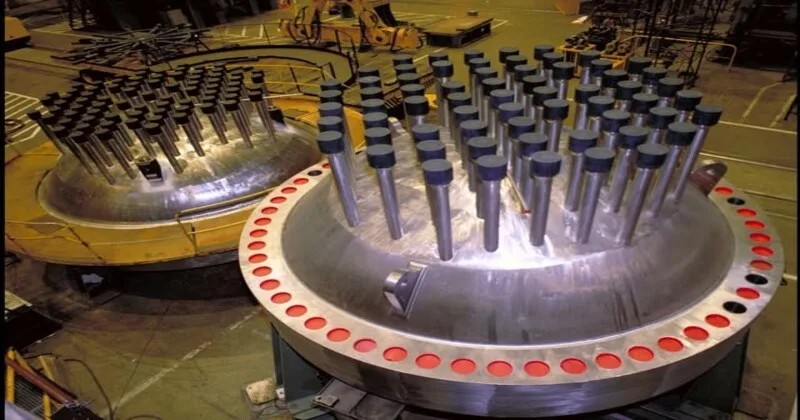
India has achieved a major step toward technological independence by inaugurating the nation’s first private testing facility for depleted heavy water upgradation. This initiative led by TEMA India Ltd. with support from BARC and NPCIL aims to decentralise the nuclear infrastructure and align it with Atmanirbhar Bharat and Make in India visions. Heavy water plays an important role in the functioning of nuclear reactors and this facility promises to bridge a critical gap in component validation and testing, which was previously confined only to government institutions.
Heavy Water and its role in PHWRs
Heavy water or deuterium oxide (D₂O), plays a critical role in both moderator and coolant, in Pressurised Heavy Water Reactors (PHWRs). Originally based on Canadian CANDU reactor technology, PHWRs are designed to use natural uranium which contains only 0.7 per cent of the U-235 isotope. The high neutron economy of PHWRs is achievable due to heavy water’s excellent moderating properties and enables the efficient use of natural uranium without enrichment.
After a few uses heavy water becomes isotopically depleted due to operational inefficiencies and neutron absorption. Thus it leads to reduced deuterium concentration, which lowers its moderation capacity and reactor efficiency, hence an increase in fuel consumption is observed. Maintaining heavy water purity is critical, even a small drop in deuterium concentration results in higher hydrogen absorption, which impacts reactor performance. Upgradation of depleted heavy water is both an operational necessity and an economic need.
India’s Heavy Water Production
In India heavy water production began in 1962 with its first unit at Nangal of Punjab, having an annual capacity of 14 tonnes. Due to frequent power shortages and unreliable hydrogen supplies often limited output. India built eight major heavy water plants across the country at Baroda, Hazira, Kota, Thal, Tuticorin, Talcher and Manuguru. These facilities are operated by the Heavy Water Board (HWB) under the Department of Atomic Energy (DAE), provided the necessary supply for India’s growing PHWR fleet.
By year 2000, India had heavy water production of stocks over 4,000 tonnes and 5,000 tonnes by 2020. This stock piling demonstrated India’s industrial capabilites and resource management capacity. Maintaining and storing large volumes of heavy water comes at a cost which estimates between 50 per cent and 100 per cent of the material value. These variations in quality across stored inventory, create a continuous need of upgradation and maintenance of reactor-grade.
Why a Private Test Facility Was Necessary
Since the testing and validation of essential components for heavy water upgradation such as distillation columns and phosphor-bronze modules were confined only to government laboratories primarily with BARC. This centralisation creates a bottleneck in scaling up the component production, especially when India has entered a new phase of nuclear expansion programme.
The commissioning of India’s first private test facility by TEMA India Ltd., will address this gap. This facility enables the testing and validation of the precision components, critical for heavy water purification, ensuring that they meet operational standards before being installed in working reactors.
The initial batch certified at the facility include eight distillation column sections. These components were cleared for use in key nuclear projects such as the Rajasthan Atomic Power Project (RAPP-8), Gorakhpur Haryana Anu Vidyut Pariyojana (GHAVP-1 to 4), and Kaiga Generating Station Units 5 and 6. This achievement will impact India’s nuclear industry.
By decentralising of testing infrastructure, it will enable private-sector participation in traditionally government-controlled domains, which significantly reduces supply time for the components. Thus, accelerating reactor construction schedules. Second, it supports India’s nuclear growth strategy, which includes deploying 40–50 Bharat Small Reactors (220 MW PHWRs) in the next decade as part of the goal to reach 100 GW of nuclear capacity by 2047. Development of quick and reliable component testing is essential to meet the timeline for clean and green energy productions.
A private test facility like TEMA can makes continuous upgradation feasible by ensuring optimal use of resources and reducing the financial burden of maintaining the large inventories. Recycling of existing heavy-water stocks reinforces the cost-effectiveness and resource efficiency of India’s nuclear programme which has an important consideration for a country looking to scale up clean energy production affordably. This is not only economical but also environmentally feasible.
Atmanirbhar Bharat and Make in India
This development supports India’s Atmanirbhar Bharat mission and Make in India campaign. By establishing an advanced testing facility in the private sector, India will reduce its dependence on foreign technology and increases the growth of domestic capabilities in a strategic sector.
The collaboration between TEMA India Ltd., BARC and NPCIL represents a successful public, private partnership (PPP) model that could also be replicated in future nuclear projects. Localised design, manufacturing and validation of components will strengthen India’s industrial base. Promotion of technical skill development and improvisation in the nuclear supply chain management have less international disruptions.
Aligning with India’s Nuclear Energy Roadmap
The test facility also plays a key role in India’s broader nuclear strategy. The Union Budget of 2025–26 allocated nearly Rs 20,000 crore to nuclear R&D, focusing especially on small modular reactors (SMRs) under the Nuclear Energy Mission for Viksit Bharat. India installed nuclear capacity of 8,180 MW as of early 2025. The Indian government has set a clear roadmap to triple this to 22,480 MW by 2031, driven by 21 reactors under development, including 9 under construction (7,300 MW) and 12 in pre-project stages (8,000 MW) with new reactors at Kakrapar, Kaiga and other sites being commissioned.
Strategic Autonomy and Skill Development
Decentralising such high-value testing processes to the private sector helps develop a larger, more skilled workforce capable of handling nuclear-grade manufacturing and quality control. The knowledge transfer from BARC to TEMA India Ltd. is a prime example of strategic capability building. In the future, this will create a stronger pool of technical talent in India, essential for long-term sustainability of the nuclear industry.
The facility also supports India’s strategic autonomy. In today’s geopolitically sensitive environment, energy security is closely tied to national security. Thus reducing dependence on foreign suppliers for critical reactor components, will ensures that India retains full control over its nuclear energy infrastructure.
Accelerating Clean Energy Goals
The plant’s contributions to the timely deployment of PHWRs and SMRs are critical. India can meet its ambitious clean energy targets by producing and installing reactor components on shorter timelines, due to faster test and validation cycles. For nuclear power to be a competitive alternative to fossil fuels in the upcoming ten years, with localized and reasonably priced components is essential.
This heavy water upgradation also contributes to the larger national objective of achieving a carbon-neutral energy system. India pursues a diversified energy mix, where nuclear energy will play an important role alongside renewable sources of energy. Initiatives like this testing facility will strengthen the backbone of climate goals and energy independence.
The commissioning of India’s first private test facility for depleted heavy water upgradation marks a major milestone in the country’s nuclear energy programme. It decentralises a key element of nuclear infrastructure and brings private-sector efficiency to component validation processes that were once exclusively government-managed.
It embodies the spirit of Atmanirbhar Bharat and Make in India, serving as a model for how public–private partnerships can drive innovation in complex scientific fields. As India targets 100 GW of nuclear capacity by 2047, such initiatives will be key ensuring that its energy expansion remains technologically self-reliant, economically sustainable and environmentally responsible.