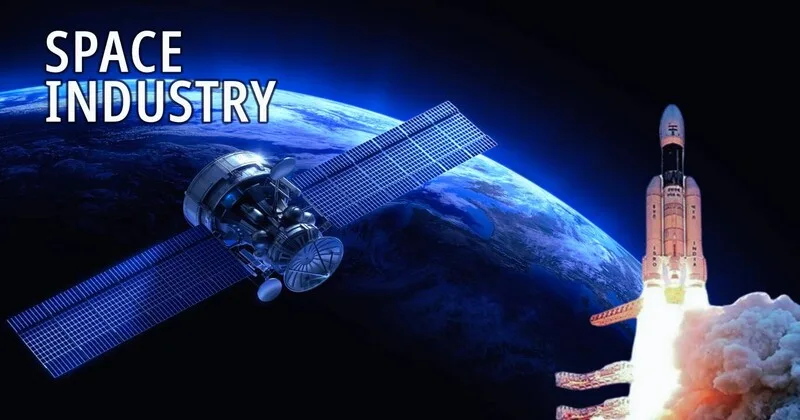
A few decades ago, India’s space exploration was known by its low-key satellite missions and low-cost ventures. With historic reforms in 2020, the Indian government opened the space industry to private sector participation and international cooperation. The launch of the Indian National Space Promotion and Authorization Centre (IN-SPACe) as a nodal agency under the Department of Space, will make India to achieve the target of an eightfold increase in its share of the global space economy.
The ambitious target aims to increase India’s contribution to the global space economy from the present 2% to a projected $44 billion by 2033. This ambition is mentioned in the report ‘Decadal Vision and Strategy for the Development of the Indian Space Economy,’ a strategic plan drawn up by IN-SPACe jointly with ISRO, Non-Governmental Organizations (NGOs) and other private consulting firms.
Decadal Vision of $44 Billion Space Economy
The Decadal Vision focuses on India needs to go beyond its strengths in satellite launches and affordable missions. It wants India to position itself as a major player in upstream (launch services), midstream (satellite operations and ground infrastructure) and downstream (space-based applications and services). The establishment of new shared RDTE facilities with higher investment in research, development, testing and evaluation (RDTE) will make space economy boom in India.
Commercial organisations can apply for access to strategic testing and R&D facilities run by the DOS and different ministries, such as the Ministry of Defence. The reforms will enable non-government commercial organizations to carry out RDTE with a focus on space technology and services, create their intellectual property, commercialize it and become involved in business-to-government, business-to-business and business-to-customer transactions.
In addition to these, the report highlights key focus areas:
Demand Generation: Encouraging broader usage of satellite-based services in agriculture, logistics, climate monitoring and disaster management.
Capability Building: Creating a strong industrial ecosystem, facilitating component manufacturing, satellite fabrication and cutting-edge R&D.
Cross-Sectoral Collaborations: Facilitating convergence of space technology with AI, biotechnology, quantum computing and green energy.
Access to Finance and Talent: Facilitating finance and talent support to space start-ups and MSMEs in the form of financial incentives, venture capital funding and specialized training programs.
International Outreach: Enhancing space diplomacy to bring global clients and partnerships.
Strategic Initiatives of DoS
The report of the Department of Space throws light on a series of projects already on the ground or in the process of execution by IN-SPACe and ISRO to meet the ambitious target. India has relaxed the regulatory regime for allowing private entities to design, manufacture and launch satellites. It also allows them to construct launch vehicles and offer downstream services. IN-SPACe is an authorizing agency working as a single window to reduce bureaucratic delays thus improving the ease of doing business.
Technology transfer of Small Satellite Launch Vehicle (SSLV) to industry is a big leap in launch services. The government is setting up manufacturing clusters to enhance the manufacturing of components and fabrication of satellites, which is essential in developing a cost-competitive supply chain.
Government introduced ₹1000 crore Antariksh Venture Capital Fund to develop startups and MSMEs. Along with the investor awareness initiatives, government is anticipated to draw overseas venture capital and filling the gap in funding against developed countries. Public-Private Partnerships (PPP) are actively being encouraged in India, particularly in Earth observation and satellite communications. PPP is anticipated to spur innovation and develop commercial applications for local and international markets.
Specialized training programs and courses have been introduced in association with educational institutions to develop a trained workforce capable of space-tech-anchored innovation. With the successful missions like Chandrayaan-3 and India is and active member of international platforms like the Axiom-4 and Artemis Accords. India is an emerging and a trusted partner for new entrant space-faring nations.
The Decadal Vision promotes cross-sector innovation, coupling space technology with high-growth sectors like AI, quantum computing, biotechnology and green energy. Through such convergence, India can develop a well-balanced portfolio of innovation which is crucial. This balancing act will provide strength even if global space markets experiences turbulence.
India’s Global Standing and Competitive Edge
Currently, India accounts for merely 2% of the global space economy which is dominated by the U.S. (60%) and China (10%). But India has one distinct advantage i.e. cost-effectiveness. ISRO’s launches are 30 to 40% less expensive than those of international competitors which makes India as a popular choice for small satellite launches. India has also launch 108 satellites in one go, which shows the efficiency of ISRO
An increasing global demand for low Earth orbit (LEO) satellite constellations is increasing, India is also collaborating with ventures such as OneWeb (co-owned by India’s Bharti Group) creating indigenous strength to cater to the global broadband and IoT economies.
Global Context and Comparative Insights
United States: NASA and SpaceX are leading the way on reusable rockets and lunar expeditions through public-private initiatives, cost cutting and vastly increasing commercial potential.
Europe: The European Space Agency is heavily investing in downstream uses such as climate monitoring and is creating its own satellite internet projects to diminish foreign reliance.
China: Investing heavily in lunar research, space stations and asteroid mining, China is rapidly becoming a powerhouse competitor for NASA and US led private entities
South Korea: With the creation of the Korean Aerospace Administration (KASA), it aims for a lunar base in 2045, reflecting the escalating ambitions of mid-tier space countries.
India needs to draw some lessons from these countries, focusing on niche areas such as low-cost launch and data analytics, by scaling up in high-value sectors such as in-orbit manufacturing and space-based transmission of energy.
Way Forward: Constructing a Resilient Space Economy
To reach the target of $44 billion and to grow in the long term, there are critical steps that has to be taken like, Consolidation of Intellectual Property Rights (IPR) for facilitating indigenous R&D. Creation of Space Industrial Corridors with manufacturing, testing and talent clusters. Through Foreign Investments and transparent policies, strategic tech alliances can be made with different entities. Increasing the Space Diplomacy to win market share in Asia, Africa and Latin America. Heavy investment in Emerging Technologies like in-orbit manufacturing, space-based solar power and new-gen satellite constellations.
A Catalyst for Wider Economic Growth
India’s space industry is no longer simply about exploration, it has now become a major catalyst of economic change. By serving as a medium between agriculture, logistics, climate and digital services to integrate with space technology, which has the potential to provide inclusive socio-economic benefits.
If India manages to balance its speedy growth with cross-sector convergence, it will not only attain its $44 billion space economy ambition by 2033 but also become a world leader by managing the future of space business. In the upcoming decade, the question whether India will be a centre of low-cost launch provider or a centre of high-end space services, manufacturing and technology exports will be answered. With government initiative and combined efforts of IN-SPACe will make India a vishwaguru (global leader) in space technology.