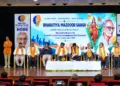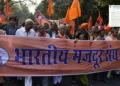

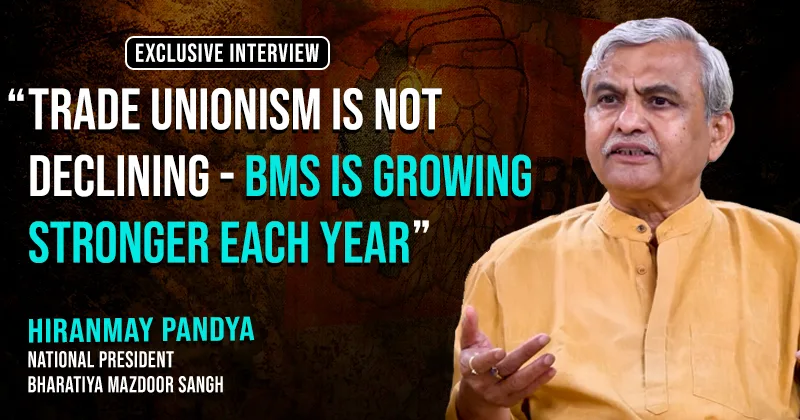
As Bharat’s labour landscape undergoes rapid transformation, one organisation that has consistently upheld a nationalist, apolitical, and worker-centric vision is the Bharatiya Mazdoor Sangh (BMS). Founded in 1955 by Dattopant Thengadi ji, BMS has grown to become the largest trade union in the country. What makes the BMS distinctively Bharatiya? How has it stayed rooted in national interest? And what lies ahead? To understand more, Organiser Editor Prafulla Ketkar spoke with Hiranmay Pandya, National President of BMS. Excerpts:
BMS is completing a remarkable journey of 70 years—an era during which the labour movement in India was largely shaped and dominated by Leftist and Communist. How do you reflect on this journey of BMS amidst that backdrop?
The BMS was founded in 1955 by Dattopant Thengadi ji, who felt that existing labour organisations were too politically aligned and not truly serving workers’ interests. BMS was thus established as a non-political, democratic organisation, based on the principle—“For the workers, by the workers, of the workers.”
From the start, it was rooted in Bharatiya identity rather than imported ideologies, which is why the term Bharatiya was chosen over Rashtriya. Thanks to the dedication and discipline of its cadre, BMS today stands as India’s largest trade union, with over 2 crore members, officially verified by government membership validation processes. It was declared the second-largest union in 1980 and number one in 1989, even under a Congress-led government—a position it retains to this day. Yet, we believe our work is far from over. India has 55 crore workers, and we aim to reach all of them—not just in numbers, but in spirit and representation.
Our contributions include path-breaking efforts like the introduction of the bonus system, based on the ancient Indian concept of “Deferred Wage” from Shukra Niti, leading to the 8.33 per cent minimum bonus rule. Internationally, BMS has represented India at the ILO since 1990, regularly raising key issues of Indian labour in global forums. In 2025, our delegate was the only one to speak in the ILO plenary session. During India’s G20 presidency, BMS was given the chairmanship of L20 (Labour 20)—a first for any Indian trade union. We led two major events: the Inception Meeting in Amritsar and the Summit in Patna, with participation from 62 unions across 29 countries. The international media called it “historic and fantastic.” Even 30 Labour Ministers attended the Indore meet—far more than usual. We’ve also built strong relations with global platforms like BRICS, where BMS participated in successive summits, and India is set to host the next one in 2026.So yes, in these 70 years, we’ve come a long way—but the journey and mission continue.
When BMS was founded, Dattopant Thengadi ji gave a very unique slogan:“Nationalise the Labour, Labourise the Industry and Industrialise the Nation.” How far has BMS been able to realise that vision? And what exactly do we mean by “nationalise the labour”?
The slogan “Nationalise the Labour, Industrialise the Nation” was given by Dattopant Thengadi ji, reflecting BMS’s founding philosophy rooted in three core priorities—Rashtrahit (national interest), Udyoghit (industrial interest), and Shramikhit (workers’ interest).
We believe that without labour, industries can’t function, and without industries, the nation can’t grow. Hence, BMS uniquely works to align the interests of all three. It is not merely a trade union but a family-oriented organisation that treats every worker as part of a national family. From the beginning, we carried the vision of “Vasudhaiva Kutumbakam”, which even echoed globally during India’s G20 presidency. We don’t agitate just for worker demands; we also act in the interest of the nation and industry. For example, after the Pahalgam attack and during Operation Sindoor, we advised our affiliated unions to prioritise national interest over wage demands.
https://www.youtube.com/watch?v=ZXdbUISKQzo
Similarly, during COVID-19, over 1 lakh BMS workers volunteered selflessly—a fact acknowledged by the International Labour Organization as a symbol of our national commitment. We continuously educate workers through “Abhyas Varg” (study sessions) at all levels—district to national—emphasising that rights and duties go hand in hand. Recognising the changing times, we also initiated an Industrial Trade Union Forum, fostering cooperation between employers and unions. Today, even employers acknowledge that neither side can function without the other. For a nation to progress, government, industry, and labour—the three pillars—must work in harmony. And BMS is committed to making that vision a reality.
You mentioned earlier that BMS is non-political. But often, questions arise about its alleged affiliation with the Sangh (RSS) or ideological alignment with BJP. So how do you see this—having an ideology, yet maintaining political independence?
We have always maintained that BMS is a non-political organisation, and we strictly adhere to that. None of our office bearers—from the district to national level—can be associated with any political party. As citizens, we do vote—but our support goes to those who work in the interest of the nation, industry, and workers. This approach, defined by “Responsive Cooperation” as given by Dattopant Thengadi ji, means we support any government or party that upholds these interests—and oppose those who do not. Unlike other trade unions whose leaders are often MPs, MLAs, or ministers, BMS has no office bearer holding political office. Yes, we align ideologically with the Rashtriya Swayamsevak Sangh (RSS) in our vision of national reconstruction, but we do not function under any political party, including the BJP. Our aim is to organise workers with a nationalist outlook, not use them for electoral politics. We teach them to act in the nation’s interest, and support only those who do the same. In that sense, we are ideological co-travellers, not permanent allies—If a party reflects our values, we walk with them; if not, we don’t.
Seventy years on, with 2 crore members, BMS has achieved a remarkable milestone, especially in a space once dominated by non-Indian ideologies. But with the rise of white-collar jobs, an expanding unorganised sector, and the digital transformation of work, how does BMS view the future of trade unionism?
Absolutely. While many believe trade unionism is declining, we don’t agree. In fact, BMS continues to grow. We hold regular national and state meetings, where we affiliate around 150 new unions annually, and today, over 7,000 registered trade unions are associated with us. This shows the continued relevance and trust in BMS. Yes, technology is changing the landscape—Industry 4.0, 5.0, and AI are already here. But we believe technology should serve humans, not the other way around. At global forums like the ILO and L20, BMS has consistently advocated for human-centric growth. We’re not against machines, but we oppose replacing human presence where it’s essential. That’s why we invest in upskilling workers from unskilled to highly skilled—so they remain employable in changing times. Change is inevitable, but how we respond to it is up to us. Even employers and governments now realise that excessive automation poses challenges, robots don’t pay taxes or buy goods. That’s why we introduced the idea of a “fourth pillar” in nation-building: Government, Industry, Labour, and Customer. We must keep people at the centre of all decisions. To counter AI, we promote emotional intelligence—the human ability to respond with empathy, creativity, and wisdom. Machines lack that.