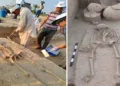
A recent multidisciplinary study has found definitive evidence of human habitation and cultural activity in Gujarat’s Kutch region dating back more than 12,000 years, dramatically predating the emergence of the Harappan civilisation. These findings not only redefine India’s civilisational chronology, but also reignite long-standing debates on the indigenous, uninterrupted growth of Hindu civilisation.
The study, led by Professor VN Prabhakar of the Archaeological Sciences Centre, IIT Gandhinagar, and involving experts from IIT Kanpur, the Inter-University Accelerator Centre (IUAC) Delhi, and the Physical Research Laboratory (PRL) Ahmedabad, unearthed shell-midden sites and stone tools across Khadir and nearby islands in the Kutch region. These pre-Harappan remains offer stunning proof of a sophisticated coastal hunter-gatherer society, which adapted to the mangrove-rich landscapes of prehistoric Gujarat through the expert use of local marine resources.
“This discovery shifts the civilisational foundation of India by at least 5,000 years,” said Prof. Prabhakar. “It challenges the colonial-era belief that Indian urban civilisation began suddenly with the Harappans. Instead, what we see is a gradual, locally driven process of cultural evolution that may have laid the groundwork for later urban planning and maritime trade.”
Shell middens and tools: Traces of an ancient, organised society
The evidence includes extensive shell middens—large heaps of discarded mollusc shells—consumed by the early communities, as well as stone tools like cutters, scrapers, and cores used in tool production. These are the first confirmed shell-midden sites in Kutch. Such cultural markers, previously ignored by British-era surveyors, now provide rich insight into the diet, ecological knowledge, and survival strategies of India’s earliest settled groups.
The shells, consisting of bivalves like oysters and gastropods, indicate sustained marine subsistence patterns. The communities demonstrated a deep understanding of their environment, with knowledge of tidal cycles, mangrove ecology, and marine harvesting techniques that ensured their survival in dynamic coastal zones.
“Their ability to adapt without modern technology and yet thrive speaks volumes about their ecological intelligence,” added Dr. Shikha Rai, co-author and postdoctoral researcher at IITGN.
Scientific Proof: Radiocarbon Dating Puts Timeline Around 10,000 BCE
The study employed Accelerator Mass Spectrometry (AMS)—a precise dating method—on the collected shell samples. Conducted at PRL Ahmedabad and IUAC Delhi, and calibrated using tree-ring data, the results placed the midden sites well before the Harappan period, in some cases as far back as 12,000 years ago.
“This isn’t speculation—it’s hard science. The Carbon-14 decay and its calibration are globally accepted methods,” said Dr. Pankaj Kumar from IUAC, who contributed to the analytical process.
This effectively pushes back India’s timeline of advanced human habitation to the Late Pleistocene to early Holocene, proving that civilisational seeds were sown in this land long before any Mesopotamian or Egyptian urban formations took root.
For decades, Bharat’s ancient history has been truncated by colonial and Eurocentric academic models, which often treated the Harappan civilisation as the starting point. But this discovery, along with earlier evidence from sites like Attirampakkam (Tamil Nadu), Jwalapuram (Andhra Pradesh), and the Narmada Valley, indicates that Bharat was not a passive recipient of civilisational impulses, but a key generator of them.
The gradual transformation from mobile foragers to settled societies, using stone technology and exploiting marine ecology, signifies a homegrown evolutionary trajectory—the prelude to the rise of the Harappan urban order. The civilisational thought that later manifested in Sanatana Dharma, early Vedic cultures, and Hindu philosophical systems must be viewed within this deep-rooted continuum.
“We must discard the notion that ‘civilisation’ in India began only with script, bricks, or metallurgy,” remarked Prof. Prabhakar. “It began when early humans in this land started forming relationships with rivers, forests, coasts, and each other. That’s the true civilisational origin story of Bharat.”
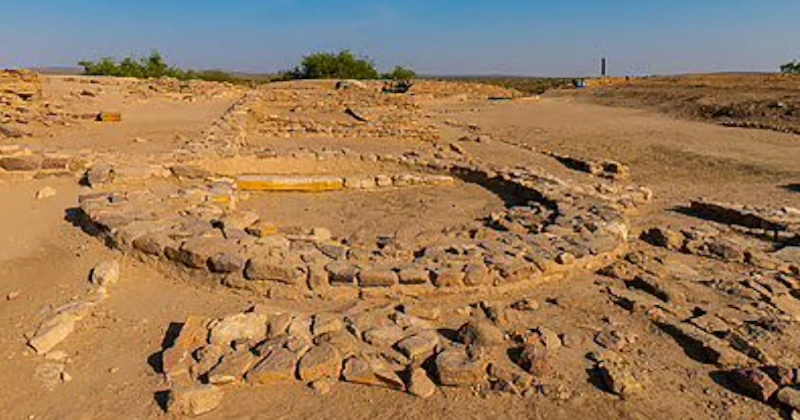
Against this historical backdrop, the National Maritime Heritage Complex (NMHC) being constructed at Lothal becomes more than just a tribute to India’s maritime past—it represents a chance to reorient our national narrative.
Lothal, one of the oldest known Harappan dockyards, symbolises India’s ancient seafaring excellence. The new museum, spread over 400 acres, aims to showcase India’s maritime achievements, but now must also incorporate the newly discovered Pre-Harappan culture of Kutch. The continuity from prehistoric shell gatherers to Harappan mariners tells a richer story than previously imagined.
“If the Lothal museum does not reflect these new findings, it will be yet another missed opportunity to tell the truth of India’s uninterrupted civilisational growth,” said Prof. Vikrant Jain, co-author from IITGN.
The museum, once completed, is expected to house interactive galleries, digital archives, underwater archaeology labs, and reconstructed models of ancient ships and ports. But it should now also include a dedicated section to Pre-Harappan coastal life, marine adaptation, and the ecological intelligence of early Indians, based on the latest evidence.
In addition to historical insight, the study offers a message for our modern world. As the planet grapples with climate crisis, ecological degradation, and unsustainable urbanism, the wisdom of early Indians—who lived within ecological limits, used sustainable resources, and understood coastal environments intimately—offers valuable lessons.
“The past is not just about pride—it’s about learning,” concluded Dr. Rai. “These communities survived for millennia not by dominating nature, but by coexisting with it. That ethos is central to Hindu civilisation.”
The time has come to rewrite textbooks, reimagine museums, and revise our understanding of India’s past. Bharat was not merely the recipient of civilisational ‘gifts’ from Mesopotamia, Persia, or Central Asia. It was a nurturer, innovator, and protector of its own civilisational stream, rooted in its soil, rivers, coasts, and cosmic understanding.
With the Lothal Maritime Museum nearing completion, there is now a golden opportunity to correct the colonial distortions and affirm the indigenous genesis of India’s civilisational identity. The Pre-Harappan roots of Hindu civilisation must be studied, showcased, and celebrated—not just by scholars and archaeologists, but by every Indian.