Operation Sindoor: A new era in India’s military doctrine
June 20, 2026
  • Read Ecopy
  • Circulation
  • Advertise
  • Careers
  • About Us
  • Contact Us
Android AppiPhone AppArattai
Organiser
  • ‌
  • Bharat
    • Assam
    • Bihar
    • Chhattisgarh
    • Jharkhand
    • Maharashtra
    • View All States
  • World
    • Asia
    • Europe
    • North America
    • South America
    • Africa
    • Australia
  • Editorial
  • International
  • Opinion
  • RSS @ 100
  • More
    • Op Sindoor
    • Analysis
    • Sports
    • Defence
    • Politics
    • Business
    • Economy
    • Culture
    • Special Report
    • Sci & Tech
    • Entertainment
    • G20
    • Azadi Ka Amrit Mahotsav
    • Vocal4Local
    • Web Stories
    • Education
    • Employment
    • Books
    • Interviews
    • Travel
    • Law
    • Health
    • Obituary
  • Subscribe
    • Subscribe Print Edition
    • Subscribe Ecopy
    • Read Ecopy
  • ‌
  • Bharat
    • Assam
    • Bihar
    • Chhattisgarh
    • Jharkhand
    • Maharashtra
    • View All States
  • World
    • Asia
    • Europe
    • North America
    • South America
    • Africa
    • Australia
  • Editorial
  • International
  • Opinion
  • RSS @ 100
  • More
    • Op Sindoor
    • Analysis
    • Sports
    • Defence
    • Politics
    • Business
    • Economy
    • Culture
    • Special Report
    • Sci & Tech
    • Entertainment
    • G20
    • Azadi Ka Amrit Mahotsav
    • Vocal4Local
    • Web Stories
    • Education
    • Employment
    • Books
    • Interviews
    • Travel
    • Law
    • Health
    • Obituary
  • Subscribe
    • Subscribe Print Edition
    • Subscribe Ecopy
    • Read Ecopy
Organiser
  • Home
  • Bharat
  • World
  • Operation Sindoor
  • Editorial
  • Analysis
  • Opinion
  • Culture
  • Defence
  • International Edition
  • RSS @ 100
  • Magazine
  • Read Ecopy
Home Bharat

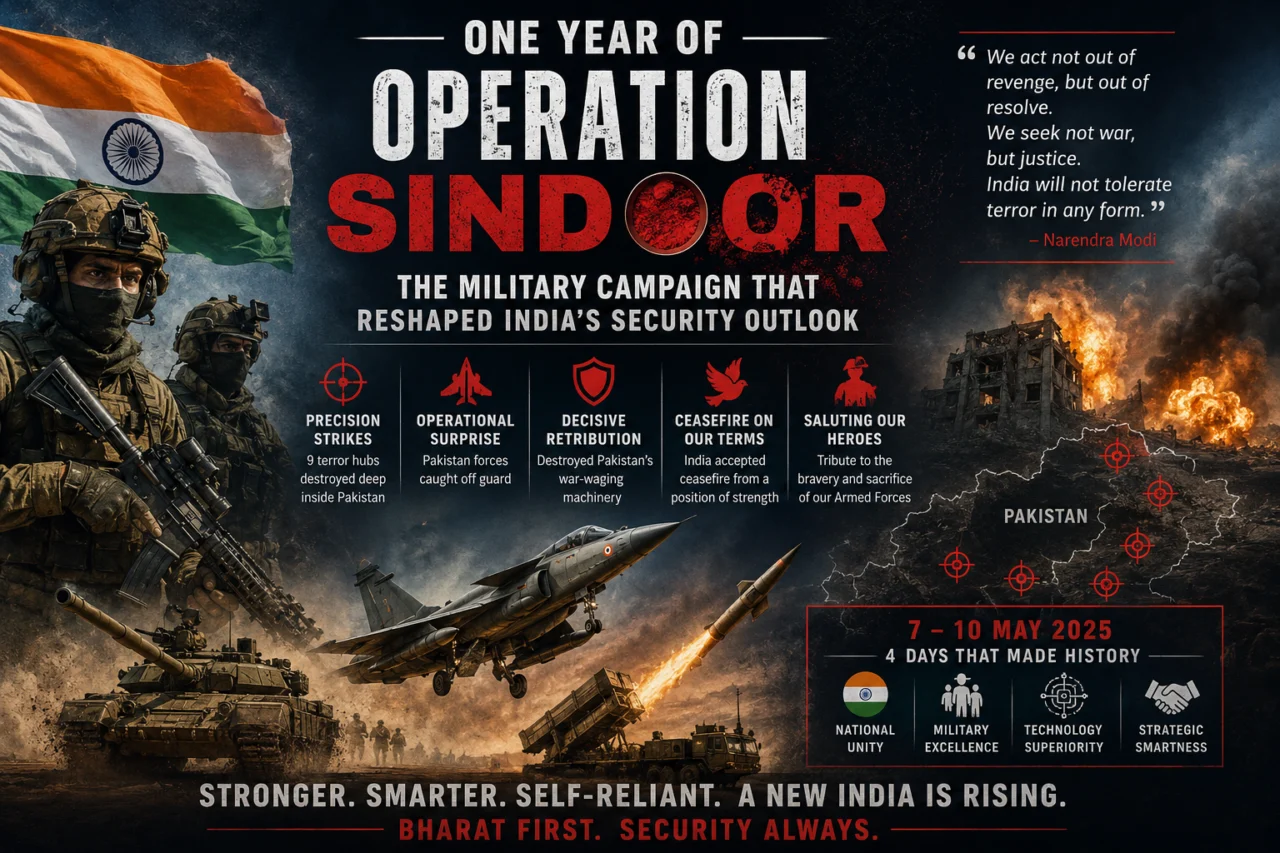
One Year of Operation Sindoor: The military campaign that reshaped India’s security outlook

One year after Operation Sindoor, strategic analysts and defence observers continue to describe the four-day conflict as a defining moment in India’s military and geopolitical evolution. Launched in the aftermath of the deadly terror attack in Pahalgam on April 22, 2025, the operation marked a decisive shift in India’s response to cross-border terrorism and regional security threats

Lt Gen M K DasLt Gen M K Das
May 10, 2026, 10:30 pm IST
in Bharat, World, Opinion, Defence, International Edition
Follow on Google News
FacebookTwitterWhatsAppTelegramEmail

On the first anniversary of Operation Sindoor, I begin by paying my homage to the Fallen Heroes and salute the valour of the Indian Armed Forces. Looking back, Operation Sindoor stands out as the most important transformative milestone for the Indian Armed Forces and even for the national leadership. The last one year has seen continuation of Russia-Ukraine War (now more than four years old), Israel-Hamas conflict (now more than 2 ½ years), 12-day war between the US & Israel with Iran in June last year and the ongoing conflict in West Asia since 28 February. In such a conflict driven world, India’s success against Pakistan in less than four days in Operation Sindoor (May7, 2025-May 10, 2025) is a testimony of India’s strategic smartness.

It is believed that a military always fights a war as per the last one fought by it. This axiom suggests that the military leadership often relies on outdated strategies of the past wars and generally fails to adopt the new technology and tactics. To some extent, this is true of Indian military leadership too. In our case, the most of the military planning and conduct is based on the Indo-Pakistan war of December 1971, which is considered the greatest success of our armed forces in the last century. It was only after operations in Kargil (Operation Vijay) in the year 1999 that Indian Armed Forces seriously carried out the much necessary reforms in military affairs. Even then, the first decade of this century saw slow progress in defence reforms and not much urgency.

Read More: India & Vietnam ink 13 pacts, eye $25B trade goal under new “Enhanced Comprehensive Strategic Partnership”

Mr. Manohar Parrikar as the Defence Minister from November 2014 to March 2017 under Modi 1.0 government accelerated military modernisation, policy reforms and ‘Make in India’ push. Under Mr. Rajnath Singh as the Raksha Mantri under Modi 2.0 government from the year 2019 and once again under Modi 3.0 government from the year 2024 has given the defence reforms necessary continuity and urgency. Appointment of the CDS from 1 January 2020 onwards has also played a key role in ushering jointness and integration between the Army, Navy and Air Force. Uri cross-border surgical strike in September 2016 and Balakot airstrike in February 2019 indicated the offensive intent of Modi government against terrorism. But Pakistan needed a completely different approach to defeat it decisively.

Two conflicts changed the mindset of Indian military leadership. First was Russia-Ukraine war which commenced in February 2022 and still continues after more than four years. Russia-Ukraine war presented a case study on the conventional war as also gave a clear demonstration of non-kinetic warfare with missiles, drones and air power. The second war was Israel- Hamas conflict which is ongoing since October 7, 2023. The decisive response of Israel towards cross-border terrorism from Hamas, Hezbollah and Houthi certainly influenced our military thinking. India for long had suffered from the cross-border terrorism sponsored by Pakistan. Galwan clashes with China in Eastern Ladakh in June 2020 once again made our armed forces to review their operational doctrine. Backed by PM Modi, Indian Armed Forces continued on the path of force modernisation and organisational restructuring with a degree of urgency never seen before.

Then Pahalgam terror attack happened on April 22, 2025. This dastardly terror attack shook the conscience of the nation like never before because Hindu tourists were selectively killed after identifying their religion. Even Jammu & Kashmir witnessed massive protests against the terror attack. The opposition parties also gave full support to Modi government. In short, India was now ready for a decisive response against Pakistan, the sponsor of Pahalgam terror attack. But a military action against Pakistan always carried a self-imposed restriction of Pakistan’s use of tactical nuclear weapons against India. A confident, militarily superior and resolute India thought otherwise this time around. Indian leadership therefore clearly laid down the political and military objectives of war. It was evident from the numerous meetings between the PM, RM, NSA, CDS and the Service Chiefs.

India punished Pakistan decisively during the Operation Sindoor from 7-10 May last year. Though Pakistan was expecting retribution from India, yet the armed forces achieved operational surprise and caught Pakistani forces off guard. To begin with, India destroyed the nine terror hubs deep inside Pakistan with precision strikes. When Pakistan attempted to escalate the conflict, India destroyed the entire war waging machinery of Pakistan. During my military career, I have served on the Pakistan border and Line of Control many times. But the type of retribution inflicted by the Indian armed forces during Operation Sindoor remains unparalleled. So severe was Indian offensive that Pakistan pleaded for ceasefire, which India accepted on own terms, from a position of strength. It is the moral ascendency of a victorious India that the ceasefire with Pakistan has held on for one year. Operation Sindoor in many ways has thus heralded the era of India’s strategic smartness.

For India, it has become clear that any conflict with Pakistan gives it the direct support of China, thus making two-front war a strategic reality. Importantly, India has now embarked on serious modernisation of the armed forces through the indigenous route. Various weapon platforms made in our country are finding acceptance of the armed forces. The military leadership of India has gained special strategic confidence and is looking ahead with self-assurance. This was evident in another detailed media interaction of the military authorities on 7 May at Jaipur. Even in a pure democratic setup of India, Indian armed forces are getting the operational freedom never experienced before. India also demonstrated the necessary strategic smartness to cease the operations on 10 May last year having achieved all the political and military objectives. India has proved to the world that a victory is not necessarily measured in remaining involved in conflict for a longer duration. India has demonstrated that strategic decisiveness and operational smartness is the way to achieve swift victory. US-Iran leadership may well take note of India’s outstanding victory in Operation Sindoor.
Topics: Pahalgam Terrorist attackOperation Sindoor
ShareTweetSendShareSend
✮ Subscribe Organiser YouTube Channel. ✮
✮ Join Organiser's WhatsApp channel for Nationalist views beyond the news. ✮
Previous News

PM Modi in Hyderabad: Congress Has Become “Muslim League Maoist Congress”, Says Centre Backing Telangana’s Growth

Next News

China admits support to Pakistan during India’s anti-terror Op Sindoor, indirectly validating battlefield losses

Related News

India's firm national security response after Operation Sindoor reshaped ties with Turkey, forcing Celebi's exit from the country's aviation sector

Operation Sindoor Impact: Turkish firm Celebi Aviation says India exit erased Rs 4,700 crore overnight

Chinese President Xi Jinping, Russian President Vladimir Putin and Prime Minister Narendra Modi

China’s New Tone Towards India: Tactical shift or strategic necessity? What Beijing’s push for RIC ties really signals

Saurav Das, Chief Spokesperson of CJP

Exposing CJP’s Saurav Das: Inside his controversial commentary on Article 370, Umar Khalid & nationalism

As Khalistani networks seek new platforms beyond the West, Azerbaijan has emerged as a key venue for conferences, campaigns and narratives aligned with the Pakistan-Turkey axis against India.

Khalistan’s New Grazing Ground: Azerbaijan emerges as new hub for Turkey-Pakistan backed anti-India networks

Bangladesh’s reported JF-17 push has triggered fresh scrutiny after India’s Ops Sindoor exposed the vulnerabilities of Pakistani-Chinese defence systems and precision strike capabilities

Shadows of Operation Sindoor: Questions loom over Bangladesh’s JF-17 ambitions amid Sino-Pakistani tech vulnerabilities

Rajnath Singh releases book on Operation Sindoor; The publication chronicles unparalleled valour of the Indian soldiers

Load More

Latest News

Yoga teaches the harmony of body, mind and spirit, the foundation of enduring civilizations and enlightened leadership.

From Self-Mastery to World Harmony: Yoga as the foundation of civilizational survival and progress

Sewa Bharati reaffirmed its commitment to the displaced families of Wayanad, Kerala, by handing over eight newly constructed homes under the "Sneh Nikunjam"

Sewa Bharati: The silent revolution of selfless service, strengthening the roots of Bharat

250-year-old Ramcharitmanas manuscript to be preserved in Ayodhya museum

Rare 250-year-old Ramcharitmanas manuscript set to be preserved at Ayodhya’s International Ramkatha Museum

Yogi Government’s school transformation drive gets national boost as 11 Uttar Pradesh schools make SHVR list

Uttar Pradesh: Eleven schools earn national recognition in Swachh Evam Harit Vidyalaya rankings 2025-26

Aligarh police arrest Anwar Hussain, brother of Samajwadi Party leader in beef smuggling case

Beef Smuggling Case in Uttar Pradesh: Samajwadi Party leader Sarwar Hussain’s brother Anwar arrested in Aligarh

Japan Prime Minister Sanae Takaichi and Prime Minister Narendra Modi

Assam at the Epicentre of India’s Foreign Policy: Japan PM Sanae Takaichi to visit for the Indo-Japan summit

Tamil Nadu: TVK govt scraps Rs246 Cr commercial projects on temple lands approved under DMK, move welcomed with caution

Revisiting the historic June 20 vote that led to the creation of West Bengal within India

Paschimbanga Divas 2026: The untold story of how West Bengal was created from undivided Bengal in 1947

Andhra Explosives Case: NIA chargesheets Mohammed Ali; Bomb expert accused in LK Advani attack plot, hid for 20 years

Tarabai Bhonsale

Tarabai Bhonsale: The fearless Maratha queen who defied Aurangzeb and preserved swarajya against all odds

Load More
  • Privacy
  • Terms
  • Cookie Policy
  • Refund and Cancellation
  • Delivery and Shipping

© Bharat Prakashan (Delhi) Limited.
Tech-enabled by Ananthapuri Technologies

  • Home
  • Search Organiser
  • Bharat
    • Assam
    • Bihar
    • Chhattisgarh
    • Jharkhand
    • Maharashtra
    • View All States
  • World
    • Asia
    • Africa
    • North America
    • South America
    • Europe
    • Australia
  • Editorial
  • Operation Sindoor
  • Opinion
  • Analysis
  • Defence
  • Culture
  • Sports
  • Business
  • RSS @ 100
  • Entertainment
  • More ..
    • Sci & Tech
    • Vocal4Local
    • Special Report
    • Education
    • Employment
    • Books
    • Interviews
    • Travel
    • Health
    • Politics
    • Law
    • Economy
    • Obituary
  • Subscribe Magazine
  • Read Ecopy
  • Advertise
  • Circulation
  • Careers
  • About Us
  • Contact Us
  • Policies & Terms
    • Privacy Policy
    • Cookie Policy
    • Refund and Cancellation
    • Terms of Use

© Bharat Prakashan (Delhi) Limited.
Tech-enabled by Ananthapuri Technologies