The 18th BRICS Summit in New Delhi on September 12–13 brought together the leaders of the expanded BRICS grouping at Bharat Mandapam at a moment of intense geopolitical turbulence. Wars in West Asia and Ukraine, economic fragmentation, unilateral tariffs and uncertainty over the Western global order formed the backdrop to the meeting.
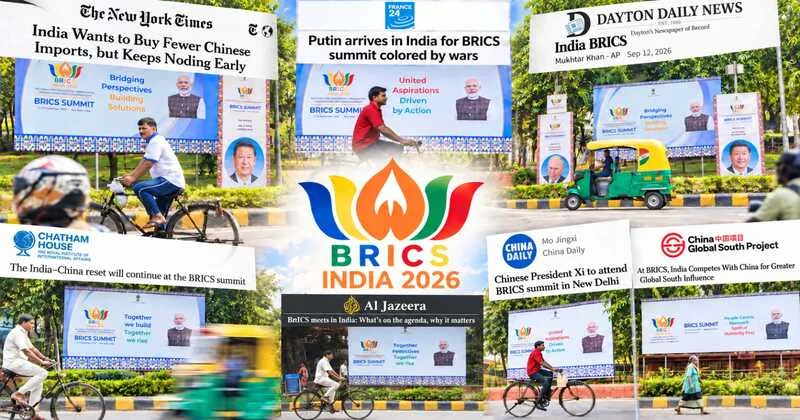
Yet, alongside serious coverage of diplomacy and economics, a section of international media coverage attracted attention for another reason. The repeated use of images showing cyclists, pedestrians, mopeds and auto-rickshaws passing BRICS billboards in Delhi.
The visual choices generated criticism in India because they appeared to reduce the backdrop of one of the world’s largest diplomatic gatherings to familiar images associated with poverty and developing-country stereotypes. The issue is not whether bicycles, pedestrians or autorickshaws are part of Indian life. They obviously are. The question is why these particular images were repeatedly selected to represent a country hosting one of the most consequential gatherings of emerging economies.
A summit of 21 countries, but a visual story of bicycles and autos
The summit itself presented a vastly different picture. BRICS now comprises 11 member countries, Brazil, Russia, India, China, South Africa, Egypt, Ethiopia, Indonesia, Iran, Saudi Arabia and the UAE. India’s 2026 presidency also brought all partner countries into the wider BRICS engagement, while heads of major international organisations participated in the summit.
Bharat Mandapam was the venue for the gathering. The convention centre is designed for international-scale events, with capacity for up to 7,000 delegates, technology-equipped meeting rooms, VIP facilities, large auditoriums and extensive underground parking.
Indian journalists working for Western media are helping turn BRICS coverage into a cheap propaganda exercise against India.
Instead of showing India’s growth, western outlets are pushing selected images of bicycles and brick kilns to create the impression that India is still… pic.twitter.com/acfJXxIK6w
— Military Observer (@TheMilObserverr) September 15, 2026
Against this setting, however, some international outlets repeatedly selected ordinary street scenes. The China Global South Project, in its September 7 article titled “At BRICS, India Competes With China for Greater Global South Influence”, used a Reuters photograph showing a man walking past a large BRICS hoarding featuring Prime Minister Narendra Modi. The image itself was an ordinary Delhi street scene, but its placement alongside an article about India’s international ambitions created a particular visual juxtaposition.
The New York Times, in its September 12 report “India Wants to Buy Fewer Chinese Imports, but Keeps Needing More”, placed a photograph of people riding bicycles past BRICS summit signs alongside its analysis of India’s trade dependence on China.
Al Jazeera, in its September 12 explainer, “BRICS meets in India: What’s on the agenda, why it matters”, used another Reuters photograph of a cyclist passing a BRICS billboard. China Daily, in its report “Chinese President Xi to attend BRICS summit in New Delhi”, also carried a photograph of a cyclist passing a Modi-branded BRICS hoarding. The image was credited to AFP.
Britian’a Chatham House, in its September 8 analysis titled “The India–China reset will continue at the BRICS summit”, used a photograph of Delhi traffic passing a large hoarding featuring Prime Minister Narendra Modi.
France 24/AFP used another photograph showing a cyclist passing BRICS signage in its coverage of Vladimir Putin’s arrival. Its headline, “Putin arrives in India for BRICS summit coloured by wars,” framed the meeting primarily through the wars in the West Asia and Ukraine. And a photograph carried by the Dayton Daily News showed an autorickshaw passing BRICS posters featuring Modi, Putin and Xi.
Germany’s Deutsche Welle (DW) also used a street-level image in its BRICS coverage, showing a person resting near a BRICS summit sign in the heat. The photograph, credited to IANS photographer Qamar Sibtain.
The South China Morning Post, in its September 9 analysis, “Delhi’s test: make Brics work without making it work against India,” used a Reuters photograph showing passengers waiting at a bus stop beneath a signboard featuring Prime Minister Narendra Modi ahead of the summit.
Spectrum News in New York, in an Associated Press-syndicated report ahead of the summit, used a photograph of a green-and-yellow auto-rickshaw moving past BRICS summit banners. The report focused on preparations for the summit and traffic conditions in New Delhi, adding another example of an ordinary street scene being used as the principal visual alongside BRICS coverage.
None of these photographs is necessarily false. The issue is editorial selection. Delhi contains bicycles, autorickshaws and pedestrians as well as airports, metro systems, technology parks, modern highways, financial districts, advanced manufacturing facilities and international convention infrastructure. Selecting one image rather than another can shape how an audience thousands of kilometres away imagines the country.
From “snake charmers” to the modern poverty visual
This criticism also has a historical dimension. For decades, India’s international image was frequently filtered through familiar colonial-era stereotypes, the snake charmer, the impoverished villager, the cow, the crowded street and the dusty road. The vocabulary has changed, but critics argue that some contemporary visual journalism sometimes reproduces the same basic grammar in a modern form that a high-tech or diplomatic India placed beside an image intended to evoke poverty or underdevelopment.
The controversy surrounding The New York Times and India’s Mars mission in 2014 remains one of the clearest examples. After India successfully placed Mangalyaan into Mars orbit, the newspaper published a cartoon showing an Indian farmer with a cow knocking on the door of an “Elite Space Club”. The cartoon generated widespread criticism, after which the newspaper apologised for the choice of imagery, while explaining that the cartoonist’s intention had been to highlight the changing geography of space exploration.
The important point is not that every foreign journalist or photographer shares an anti-India position. Nor is every photograph of an Indian cyclist evidence of prejudice. But the recurrence of the same visual formula during major Indian achievements deserves scrutiny that India’s global ambition appears in the background while a bicycle, autorickshaw, slum, crowded road or roadside worker is placed prominently in the foreground.
The summit itself supplied a different image of India
The strongest response to such framing did not come from rhetoric. It came from the summit itself. India brought together an expanded BRICS grouping at a time when its members had sharply differing geopolitical interests. Iran and the UAE were participating in the same forum amid regional tensions. Russia remained deeply involved in the Ukraine conflict. China and India were simultaneously attempting to stabilise their bilateral relationship. The United States and its partners were engaged in wider strategic and economic competition with several BRICS members.
#WATCH | Delhi: Prime Minister Narendra Modi and BRICS Leaders pose for a Family Photo (Leaders of BRICS Member Countries).
(Video: DD News) pic.twitter.com/Vqatv2bbd9
— ANI (@ANI) September 12, 2026
Yet the summit produced a New Delhi Declaration. The official declaration reaffirmed BRICS commitments to mutual respect, sovereign equality, solidarity, inclusiveness, collaboration and consensus. It also called for greater cooperation in political and security affairs, economic and financial matters, and cultural and people-to-people relations.
On the West Asia, the members adopted language calling for maximum restraint and diplomacy despite the divergent interests of countries within the grouping. Reuters reported that the 11 members reached consensus on the statement amid the conflict.
That achievement matters because the summit was not taking place in an era of calm. It was taking place amid multiple conflicts and growing fractures in the international system. India’s BRICS presidency therefore placed cooperation, resilience, innovation and sustainability at the centre of the agenda. The official declaration specifically praised the progress achieved under India’s chairship and recognised BRICS’s role in voicing the concerns and priorities of the Global South.
India’s answer was the summit, not the stereotype
The New Delhi BRICS summit offered an unusually clear counterpoint. The same Delhi streets that supplied photographs of cyclists and autorickshaws also led to a convention centre capable of hosting thousands of delegates, leaders from 11 member states and 10 partner countries, and representatives of international organisations. The summit ended not with India isolated from the world, but with governments with different interests sitting around the same table and signing a common declaration.
The pattern of visual framing is not confined to BRICS. India’s G20 presidency generated similar debates, while the 2014 Mangalyaan cartoon became a lasting example of how Indian technological achievement could be interpreted through older cultural stereotypes. The recurrence does not prove a coordinated media campaign. It does, however, raise a legitimate question about the assumptions that sometimes influence international representations of a rapidly changing India.
India’s BRICS presidency therefore presented a broader picture than the visual narrative seen in parts of the foreign media. The summit demonstrated India’s capacity to convene diverse powers, facilitate dialogue and advance cooperation, while the contrasting coverage highlighted the continuing gap between India’s evolving global role and some of the images used to portray it.