Swadeshi Strength: Securing India’s future through self-reliance
June 4, 2026
  • Read Ecopy
  • Circulation
  • Advertise
  • Careers
  • About Us
  • Contact Us
Android AppiPhone AppArattai
Organiser
  • ‌
  • Bharat
    • Assam
    • Bihar
    • Chhattisgarh
    • Jharkhand
    • Maharashtra
    • View All States
  • World
    • Asia
    • Europe
    • North America
    • South America
    • Africa
    • Australia
  • Editorial
  • International
  • Opinion
  • RSS @ 100
  • More
    • Op Sindoor
    • Analysis
    • Sports
    • Defence
    • Politics
    • Business
    • Economy
    • Culture
    • Special Report
    • Sci & Tech
    • Entertainment
    • G20
    • Azadi Ka Amrit Mahotsav
    • Vocal4Local
    • Web Stories
    • Education
    • Employment
    • Books
    • Interviews
    • Travel
    • Law
    • Health
    • Obituary
  • Subscribe
    • Subscribe Print Edition
    • Subscribe Ecopy
    • Read Ecopy
  • ‌
  • Bharat
    • Assam
    • Bihar
    • Chhattisgarh
    • Jharkhand
    • Maharashtra
    • View All States
  • World
    • Asia
    • Europe
    • North America
    • South America
    • Africa
    • Australia
  • Editorial
  • International
  • Opinion
  • RSS @ 100
  • More
    • Op Sindoor
    • Analysis
    • Sports
    • Defence
    • Politics
    • Business
    • Economy
    • Culture
    • Special Report
    • Sci & Tech
    • Entertainment
    • G20
    • Azadi Ka Amrit Mahotsav
    • Vocal4Local
    • Web Stories
    • Education
    • Employment
    • Books
    • Interviews
    • Travel
    • Law
    • Health
    • Obituary
  • Subscribe
    • Subscribe Print Edition
    • Subscribe Ecopy
    • Read Ecopy
Organiser
  • Home
  • Bharat
  • World
  • Operation Sindoor
  • Editorial
  • Analysis
  • Opinion
  • Culture
  • Defence
  • International Edition
  • RSS @ 100
  • Magazine
  • Read Ecopy
Home Bharat

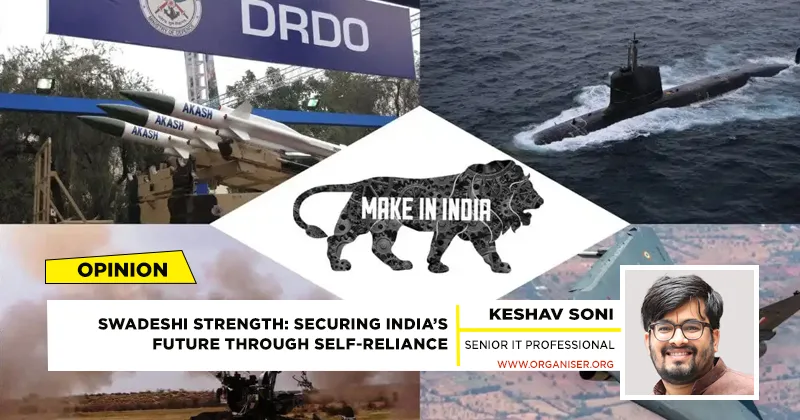
Swadeshi Strength: Securing India’s future through self-reliance

The journey from being the world's largest arms importer to a significant indigenous exporter underscores a transformative shift in India's defence landscape, driven by the clarion call for an Aatmanirbhar Bharat and underpinned by robust policy reforms, a thriving innovation ecosystem, and strategic partnerships

Keshav SoniKeshav Soni
May 21, 2025, 07:00 pm IST
in Bharat, Opinion, Defence
Follow on Google News
FacebookTwitterWhatsAppTelegramEmail

Dattopant Thengadi, one of the foremost visionaries of modern India, conceived Swadeshi not merely as an economic strategy but as the living spirit of patriotism itself. It is a call to build national self-reliance, safeguard India’s sovereignty, and engage with the world from a position of strength and equality. Swadeshi is a civilisational compass guiding us toward economic freedom, political autonomy, and cultural pride. In many ways, the recent success of Operation Sindoor embodies this vision in action. This operation is more than just a chapter in India’s security narrative  –  it is a testament to the strength of indigenous capabilities, strategic precision, and above all, the confidence of a new Bharat committed to Swadeshi as a force of national power.

From Arms Importer to Indigenous Exporter: A Strategic Shift

For decades, India was the world’s largest arms importer. According to the Stockholm International Peace Research Institute, between 2017 and 2021, India accounted for 11 per cent of global arms imports, tying with Saudi Arabia. While this ensured preparedness, it also exposed vulnerabilities – both in supply chains and in our diplomatic maneuvering. Relying on foreign powers compromised not only our security but also our ability to make independent strategic decisions.

Under the leadership of Prime Minister Narendra Modi, this began to change with the clarion call for an Aatmanirbhar Bharat – a self-reliant India. The defence sector shifted focus from buying to making. Instead of being passive consumers, India began manufacturing sophisticated defence equipment at home, reducing dependence and building indigenous capacity.

The transformation is staggering. Defence exports have skyrocketed from Rs 686 crore in 2013–14 to a projected R 23,622 crore in 2024–25 – a remarkable 34-fold increase. This surge is not accidental; it reflects a change in mindset, a leap in industrial capabilities, and growing global confidence in Indian defence products. Today, India exports Pinaka rocket launchers, Chetak helicopters, Do-228 aircraft, bulletproof jackets, and fast interceptor boats. These are battle-tested systems trusted by over 100 countries, including major global powers like the United States, France, and Armenia. India is no longer a passive buyer – it is a respected player and contributor in global defence.

Building the Swadeshi Ecosystem: Policy, Innovation, and Infrastructure

This shift towards self-reliance is rooted in consistent policy reforms and innovation-friendly ecosystems. The Ministry of Defence prioritised domestic procurement through the Defence Acquisition Procedure (DAP), streamlining processes to encourage local manufacturing. Initiatives like iDEX (Innovations for Defence Excellence) have brought startups and MSMEs into the defence fold, fostering an environment where innovation meets demand.

Dedicated Defence Corridors in Uttar Pradesh and Tamil Nadu have become hubs of manufacturing excellence, promoting investment and skill development. In the last year alone, the Department of Defence Production issued 1,762 export authorisations – up from 1,507 the year prior. The number of defence exporters grew by 17.4 per cent, a clear sign that Swadeshi is not limited to large companies but is a participative, expansive movement involving micro, small, and medium enterprises across the country.

Both the private sector and Defence Public Sector Undertakings (DPSUs) have contributed significantly to this growth. In 2024–25, private industry accounted for Rs 15,233 crore in defence exports, while DPSUs contributed Rs 8,389 crore – a sharp 42.85 per cent rise over the previous year. This balance between private innovation and public sector reliability is critical for sustained growth and strategic security.

Indigenous Technology: The Core of Strategic Advantage

At the heart of this transformation are cutting-edge technologies that have made India a formidable force. From the Akash surface-to-air missile system and the Light Combat Aircraft Tejas to AI-powered surveillance solutions, India’s defence industry is crafting a new strategic advantage. A remarkable example is the recent deployment of indigenous loitering munitions – also known as suicide drones – developed by startups in Bengaluru. These systems, once deemed too advanced for domestic production, were successfully operationalised during Operation Sindoor, showcasing India’s technological prowess.

Defence Minister Rajnath Singh often refers to this approach as “peace through credible deterrence.” The goal is not to provoke conflict but to ensure stability backed by strength – and that strength must originate within. The inspiring stories behind this strength are not always in the headlines; they unfold daily in workshops, research labs, and small manufacturing units from Bengaluru to Gujarat. Startups innovating AI-guided drones, components suppliers producing naval parts – these are no longer exceptions but the norm. Swadeshi is rising organically from the grassroots.

Strategic Partnerships on Indian Terms

While promoting indigenous capabilities, India has also forged strategic partnerships based on mutual respect and equal terms. Collaborations include co-developing the BrahMos missile with Russia, manufacturing General Electric engines with the United States, and engaging with France’s Safran and the UK’s Rolls Royce for projects like the Kaveri engine. These alliances demonstrate India’s growing confidence to negotiate, co-create, and assert its interests on the global stage.

In an increasingly polarized world marked by US-China rivalry and US-Russia tensions, India has maintained its strategic autonomy. Despite pressures such as those stemming from CAATSA (Countering America’s Adversaries Through Sanctions Act), India has prioritized its national interest, underscoring the fact that true independence requires self-reliance in critical sectors, especially defence.

Operation Sindoor: Lighting the Path for Swadeshi Beyond Defence

Operation Sindoor is more than a military success – it is a beacon illuminating the power of Swadeshi to secure India’s future. It demonstrates that indigenous capabilities can protect national interests, strengthen sovereignty, and project confidence. Defence is only the beginning. The success of Swadeshi in this sector must set the benchmark for others – semiconductors, electronics, pharmaceuticals, energy storage, and beyond.

In today’s global landscape, India can no longer afford to depend on external sources for critical needs. Strategic autonomy is inseparable from economic self-reliance. The spirit of Swadeshi must permeate policy-making and public consciousness alike, encouraging innovation, nurturing local capacity, and cultivating pride in what is made in Bharat.

Operation Sindoor has lit the path. Now, it is up to every sector, every citizen, and every stakeholder to walk it. Swadeshi is not a mere slogan or political buzzword – it is the roadmap to a resilient, self-assured, and sovereign India.


Topics: PM Narendra ModiSwadeshiOperation SindoorCountering America’s Adversaries Through Sanctions ActCAATSAAatmanirbhar Bharat
ShareTweetSendShareSend
✮ Subscribe Organiser YouTube Channel. ✮
✮ Join Organiser's WhatsApp channel for Nationalist views beyond the news. ✮
Previous News

Red Terror: ‘Nambala Keshav Rao alias Basavaraju’ gunned-down in encounter: Know all about the notorious Maoist leader

Next News

Media Bias and the Pahalgam Attack: A tale of selective outrage

Related News

Bangladesh’s reported JF-17 push has triggered fresh scrutiny after India’s Ops Sindoor exposed the vulnerabilities of Pakistani-Chinese defence systems and precision strike capabilities

Shadows of Operation Sindoor: Questions loom over Bangladesh’s JF-17 ambitions amid Sino-Pakistani tech vulnerabilities

Fire-fighting officials at the site of the restaurant in Delhi Malviya Nagar

Fire at Delhi restaurant in Malviya Nagar claims 21 lives, 40 rescued; PM Modi expresses grief, announces relief

Telangana Foundation Day

Telangana statehood day: Remembering historic movement & celebrating new era; President Murmu, PM Modi extend greetings

Uttar Pradesh CM Yogi Adityanath warns those of dire consequences if they disrespect gau mata

Uttar Pradesh CM Yogi Adityanath says “Gaumata is Rashtramata”, warns against cow slaughter posts

Veteran playback singer Suman Kalyanpur (File Image)

Veteran Singer Suman Kalyanpur dies at 89: The golden voice that defined an era falls silent; PM Modi pays tribute

Mann Ki Baat: PM Modi hails Indian athletes

Mann Ki Baat: PM Modi hails Indian athletes for breaking records at National Senior Athletics Federation Competition

Load More

Latest News

India receive the fourth squadron of the Russian-made S-400 air defence system

India receives fourth S-400 missile squadron from Russia, bolstering air defence

Union Minister Shivraj Singh Chouhan

Union Minister Shivraj Singh Chouhan pushes farmer-first reforms at national kharif campaign 2026 meet

Firhad Hakim Seeks Resignation as Kolkata Mayor Amid Growing Crisis in Mamata Banerjee's TMC

Another Shock for TMC? Mamata Banerjee’s trusted lieutenant Firhad Hakim seeks to quit as Mayor amid crisis

TCS Nashik Case: Former AIMIM MP Imtiaz Jaleel Mentioned in 1,500-Page Chargesheet; Admits Meeting Nida Khan’s Family

TCS Corporate Jihad Case: Imtiaz Jaleel met Nida Khan’s family while she was absconding, says 1,500-page chargesheet

PM Modi to Overtake Nehru as India's Longest-Serving Elected Prime Minister on June 10

PM Modi set to surpass Nehru’s record, become India’s longest-serving elected Prime Minister

A representative image

West Bengal Joins Ayushman Bharat: CM Suvendu Adhikari announces coverage for 1.36 crore families

Representatives of the Hindu Janajagruti Samiti, advocates associated with the case, and the complainant address a press conference in Pune regarding allegations of religious conversion pressure and workplace harassment at Wipro Technologies.

After TCS, another Corporate Jihad: Hindu employee alleges Shahina pressured to convert, HR Zeeshan forced resignation

(Left) Nivedita Menon (Right) Arfa Khanum

Podcast Storm: Nivedita Menon & Arfa Khanum slammed for remarks on ‘Love Jihad’ and Hindu women

Operation Delta Hunt: Gujarat Police arrests 362 illegal Bangladeshis, investigates wider network

Operation Delta Hunt: Gujarat Police arrest 362 illegal Bangladeshi nationals during thes crackdown 72-hour

Bangladesh’s reported JF-17 push has triggered fresh scrutiny after India’s Ops Sindoor exposed the vulnerabilities of Pakistani-Chinese defence systems and precision strike capabilities

Shadows of Operation Sindoor: Questions loom over Bangladesh’s JF-17 ambitions amid Sino-Pakistani tech vulnerabilities

Load More
  • Privacy
  • Terms
  • Cookie Policy
  • Refund and Cancellation
  • Delivery and Shipping

© Bharat Prakashan (Delhi) Limited.
Tech-enabled by Ananthapuri Technologies

  • Home
  • Search Organiser
  • Bharat
    • Assam
    • Bihar
    • Chhattisgarh
    • Jharkhand
    • Maharashtra
    • View All States
  • World
    • Asia
    • Africa
    • North America
    • South America
    • Europe
    • Australia
  • Editorial
  • Operation Sindoor
  • Opinion
  • Analysis
  • Defence
  • Culture
  • Sports
  • Business
  • RSS @ 100
  • Entertainment
  • More ..
    • Sci & Tech
    • Vocal4Local
    • Special Report
    • Education
    • Employment
    • Books
    • Interviews
    • Travel
    • Health
    • Politics
    • Law
    • Economy
    • Obituary
  • Subscribe Magazine
  • Read Ecopy
  • Advertise
  • Circulation
  • Careers
  • About Us
  • Contact Us
  • Policies & Terms
    • Privacy Policy
    • Cookie Policy
    • Refund and Cancellation
    • Terms of Use

© Bharat Prakashan (Delhi) Limited.
Tech-enabled by Ananthapuri Technologies