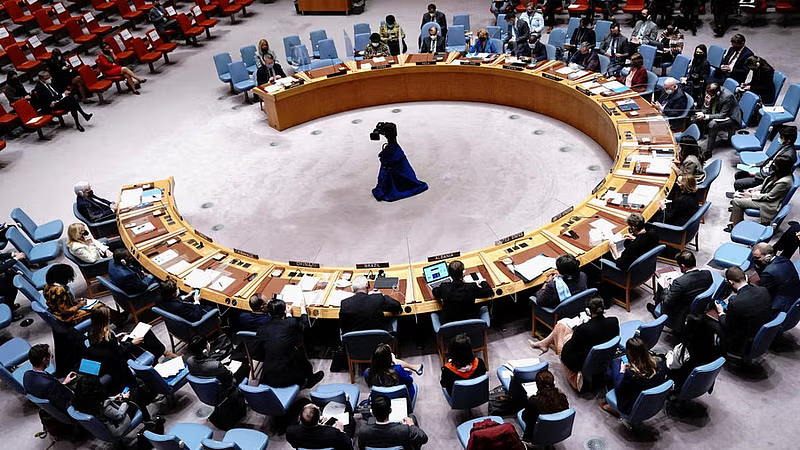
In the aftermath of the deadly Pahalgam terror attack on April 22, 2025, which claimed 26 lives, Indian officials have intensified their diplomatic push at the United Nations. In a significant development, Indian officials briefed the monitoring team of the UN Security Council’s (UNSC) 1267 Sanctions Committee on the activities of The Resistance Front (TRF), the Pakistan-based proxy of Lashkar-e-Taiba (LeT), responsible for the attack.
An Indian technical team has travelled to New York to engage with the monitoring team of the 1267 Sanctions Committee and other partner countries at the United Nations, according to sources familiar with the matter. As part of the visit, the team is also scheduled to meet representatives from the UN Office of Counter-Terrorism (UNOCT) and the Counter-Terrorism Committee Executive Directorate (CTED). The visit underscores India’s ongoing efforts to secure the designation of TRF as a global terrorist organisation.
The move follows India’s submission of a comprehensive dossier to the UNSC 1267 Sanctions Committee, highlighting new evidence linking Pakistan to cross-border terrorism through TRF. The dossier, meticulously prepared by Indian security agencies, includes intelligence reports, financial trails, and operational documents pointing to TRF’s involvement in the Pahalgam attack and its close ties with Pakistan’s Inter-Services Intelligence (ISI).
Background of the Pahalgam Attack and TRF’s Role
The Pahalgam terror attack, executed on April 22, 2025, in Jammu and Kashmir, was a brutal assault that killed 26 civilians and security personnel at a public gathering and security checkpoints. The attack, marked by the use of automatic rifles and improvised explosive devices (IEDs), was initially claimed by TRF, a group Indian officials describe as a “known front” for the UN-proscribed Lashkar-e-Taiba.
Foreign Secretary Vikram Misri noted, “TRF took responsibility for the April 22 Pahalgam terror attack twice before rolling back their statement… possibly at the behest of their handlers,” highlighting the group’s retraction as evidence of external influence from Pakistan.
TRF, formed in 2019 after the abrogation of Article 370, has positioned itself as a local resistance movement in Jammu and Kashmir.
However, investigations by the National Investigation Agency (NIA) and Indian intelligence agencies reveal that TRF operates as a covert wing of LeT, relying on its infrastructure, funding, and operational guidance from Pakistan’s Inter-Services Intelligence (ISI). “TRF is a front for Pakistan-based Lashkar-e-Taiba,” an official source confirmed, noting its involvement in planning, killings, and weapons smuggling in the region.
Operation Sindoor: A Decisive Response
In response to the Pahalgam attack, India launched Operation Sindoor on May 7, 2025, targeting nine terror hubs linked to TRF and LeT, including LeT’s headquarters in Muridke and facilities in Rawalpindi and Pakistan-occupied Kashmir (PoK).
Prime Minister Narendra Modi described the operation as “India’s new policy against terrorism and an unwavering pledge for justice,” emphasising that “trade and terror and talks and terror cannot go hand-in-hand.”
Pakistan retaliated with drone and missile attacks targeting Indian territories, including Jammu and Kashmir, Punjab, Haryana, and Rajasthan. However, India’s advanced air defence systems, including the indigenous Akashteer, Medium-Range Surface-to-Air Missile (MRSAM), and Russian-supplied S-400, intercepted all threats, preventing any significant damage.
“India’s response to the ‘barbaric’ Pahalgam terror attack was targeted, measured, and non-escalatory,” Foreign Secretary Vikram Misri said, underscoring the operation’s success in dismantling terror infrastructure. The four-day conflict culminated in a ceasefire on May 10, 2025, highlighting India’s military and technological superiority.
India’s Briefing at the UNSC 1267 Sanctions Committee
On May 15, 2025, an Indian technical team engaged with the Monitoring Team of the UNSC 1267 Sanctions Committee, the UN Office of Counter-Terrorism (UNOCT), and the Counter-Terrorism Committee Executive Directorate (CTED) in New York. The team presented a comprehensive dossier aimed at securing TRF’s designation as a global terrorist organisation under UNSC resolutions 1267 (1999), 1989 (2011), and 2253 (2015).
The dossier includes:
Intelligence Reports: Intercepted communications and eyewitness accounts detailing TRF’s planning and execution of the Pahalgam attack, with clear links to LeT and ISI handlers.
Financial Trails: Evidence of hawala networks and front organisations channelling funds from Pakistan to TRF operatives, as uncovered by the NIA.
Operational Documents: Records identifying TRF leaders, such as Sajid Jatt, Sheikh Sajjad Gul, and Salim Rehmani, and their connections to LeT’s terror ecosystem.
The Indian delegation, led by technical experts, also met with UN Under-Secretary-General for Counter-Terrorism Vladimir Voronkov and Assistant Secretary-General Natalia Gherman of CTED, reinforcing India’s call for sanctions, including asset freezes, travel bans, and arms embargoes on TRF members.
“Over the last two years or so, since 2023-24, we have been sharing information with the United Nations Security Council… as to why the terrorist TRF, which is the front for Lashkar-e-Taiba, should be listed as a terrorist entity,” Ministry of External Affairs spokesperson Randhir Jaiswal said, expressing hope that “the Security Council 1267 monitoring team will take strong note of what we present and file and take due action.”
Challenges and Geopolitical Hurdles
This marks India’s third attempt to designate TRF as a global terrorist organisation, with previous efforts in May and November 2024 blocked by China, often at Pakistan’s behest. “Pakistan has been shielding TRF at the UNSC through China,” a source noted, citing Pakistan’s success in removing TRF’s name from a UNSC statement condemning the Pahalgam attack on April 25, 2025.
Pakistan’s Foreign Minister Ishaq Dar admitted to pressuring the UNSC to omit TRF references, stating, “On behalf of Pakistan, I had two objections… the blame was put on The Resistance Forum,” revealing Islamabad’s efforts to protect the group.
Pakistan, a non-permanent UNSC member for 2025-2026, and China, a permanent member with veto power, have consistently opposed India’s proposals. “Pakistan, with support from China, has previously shielded TRF from UNSC condemnation,” sources confirmed, highlighting the geopolitical challenges India faces. Despite these obstacles, India’s latest dossier, described as containing “fresh evidence showing Pakistan’s backing for terror groups,” aims to sway the committee and isolate Pakistan diplomatically.
Pakistan’s Terror Nexus and TRF’s Operations
Pakistan’s strategy of using non-state actors to destabilise India has long involved LeT and its proxies like TRF. “Investigations had revealed the ‘communication nodes of terrorists in and to Pakistan,’” Misri stated, noting that LeT handles reposted TRF’s initial claims of responsibility for the Pahalgam attack. TRF, formed by merging smaller outfits like Tehreek-e-Millat Islamia and Ghaznavi Hind, operates under LeT’s umbrella, with leaders linked to ISI. The NIA’s probes have confirmed TRF’s involvement in targeted killings, grenade attacks, and ambushes in Kashmir, supported by Pakistan’s logistical and financial networks.
Strategic Significance and Global Implications
India’s push at the UNSC is both a legal and strategic manoeuvre to expose Pakistan’s role as a “terrorism epicentre,” as Misri described. By seeking TRF’s designation, India aims to impose global sanctions that would cripple the group’s operations and pressure Pakistan to dismantle its terror infrastructure.
“Pakistan must root out terrorism if it wants to survive,” Modi warned, highlighting the self-destructive nature of its terror sponsorship.
The briefing on May 15, 2025, marks the first time since Operation Sindoor that India has raised TRF’s activities with the UN’s anti-terror bodies. India’s consistent engagement, including briefings in December 2023 and 2024, underscores its commitment to counterterrorism.
“India had given inputs about TRF in the half-yearly report to the Monitoring Team… bringing out its role as a cover for Pakistan-based terrorist groups,” Misri noted. The success of this effort could set a precedent for sanctioning other LeT proxies and strengthen global counterterrorism frameworks.
The global community’s response will be critical. “The Indian Permanent Mission is also reaching out to UNSC members,” sources said, indicating a broader diplomatic campaign to garner support. Failure to act, however, risks emboldening terror networks and undermining regional stability, as India emphasised the “global implications of allowing such groups to operate unchecked.”
Strategically, India’s effort to designate TRF as a global terrorist organisation aims to diplomatically isolate Pakistan, exposing its nexus with terror outfits despite repeated denials. By reinforcing the narrative of Pakistan’s state-sponsored terrorism, India hopes to strengthen global consensus against allowing groups like TRF to operate unchecked.
India’s technical team in New York is expected to leverage these insights during meetings with international stakeholders, advocating for stringent sanctions on TRF, including asset freezes, travel bans, and arms embargoes. The outcome of these discussions will indicate whether the global community is prepared to hold Pakistan accountable for harbouring terror groups or continues to prioritise political alliances over counterterrorism commitments.