Ideological gap between Mahatma Gandhi and B R Ambedkar
August 23, 2026
  • Read Ecopy
  • Circulation
  • Advertise
  • Careers
  • About Us
  • Contact Us
Android AppiPhone AppArattai
Organiser
  • ‌
  • Bharat
    • Assam
    • Bihar
    • Chhattisgarh
    • Jharkhand
    • Maharashtra
    • View All States
  • World
    • Asia
    • Europe
    • North America
    • South America
    • Africa
    • Australia
  • Editorial
  • International
  • Opinion
  • RSS @ 100
  • More
    • Op Sindoor
    • Analysis
    • Sports
    • Defence
    • Politics
    • Business
    • Economy
    • Culture
    • Special Report
    • Sci & Tech
    • Entertainment
    • G20
    • Azadi Ka Amrit Mahotsav
    • Vocal4Local
    • Web Stories
    • Education
    • Employment
    • Books
    • Interviews
    • Travel
    • Law
    • Health
    • Obituary
  • Subscribe
    • Subscribe Print Edition
    • Subscribe Ecopy
    • Read Ecopy
  • ‌
  • Bharat
    • Assam
    • Bihar
    • Chhattisgarh
    • Jharkhand
    • Maharashtra
    • View All States
  • World
    • Asia
    • Europe
    • North America
    • South America
    • Africa
    • Australia
  • Editorial
  • International
  • Opinion
  • RSS @ 100
  • More
    • Op Sindoor
    • Analysis
    • Sports
    • Defence
    • Politics
    • Business
    • Economy
    • Culture
    • Special Report
    • Sci & Tech
    • Entertainment
    • G20
    • Azadi Ka Amrit Mahotsav
    • Vocal4Local
    • Web Stories
    • Education
    • Employment
    • Books
    • Interviews
    • Travel
    • Law
    • Health
    • Obituary
  • Subscribe
    • Subscribe Print Edition
    • Subscribe Ecopy
    • Read Ecopy
Organiser
  • Home
  • Bharat
  • World
  • Operation Sindoor
  • Editorial
  • Analysis
  • Opinion
  • Culture
  • Defence
  • International Edition
  • RSS @ 100
  • Magazine
  • Read Ecopy
Home Bharat

The ideological gap between Mahatma Gandhi and B R Ambedkar

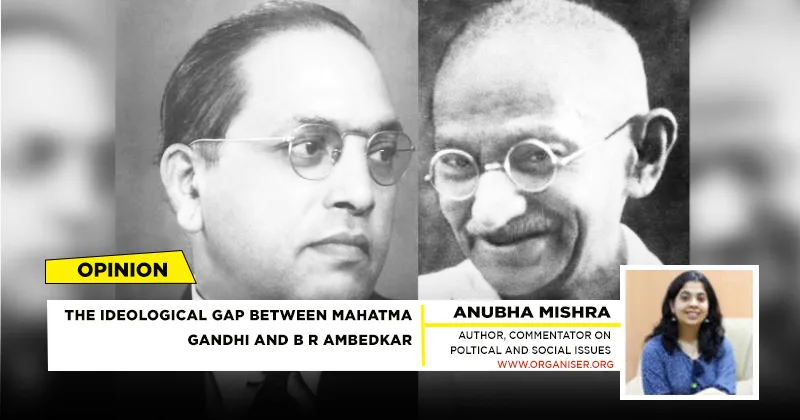
Despite their shared fight for India's independence, Mahatma Gandhi and Dr B R Ambedkar held fundamentally different ideologies on caste, governance, and social reform. Their contrasting visions shaped modern India in profoundly different ways

Anubha MishraAnubha Mishra
Apr 27, 2025, 05:00 pm IST
inBharat, Opinion
Follow on Google News
Facebook
Twitter
WhatsAppTelegramEmail

April 14 marks the birth anniversary of Dr Bhim Rao Ambedkar, affectionately known as Babasaheb Ambedkar, revered by his followers as a champion of justice and equality. Each year, this occasion is commemorated not only by government officials and politicians but also by countless admirers both within India and around the world. Dr Ambedkar’s legacy is deeply intertwined with the Constitution of India, which he played a pivotal role in drafting to secure the rights of marginalised communities.

Gandhi and Ambedkar both played important roles in India’s fight for independence and worked towards social justice, they had differing philosophies and approaches. Gandhi believed in non-violent resistance and civil disobedience, while Ambedkar advocated for a more aggressive approach to achieving social equality. Additionally, Gandhi focused on maintaining the caste hierarchy, while Ambedkar focused on the rights of Dalits and uplifting the other marginalised groups within Indian society.

At Gandhi’s invitation, Ambedkar first met him on August 14, 1931 at Mani Bhavan in Maharashtra. But Gandhi gave him a cold shoulder response and did not acknowledge his presence for a while. After some time, the dialogue began with Gandhi’s response to Ambedkar’s grievances against him and Congress regarding the problems of untouchables. He expressed his lack of faith in great leaders or Mahatma and was critical of Congress for its token recognition of untouchability and sincerity on the issue.

Furthermore, Gandhi believed that taking action was necessary to achieve one’s goals. He promoted nonviolent forms of political protest, such as civil disobedience and non-cooperation. He thought that these tactics could be effective in bringing about change. In contrast, Ambedkar believed that the Constitution could play a vital role in changing society by creating laws that would promote equality and fairness for all.

Gandhi is touted as a crusader of bringing self-reliance to the villages as he advocated for their autonomy and self-sufficiency. He thought that village autonomy would help ensure that all voices were heard equally and ultimately lead to the establishment of a harmonious traditional village community called Ram Raj. In contrast, Ambedkar criticised Gandhi’s ideas, claiming that they were the philosophy of the well-to-do and leisure class. He argued that local administration could lead to narrow-mindedness and communalism in villages and later could foster regionalism within states, and that autonomy could lead to bias and ultimately harm the freedom of others. He preferred a top-down model of administration with a strong central government. The urge for justice and equality turned Ambedkar towards urbanisation, modernity, and industrialisation, while Gandhi was critical of the idea of modernity.

Ambedkar was sceptical of Gandhi’s approach and the Congress’s sincerity in addressing untouchability.  He prioritised the self-respect and political empowerment of the Depressed Classes, and their ideological clash on untouchability ended without a resolution during the Second Round Table Conference in 1931. Notwithstanding Gandhi’s opposition, Dalit leaders continued to demand separate electorates for Dalits. Ambedkar went to London to lobby British cabinet members for it. Eventually, British Prime Minister Ramsay MacDonald announced the Communal Award of 1932 (also known as the MacDonald Award), which provided separate electorates for Depressed Classes along with other minorities including Muslims. Gandhi, imprisoned in Yerawada Jail in Poona, responded by announcing an indefinite fast until the provision of separate electorates for untouchables was revoked. Ambedkar had to concede to Gandhi’s “extreme form of coercion” and sign the Poona Pact on September 24, 1932. Madan Mohan Malviya signed on behalf of Gandhi. The pact replaced the separate electorate with reservations for the Depressed Classes. Following the pact, Gandhi broke his fast and proposed to establish the Anti-Untouchability League to continue the fight against untouchability. However, tensions between Gandhi and Ambedkar persisted, reflecting their fundamentally different approaches to caste and social reform.

The publication of Ambedkar’s Annihilation of Caste (1936) further angered Gandhi for its critique of caste-based discrimination. He responded by publishing two articles in his newspaper Harijan (11 and 18 July 1936) titled Dr Ambedkar’s Indictment. Gandhi accused Ambedkar of wanting publicity. Gandhi went to the extent of calling Ambedkar a ‘challenge to Hinduism’. Despite Gandhi’s sharp criticism, Annihilation of Caste remains a seminal text, reflecting Ambedkar’s disappointment with the Poona Pact.

In the 1937 edition of Annihilation of Caste, Ambedkar included Gandhi’s responses and provided a detailed reply. He clarified that his motive was not to seek publicity but to provoke Hindus to think. Gandhi and Ambedkar had contrasting views on the political systems as well. Gandhi was sceptical of parliamentary democracy and preferred a decentralised model of governance. He believed in the wisdom of the people and the need for a constitution suited to the Indian genius, free from external influences. Ambedkar supported a parliamentary system of government. He saw it as a way to ensure representation and protect the rights of all citizens. Ambedkar believed in the importance of a strong constitutional framework to safeguard individual liberties and promote social justice.

The standoff between Ambedkar and Gandhi continued on issues like conversion, village republic, and method of satyagraha. Ambedkar likened the caste-ridden Hindu society to ‘a multi-storeyed tower with no staircase and no entrance’, symbolising its hierarchical system. Hence, he wanted to leave Hinduism and declared in Nasik in 1935 that he would not die a Hindu. In 1956, he converted to Buddhism. The gap between the two had widened so much that in a 1955 BBC interview, Ambedkar said, “Gandhi was never a Mahatma; I refuse to call him a Mahatma.” Ambedkar also said that Gandhi was no reformer. “He was just an episode in the history of India, not an epoch maker,”
 

Topics: Dalit RightsPoona PactConstitution of IndiaMahatma GandhiAmbedkarIndian Independencecaste system
Share
Tweet
SendShareSend
✮ Subscribe Organiser YouTube Channel. ✮
✮ Join Organiser's WhatsApp channel for Nationalist views beyond the news. ✮
Previous News

Pakistan’s risky game of terrorism as statecraft is not just unethical but also a poor bet

Next News

Delhi: Hindu families protest, put ‘House for sale’ posters as Al-Mateen Mosque expansion sparks fear in Seelampur

Related News

Decolonising Bharat: From the mass movements that won Independence to the challenge of breaking colonial legacies

August 14 is observed as Partition Horrors Remembrance Day

From Crushing 1857 Jihad to Muslim Appeasement: British and Gandhi’s policies that helped partition India

Vice President hoisted the National Flag in Andaman & Nicobar and launched the Har Ghar Tiranga campaign

VP Radhakrishnan launches Har Ghar Tiranga in Andaman & Nicobar; Recalls how Netaji liberated island from British rule

Representative image (This is an AI generated image)

Ahmedabad Riots 1946: Revisiting Gandhi’s controversial “if few lakhs are killed’ remark

For the first time, NCERT adds Emergency to class 9 curriculum, highlights suspension of rights and democratic struggles

NCERT refutes claims of dropping preamble from class 9 textbook, says reports are misleading

Prime Minister Narendra Modi: A sincere effort to translate Gandhi’s philosophy of antyodaya into practice

Load More

Latest News

AIAPGET 2026 Disrupted in Jaipur; NTA Issues Notice to Eduquity (This image is generated by AI)

AIAPGET 2026: NTA suspends Eduquity after power failure disrupts exam at Jaipur centre; Show-cause notice served

MEA exposes Telangana CM Revanth Reddy real agenda of Telangana CM Revanth Reddy's visit to US. Stops him from visiting US

MEA exposes Telangana CM Revanth Reddy’s anti-Bharat agenda masked as ‘State Development’

(Left to Right) Congress MP and former Punjab chief minister Charanjit Singh Channi, Late former Congress leader Sajjan Kumar, Deepender Hooda

‘Mind your tongue’: Channi Vs Hooda clash over ‘role model’ praise for 1984 anti-Sikh riots perpetrator Sajjan Kumar

EAM Jaishankar(File Photo)

EAM Jaishankar decodes geopolitical reality with 3Cs; Outlines 4Ds as strategic solutions to fortify national security

Pakistan PM Shehbaz Sharif and Former PM Imran Khan

Pakistan: Contempt plea filed against PM Shehbaz Sharif & 2 ministers for defying Supreme Court order on Imran Khan

PM Modi’s Free Online Coaching Mission: A tool for digital inclusion and social mobility

Karnataka: Textbook crisis deepens as private school students forced to depend on photocopies months into academic year

Assam Cybercrime Shock: Rafiqul Alam, Chinese hacker nexus looted Rs 1,071 cr; Rs 16 crore routed to China via crypto

YogiConnectsUPJapanGenZ: Vasudhaiva Kutumbakam for a Selfie-Age Generation

CM Yogi Meets Gen Z: How an ascetic-politician is bridging Lucknow and Japan’s Yamanashi

Jadavpur University: When politics collides with a nationalist legacy

Load More
  • Privacy
  • Terms
  • Cookie Policy
  • Refund and Cancellation
  • Delivery and Shipping

© Bharat Prakashan (Delhi) Limited.
Tech-enabled by Ananthapuri Technologies

  • Home
  • Search Organiser
  • Bharat
    • Assam
    • Bihar
    • Chhattisgarh
    • Jharkhand
    • Maharashtra
    • View All States
  • World
    • Asia
    • Africa
    • North America
    • South America
    • Europe
    • Australia
  • Editorial
  • Operation Sindoor
  • Opinion
  • Analysis
  • Defence
  • Culture
  • Sports
  • Business
  • RSS @ 100
  • Entertainment
  • More ..
    • Sci & Tech
    • Vocal4Local
    • Special Report
    • Education
    • Employment
    • Books
    • Interviews
    • Travel
    • Health
    • Politics
    • Law
    • Economy
    • Obituary
  • Subscribe Magazine
  • Read Ecopy
  • Advertise
  • Circulation
  • Careers
  • About Us
  • Contact Us
  • Policies & Terms
    • Privacy Policy
    • Cookie Policy
    • Refund and Cancellation
    • Terms of Use

© Bharat Prakashan (Delhi) Limited.
Tech-enabled by Ananthapuri Technologies