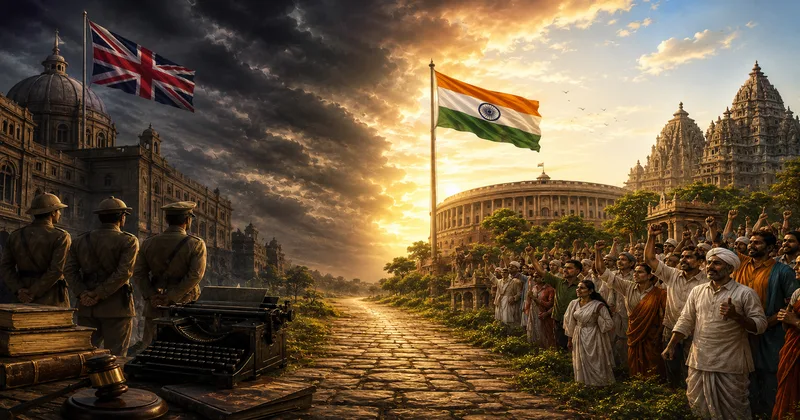
Bharat’s political independence in 1947 marked a moment that highlighted the enduring presence of colonial structures that continued to shape the newly sovereign nation.
Bharat’s Political Independence (1947): The Culmination of Mass Movements
Bharat’s political independence in 1947 was the culmination of decades of fervent nationalist struggle, characterised by a series of powerful mass movements that mobilised millions across the subcontinent.
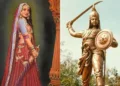
Revolutionary movements: Revolutionary movements against the British emerged across Bharat with fearless leaders from various regions. In Maharashtra, Vinayak Damodar Savarkar led armed resistance and founded Abhinav Bharat. Uttar Pradesh saw Chandrashekhar Azad and Ram Prasad Bismil in the Hindustan Socialist Republican Association (HSRA). Bengal produced Khudiram Bose, Prafulla Chaki, and Surya Sen, who carried out daring attacks on Britishers. Tamil Nadu had Vanchinathan, who assassinated British officials. Punjab witnessed Bhagat Singh, Udham Singh, and the Ghadar Party striking against British imperialism. These movements, united in sacrifice, ignited the spirit of independence nationwide.
Non-Cooperation Movement (1920-1922): Led by Mahatma Gandhi, this movement encouraged Indians to boycott British goods, institutions, and services. It significantly sparked political awareness among the masses, encouraging active participation in the struggle for independence. The movement strengthened national unity, led to the establishment of many Indian schools and colleges, and boosted Bharatiya industries like Khadi due to the boycott of British goods.
Civil Disobedience Movement (1930-1934): This movement, also spearheaded by Gandhi, involved nonviolent defiance of unjust colonial laws, most famously the Salt March. It aimed to attain swaraj (self-rule) and oppose discriminatory taxes. The movement inspired numerous acts of defiance, involved mass participation from citizens willing to risk arrest, and played a crucial role in shaping India’s quest for self-governance, exemplifying the power of nonviolent resistance. Although it did not achieve immediate independence, it impacted the Bharatiyas, strengthening their determination and shattering their faith in British rule’s legitimacy, laying groundwork for future struggles.
Quit India Movement (1942): Launched during World War II, this movement called for an immediate end to British rule. It marked a turning point, showcasing the determination, unity, and sacrifice of the Bharatiyas. Despite severe British repression, including mass arrests and violence, the movement led to widespread protests, strikes, and civil disobedience. It strengthened nationalist sentiments, united people across regions, saw significant participation from women and youth, and attracted international attention, ultimately compelling the British government to reevaluate its approach to Bharat and consider steps towards self-governance in the post-war period.
These movements, alongside other forms of resistance, culminated in the Indian Independence Act of 1947, which ended Crown suzerainty and partitioned British India into the Dominion of India and the Dominion of Pakistan. On January 26, 1950, the Constitution of India was adopted, formally establishing the Republic of India and laying the foundations for its democratic institutions.
Persistence of Colonial Structures
After independence, Communist-influenced leadership retained and expanded colonial-era structures in education, bureaucracy, and historiography to attack the ‘SWA of Bharat’. Controlling key institutions like the ICHR, universities, and textbook boards, they marginalised Hindu nationalist leaders and thinkers such as Savarkar, Sri Aurobindo, Bhagat Singh, Lala Lajpat Rai, and Subhash Chandra Bose, framing them through communal or sectarian lenses.
Adopting Eurocentric-Marxist frameworks, they reinforced colonial narratives on caste, communalism, and Western superiority, sidelining Bharat’s civilizational ethos. By retooling British historiographical biases, they shaped public memory and academic discourse to fit class-struggle narratives, weakening the cultural selfhood vision of many freedom fighters and delaying the intellectual decolonisation essential for a truly self-defined Bharat.
Bureaucratic Hierarchy: The Indian Civil Service, built for British imperial control, became the IAS post-independence, with British officers replaced by Indians by the 1950s. Though serving a democratic India, it retained its colonial bureaucratic framework, continuing administrative practices originally designed to govern in the interests of the British Crown.
English Dominance: Macaulay’s 1835 Minutes promoted English for colonial administration, sidelining traditional knowledge and vernaculars, and creating a Westernised elite. Post-1947, English persisted in higher education, governance, and law as a unifying link language. Laws, courts, and legal education remained English-centric, despite initiatives to promote Hindi, Tamil and regional languages.
Colonial Legal Codes: The Indian legal system largely mimicked British common law, retaining outdated laws like sedition, which were originally used to suppress freedom fighters. Special laws pertaining to tribal areas, which exempted certain groups from general civil and criminal jurisdiction and placed them under direct British control, also persisted. This continuity meant that the very structure of the state often operated within a colonial frame, governed by laws designed for imperial control rather than civilizational flourishing.
Education System: The education system remained largely shackled to the colonial blueprint, designed to produce clerks and administrators rather than empower Indians. Textbooks often glorified British ‘reforms’ while downplaying Bharat’s civilizational achievements, ignoring or caricaturing ancient sciences, spiritual philosophies, and alternative epistemologies. This led to cultural alienation, where English-educated Indians often felt distanced from their own traditions and languages, fostering a sense of inferiority and a loss of cultural identity.