Ideological gap between Mahatma Gandhi and B R Ambedkar
June 21, 2026
  • Read Ecopy
  • Circulation
  • Advertise
  • Careers
  • About Us
  • Contact Us
Android AppiPhone AppArattai
Organiser
  • ‌
  • Bharat
    • Assam
    • Bihar
    • Chhattisgarh
    • Jharkhand
    • Maharashtra
    • View All States
  • World
    • Asia
    • Europe
    • North America
    • South America
    • Africa
    • Australia
  • Editorial
  • International
  • Opinion
  • RSS @ 100
  • More
    • Op Sindoor
    • Analysis
    • Sports
    • Defence
    • Politics
    • Business
    • Economy
    • Culture
    • Special Report
    • Sci & Tech
    • Entertainment
    • G20
    • Azadi Ka Amrit Mahotsav
    • Vocal4Local
    • Web Stories
    • Education
    • Employment
    • Books
    • Interviews
    • Travel
    • Law
    • Health
    • Obituary
  • Subscribe
    • Subscribe Print Edition
    • Subscribe Ecopy
    • Read Ecopy
  • ‌
  • Bharat
    • Assam
    • Bihar
    • Chhattisgarh
    • Jharkhand
    • Maharashtra
    • View All States
  • World
    • Asia
    • Europe
    • North America
    • South America
    • Africa
    • Australia
  • Editorial
  • International
  • Opinion
  • RSS @ 100
  • More
    • Op Sindoor
    • Analysis
    • Sports
    • Defence
    • Politics
    • Business
    • Economy
    • Culture
    • Special Report
    • Sci & Tech
    • Entertainment
    • G20
    • Azadi Ka Amrit Mahotsav
    • Vocal4Local
    • Web Stories
    • Education
    • Employment
    • Books
    • Interviews
    • Travel
    • Law
    • Health
    • Obituary
  • Subscribe
    • Subscribe Print Edition
    • Subscribe Ecopy
    • Read Ecopy
Organiser
  • Home
  • Bharat
  • World
  • Operation Sindoor
  • Editorial
  • Analysis
  • Opinion
  • Culture
  • Defence
  • International Edition
  • RSS @ 100
  • Magazine
  • Read Ecopy
Home Bharat

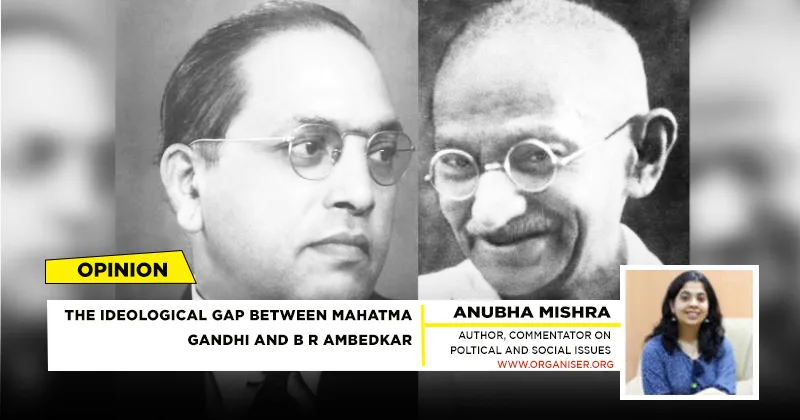
The ideological gap between Mahatma Gandhi and B R Ambedkar

Despite their shared fight for India's independence, Mahatma Gandhi and Dr B R Ambedkar held fundamentally different ideologies on caste, governance, and social reform. Their contrasting visions shaped modern India in profoundly different ways

Anubha MishraAnubha Mishra
Apr 27, 2025, 05:00 pm IST
in Bharat, Opinion
Follow on Google News
FacebookTwitterWhatsAppTelegramEmail

April 14 marks the birth anniversary of Dr Bhim Rao Ambedkar, affectionately known as Babasaheb Ambedkar, revered by his followers as a champion of justice and equality. Each year, this occasion is commemorated not only by government officials and politicians but also by countless admirers both within India and around the world. Dr Ambedkar’s legacy is deeply intertwined with the Constitution of India, which he played a pivotal role in drafting to secure the rights of marginalised communities.

Gandhi and Ambedkar both played important roles in India’s fight for independence and worked towards social justice, they had differing philosophies and approaches. Gandhi believed in non-violent resistance and civil disobedience, while Ambedkar advocated for a more aggressive approach to achieving social equality. Additionally, Gandhi focused on maintaining the caste hierarchy, while Ambedkar focused on the rights of Dalits and uplifting the other marginalised groups within Indian society.

At Gandhi’s invitation, Ambedkar first met him on August 14, 1931 at Mani Bhavan in Maharashtra. But Gandhi gave him a cold shoulder response and did not acknowledge his presence for a while. After some time, the dialogue began with Gandhi’s response to Ambedkar’s grievances against him and Congress regarding the problems of untouchables. He expressed his lack of faith in great leaders or Mahatma and was critical of Congress for its token recognition of untouchability and sincerity on the issue.

Furthermore, Gandhi believed that taking action was necessary to achieve one’s goals. He promoted nonviolent forms of political protest, such as civil disobedience and non-cooperation. He thought that these tactics could be effective in bringing about change. In contrast, Ambedkar believed that the Constitution could play a vital role in changing society by creating laws that would promote equality and fairness for all.

Gandhi is touted as a crusader of bringing self-reliance to the villages as he advocated for their autonomy and self-sufficiency. He thought that village autonomy would help ensure that all voices were heard equally and ultimately lead to the establishment of a harmonious traditional village community called Ram Raj. In contrast, Ambedkar criticised Gandhi’s ideas, claiming that they were the philosophy of the well-to-do and leisure class. He argued that local administration could lead to narrow-mindedness and communalism in villages and later could foster regionalism within states, and that autonomy could lead to bias and ultimately harm the freedom of others. He preferred a top-down model of administration with a strong central government. The urge for justice and equality turned Ambedkar towards urbanisation, modernity, and industrialisation, while Gandhi was critical of the idea of modernity.

Ambedkar was sceptical of Gandhi’s approach and the Congress’s sincerity in addressing untouchability.  He prioritised the self-respect and political empowerment of the Depressed Classes, and their ideological clash on untouchability ended without a resolution during the Second Round Table Conference in 1931. Notwithstanding Gandhi’s opposition, Dalit leaders continued to demand separate electorates for Dalits. Ambedkar went to London to lobby British cabinet members for it. Eventually, British Prime Minister Ramsay MacDonald announced the Communal Award of 1932 (also known as the MacDonald Award), which provided separate electorates for Depressed Classes along with other minorities including Muslims. Gandhi, imprisoned in Yerawada Jail in Poona, responded by announcing an indefinite fast until the provision of separate electorates for untouchables was revoked. Ambedkar had to concede to Gandhi’s “extreme form of coercion” and sign the Poona Pact on September 24, 1932. Madan Mohan Malviya signed on behalf of Gandhi. The pact replaced the separate electorate with reservations for the Depressed Classes. Following the pact, Gandhi broke his fast and proposed to establish the Anti-Untouchability League to continue the fight against untouchability. However, tensions between Gandhi and Ambedkar persisted, reflecting their fundamentally different approaches to caste and social reform.

The publication of Ambedkar’s Annihilation of Caste (1936) further angered Gandhi for its critique of caste-based discrimination. He responded by publishing two articles in his newspaper Harijan (11 and 18 July 1936) titled Dr Ambedkar’s Indictment. Gandhi accused Ambedkar of wanting publicity. Gandhi went to the extent of calling Ambedkar a ‘challenge to Hinduism’. Despite Gandhi’s sharp criticism, Annihilation of Caste remains a seminal text, reflecting Ambedkar’s disappointment with the Poona Pact.

In the 1937 edition of Annihilation of Caste, Ambedkar included Gandhi’s responses and provided a detailed reply. He clarified that his motive was not to seek publicity but to provoke Hindus to think. Gandhi and Ambedkar had contrasting views on the political systems as well. Gandhi was sceptical of parliamentary democracy and preferred a decentralised model of governance. He believed in the wisdom of the people and the need for a constitution suited to the Indian genius, free from external influences. Ambedkar supported a parliamentary system of government. He saw it as a way to ensure representation and protect the rights of all citizens. Ambedkar believed in the importance of a strong constitutional framework to safeguard individual liberties and promote social justice.

The standoff between Ambedkar and Gandhi continued on issues like conversion, village republic, and method of satyagraha. Ambedkar likened the caste-ridden Hindu society to ‘a multi-storeyed tower with no staircase and no entrance’, symbolising its hierarchical system. Hence, he wanted to leave Hinduism and declared in Nasik in 1935 that he would not die a Hindu. In 1956, he converted to Buddhism. The gap between the two had widened so much that in a 1955 BBC interview, Ambedkar said, “Gandhi was never a Mahatma; I refuse to call him a Mahatma.” Ambedkar also said that Gandhi was no reformer. “He was just an episode in the history of India, not an epoch maker,”
 

Topics: Poona PactConstitution of IndiaMahatma GandhiAmbedkarIndian Independencecaste systemDalit Rights
ShareTweetSendShareSend
✮ Subscribe Organiser YouTube Channel. ✮
✮ Join Organiser's WhatsApp channel for Nationalist views beyond the news. ✮
Previous News

Pakistan’s risky game of terrorism as statecraft is not just unethical but also a poor bet

Next News

Delhi: Hindu families protest, put ‘House for sale’ posters as Al-Mateen Mosque expansion sparks fear in Seelampur

Related News

More than 1,000 temple trustees and Hindu organisations across Maharashtra have opposed the proposed Act, alleging it threatens temple land rights and traditional religious institutions. In this regard, a memorandum was submitted to Maharashtra CM Devendra Fadnavis on May 15 by Maharashtra Mandir Mahasangh

Maharashtra Devasthan Inams Abolition Draft Act, 2026: Not just ‘Inam’, but sacred heritage

Ravan Wants Separate Electorate, But didn’t Ambedkar reject it?

Separate electorate for Dalits: What would Ambedkar say to Chandra Shekhar Ravan today?

National anti-conversion law demand sparks debate on rights & social harmony

Growing demand for a strict national anti-conversion law sparks debate on constitutional rights & social harmony

Dr Ambedkar: The architect who prevented India from becoming a communist state

The soldiers surrounded the garden and started firing on unarmed people without giving any warning and a total of 1650 rounds were fired in 10 minutes

Anniversary of Jallianwala Bagh Massacre: From bloodshed to national awakening; Turning point in freedom struggle

Why Maharashtra’s Freedom of Religion Bill strengthens, not restricts liberty

Load More

Latest News

Kaushik Ashram of RSS helps fulfil duty towards senior citizens: Bhayyaji Joshi

‘Kaushik Ashram’ of RSS is a home for the seniors, a medium for us to fulfil our duties towards them: Bhayyaji Joshi

Two Years of Odisha Govt: Rs 47,600 crore projects launched; President Murmu highlights inclusive development

Two Years of Odisha Govt: Rs 47,600 crore projects launched; President Murmu highlights inclusive development

Tamil Nadu Chief Minister Joseph Vijay in the Legislative Assembly

Tamil Nadu: CM Vijay seeks Centre’s intervention on Mekedatu dam, avoids confrontation with Congress ally in Karnataka

7 killed and 3 injured in a twin blast at Khyber Pakhtunkhwa

Pakistan: 7 killed, 3 injured in twin blasts in Wazir sub-division of Khyber Pakhtunkhwa

The wisdom of sattvik food: Nourishing inner balance

Uniform Civil Code (UCC): A step towards ensuring equality, justice & national integration

Illegal Bangladeshi migrants detained by Assam Police

Assam: Police detain 14 suspected Bangladeshi infiltrators from Guwahati lodge in a verification drive

BJP Keralam State president Rajeev Chandrasekhar; Keralam CM VD V D Satheesan (Left to Right)

BJP Keralam calls VD Satheesan’s first Budget a mockery of the poor, says ‘Indira Guarantee’ promises ignored

UK grooming gang has 95% Pakistani Muslim men; Did media, govt & civil society conceal it fearing Islamophobic label?

The Political Winter of Pakistan occupied Jammu & Kashmir – A Crisis of Oppression and Global Apathy

Load More
  • Privacy
  • Terms
  • Cookie Policy
  • Refund and Cancellation
  • Delivery and Shipping

© Bharat Prakashan (Delhi) Limited.
Tech-enabled by Ananthapuri Technologies

  • Home
  • Search Organiser
  • Bharat
    • Assam
    • Bihar
    • Chhattisgarh
    • Jharkhand
    • Maharashtra
    • View All States
  • World
    • Asia
    • Africa
    • North America
    • South America
    • Europe
    • Australia
  • Editorial
  • Operation Sindoor
  • Opinion
  • Analysis
  • Defence
  • Culture
  • Sports
  • Business
  • RSS @ 100
  • Entertainment
  • More ..
    • Sci & Tech
    • Vocal4Local
    • Special Report
    • Education
    • Employment
    • Books
    • Interviews
    • Travel
    • Health
    • Politics
    • Law
    • Economy
    • Obituary
  • Subscribe Magazine
  • Read Ecopy
  • Advertise
  • Circulation
  • Careers
  • About Us
  • Contact Us
  • Policies & Terms
    • Privacy Policy
    • Cookie Policy
    • Refund and Cancellation
    • Terms of Use

© Bharat Prakashan (Delhi) Limited.
Tech-enabled by Ananthapuri Technologies