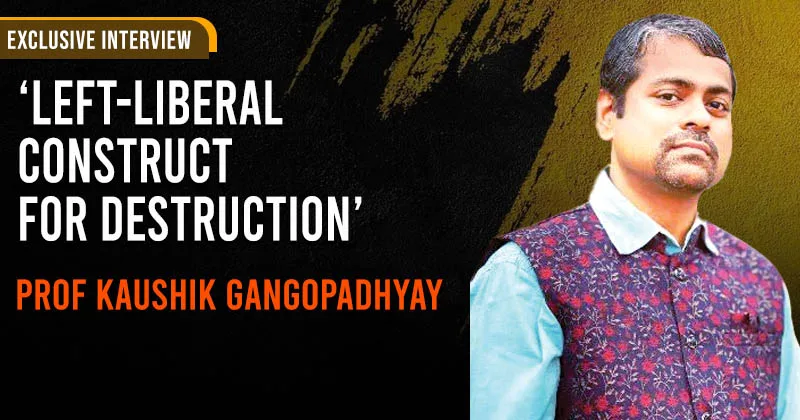
Left Social Sciences are neither scientific, nor do they facilitate social welfare. A book “The Majoritarian Myth” is an attempt to give a direction to the academic world for starting a scientific discourse for society based on conservative dharmic understanding that has evolved over the ages, says Prof Kausik Gangopadhyay to Pradeep Krishnan
What prompted you to write this book?
I was a student of Science, who later shifted to Social Science because I had a fascination for explaining the reality using scientific ideas. Over time, I discovered that many of the ideas in the so-called Social Sciences are neither scientific, nor do they facilitate social welfare. Rather, they merely cater to a dogma. Nowadays, this fact has become quite apparent to many thoughtful people — The Harvard University defends the calls for genocide in its campus in the name of freedom of expression, while it routinely disallows people from giving a speech over a speaker’s refusal to call a biologically male person a female and vice versa! There may not be any better example of demonstrating how unreal the academic world has become in the absence of scientific ideas.
I became aware of all these developments many years ago and decided to study the issue deeply to understand their deficiencies. I have chosen to highlight those deficiencies with some social theories severely affecting the educated Indian mind. My other reason for writing this book is to offer a direction to the academic world for starting a scientific discourse for society based on conservative dharmic understanding that has evolved over the ages… India should invest in this project of mine if we want to see it becoming the knowledge capital of the world.
Please explain the theory of Linear Theory of Social Evolution (LTSE) so that a common reader can understand it.
A persistent social intolerance happens in society not because there are some intolerant people out there. In our Indic civilisational understanding, we say Sarvam Khalvidam Brahma (सर्वं खल्विदं ब्रह्म) which means the cosmological conscience is within all of us. This is the reason that common people do not approve of any persistent intolerance when they go by their own experiential understanding. The problem occurs when the acts of intolerance enjoy the support of a social theory. I have defined these social theories as Linear Theory of Social Evolution (LTSE) which justifies intolerance in the interest of spreading their theory alone. To the adherents of these theories, these represent morality over their own inner understandings.
An LTSE has two characteristics. First, it cannot be changed by any amount of data. Once this theory has been posited, it remains valid for all the time, irrespective of actual human experience. It is like people deny the fact that the earth revolves around the sun even after observing this phenomenon from satellites. Second, LTSE believes in differentiating between different human beings based on their belief in that particular LTSE not based on their actual action or karma (कर्म).
Why do you say that Indian Constitution, judiciary and political system are more favourably disposed towards minorities as compared to Hindus?
First and foremost, if the Indian Constitution’s bias against the Hindus helped create a better society, I would have nothing against it. My argument is that the belief in the theory of majoritarianism by the Indian Constitution, in particular, and by the Indian political system in general, goes against the Indic civilisation. This belief creates a rootless society and is detrimental for creating good social values.
The Indian Constitution has some clauses that are against the Indian civilisational values of promoting tolerance. For example, Article 25 of the Indian Constitution offers the right to propagate religion. This is completely against the Gandhian idea of celebrating own tradition and making it more and more beautiful rather than intruding into others. It does not promote, at all, the idea of respect for others’ culture, as the proselytisers feel that others should be won for their imperial cultural agenda.
In India, we don’t believe in application of force – either to impose our culture on others, or to stop the inevitability of reform as a reaction, to growing human experience. In case we want to allow people explicitly to join another religion, we can very well do so just like the Greek Constitution does – it allows the right to practice but not to propagate. Similarly, Articles 28 and 30 of the Indian Constitution do not allow the Indic texts to be taught as knowledge but at the same time allows non-Hindu religions to teach their texts in their schools. This creates gross illiteracy about civilisational values in the minds of the young Indians.
The judiciary considers anything that is not an essential religious practice, as something in the secular domain. Religions that have originated outside India, believe in some holy scripture. Their religious practices originate from that scripture and are deemed as essential religious practices by the Indian Judiciary. The judiciary cannot impose their secular ideas on their religious practices. However, the Indian traditions do not stem from any scripture or book but are a continuation of our thousands-year-old traditions wherein people decide collectively what to celebrate, how to celebrate and when to celebrate. The Judiciary deems these as non-essential and curb these celebrations by imposing their secular understanding and values.
Ramachandra Guha has objected to naming any road in New Delhi by the name of Shivaji as it is an act of majoritarianism, as per his secular liberal understanding. This is ridiculous as Rabindranath Tagore was effusive about Shivaji for upholding our civilisational values. This shows how secular liberal values want to create a rootless and ignorant society In India
Their secular values stem from the Western ideas and are often without any understanding of our civilisational ethos. For example, Ramachandra Guha has objected to naming any road in New Delhi by the name of Shivaji as it is an act of majoritarianism, as per his secular liberal understanding. This is ridiculous as Rabindranath Tagore was effusive about Shivaji for upholding our civilisational values. This shows how secular liberal values want to create a rootless and ignorant society In India.
What are your observations on the recent happenings in Bangladesh?
To understand the happenings in Bangladesh, we need to understand the dynamics of the socio-political reality of that country. In a way, the formation of Bangladesh was an explicit rejection of political Islam that created Pakistan. The Bangladeshi population emphasised their Bengali identity out of the confines of the LTSE called political Islam. That rejection was definitely a shock to that LTSE but in today’s era of globalisation, no region is immune from an idea, nor can one locally banish an idea completely. Political Islam is a vibrant idea globally. Now, the rulers of Bangladesh were not exactly Kemal Atatürks who had waged a war on political Islam in Turkey. They chose the convenient path of seeking a middle ground and gradually left education and lower polity to Islamists. The Frankenstein of today was created by them many years ago. Today, that Frankenstein has become powerful enough to engulf them. The Bangladeshi peoples’ belief that the elections were rigged didn’t help either. The recent events in Bangladesh actually offer us a valuable lesson that the middle path between tolerance and intolerance does not lead to tolerance but to more and more intolerance.
You say that in traditional India the alien faiths gradually became traditionalised which transitioned them from intolerance to tolerance. What caused this process to stop?
The idea of Bharat was to make everyone a part of the same big family of civilisational virtues through the transmission of our values over generations. The primary requirement for an environment conducive to the reform of the intolerant is their defeat.
The idea of Bharat was to make everyone a part of the same big family of civilisational virtues through the transmission of our values over generations. The primary requirement for an environment conducive to the reform of the intolerant is their defeat
Why do I say so? The intolerant believers in an LTSE would never outgrow their intolerant dogma without a lesson from the reality that they are compelled to accept. They must have the experience of a decisive defeat of their LTSE which is the only thing that would prompt them to rethink and reform themselves. Bharat used to have visionary philosopher-kings during the times of her civilisational glory. Our rulers used to sacrifice themselves against those barbaric intolerant people to defeat them and then reform them. To give you an example: King Skandagupta spent 12 years of his life in the frontier provinces fighting Huns so as to keep Indians safe from barbarism. However, in the last millennia we have lost to the barbaric forces one after the other, without a single decisive military victory. In the Modern age, battles happen more at the thought level in the educational and media platforms. We have not ever formulated our long-term strategy to defeat them – we have merely been reactive to their stratagem. So long as the intolerant keep on winning, they have no real reason to shun intolerance.
What, according to you, are the dangers of modern liberalism?
I shall explain it with an example. Today we all are concerned about the disturbing phenomenon of extreme political polarisation. It is happening in India. Left liberals are blaming Hindus for their majoritarianism. Just for a moment, let us assume that to be exactly the case. It may mean that without the Hindu majoritarianism, there is no polarisation. But look at the United States, a country without Hindus, we find even more polarisation there than in India. The Left liberals would blame it on Christian conservatism (or something like that), even though diminishing Christian orthodoxy could never explain growing majoritarianism there. Let us again, assume it to be true. We could again find yet another country plagued by majoritarianism. It is the Netherlands where most of the people are atheists, neither Christians nor Hindus. So, what is common among all these countries? It is the dominance of liberalism within a significant part of the elite. This clearly shows that the root of intolerance and polarisation lies in liberalism. Strangely, it is the liberals who gaslight others for being intolerant. Left-liberalism is a very dangerous phenomenon that creates quite a bigoted world in the veil of jugglery of words.
Even the word liberalism doesn’t mean any broadmindedness, at all. It is a self-praise of being broadminded while being completely intolerant to any difference in opinion. Australian researcher James P Casey and his co-authors have found that conservatives consistently showed more empathy to liberals than liberals showed to conservatives. They have documented it in their paper published in a peer-reviewed journal called Personality and Social Psychology Bulletin in 2023, titled Empathic Conservatives and Moralizing Liberals: Political Intergroup Empathy Varies by Political Ideology and Is Explained by Moral Judgment. Obviously, the label liberal is simply an instrument of gaslighting others so as to dominate them.
How can we make Bharat a vibrant dharmic State?
Dharma is nothing but a sustainable socio-political policy by the etymology of the word. The West has attempted to create an ethical society by relegating religion out of the public life and developing secular codes. They have done so as they have found that the imperialistic ambitions in their religious ideas are responsible for unethical collective life.