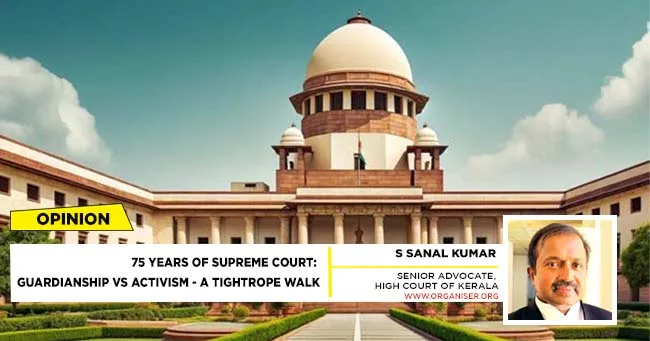
The Regulating Act 1773 is memorable for Indians for bringing to familiarity the judicial establishment of `Supreme Court’ and the office of `Chief Justice’. Sir Elijah Impey was the first Chief Justice of Supreme Court at Fort Williams at Calcutta, established in 1774 – from where our judicial establishment travelled through the Chartered High Courts established under the High Courts Act 1861 followed by Federal Court under Government of India Act, 1935, the immediate precursor to the present Supreme Court. Under Article 124 of the Constitution of India, the Supreme Court came into being on January 26, 1950. The working of the Supreme Court with HJ Kania at the helm of affairs to Justice DY Chadrachud, lays down a path of steady development of constitutional jurisprudence, though, at times, breaking the principle of separation of powers. Judicial activism, when actuated by culpable administrative inertia and legislative vacuum, is the appreciable distinction earned by the Apex Court of the country in its evolutionary process.
Judiciary, Legislature & Executive in Tandem
Shankari Prasad Vrs. Union of India (AIR 1951 SC 458) came as the first test before the Supreme Court of India for expression of its reformist attitude which the Constitution of India looked forward to. The First Amendment to the Constitution of India, which restricted the Fundamental Right to Property, was subject to judicial review. While upholding the amendment, the Supreme Court held that the Parliament had the power to amend any part of the Constitution and a Constitutional Amendment was not a ‘law’ as defined under Article 13 of the Constitution. The reforms envisioned in the Preamble to the Constitution by setting goals like `justice-social, economic and political’, when undertaken by the political executive, were supported by the judiciary. A perfect camaraderie existed between the three wings of State. When arguments like Fundamental Rights cannot be altered or amended under Article 368 was raised in Sajjan Singh Vs. State of Rajasthan, wherein a challenge to Constitution Amendment of Article 31A was mounted, the Supreme Court stood firmly with the Executive. Of course, the dissenting judgements of Justice Mudholkar and Hidayatulla are praiseworthy for its nuanced constitutional philosophy on Fundamental Rights in preference to collective community rights.
Judiciary in Conflict with Executive
IC Golaknath Vs. State of Punjab (AIR 1967 SC 1643) presented a terrain for the Supreme Court to assert its arbiter’s role in the interpretation of the Constitution, unmindful of the likings of the Executive. An 11-judge Constitutional bench was constituted to adjudicate the constitutional validity of law on ceiling limits of land tenures, when the same was questioned on the premise of violation of Article 14 and Article 19(1)(g). In a ratio of 6:5, the Supreme Court held that Fundamental Rights cannot be amended by a Constitution amendment. The shake and sour in relations between judiciary and executive became strained with this pronouncement. Following this judgement, the Constitution’s 24th amendment was passed to nullify the effect of the judgement in the Golaknath case. The unlimited power of Parliament to amend the Constitution declared in 24th Amendment was put to judicial scrutiny in the Kesavananda Bharati case. The `Basic Structure’ which has its source in the Constitutions of France, Germany, Greece and Portugal was formulated in Kesavanada Bharati by the apex court, in a veiled assertion of judicial supremacy and also as an armistice for peacemaking between two wings. While recognising the amending power of the Parliament, Kesavananda Bharati case declared that the basic structure of the Constitution cannot be touched in the amending process. Indira Nehru Vs. Raj Narain (AIR 1975 SC 2299) showcased the valour of the Supreme Court, when it set aside the 39th Constitution Amendment providing for ‘no-challenge’ to the elections of President, Vice President and Prime Minister on the ground that free and fair elections are part of basic structure of the Constitution. Minerva Mills Ltd. Vs. Union of India (1980 AIR SC 1789), where 42nd Amendment which essentially excluded Constitution amendments from the purview of judicial review was struck down as unconstitutional for it offended one of the basic features, namely judicial review. The war of words and swords continued up to the `Judges Appointment Cases’ and the evolution of the collegium system.
The Overreach
The Judges’ Transfer Case, (SP Gupta Vs. Union of India AIR 1982 SC 149) heralded the tug of war between the Union of India and the Supreme Court in the matter of appointment and transfer of judges of constitutional courts. The case was decided in the wake of Indira Gandhi coming back to power with a huge majority in the General Elections held in January 1980. Mrs Gandhi, who lost the 1977 General Elections, to which the verdicts of the Supreme Courts rendered in her election cases contributed in no less a way, was revengeful in her exercise of powers. The Judge’s Transfer Case was decided to the liking of the Executive, ceding primacy to it in the process. The period after 1989, from where India witnessed minority governments and coalition governments till 2014, marked the era of political instability. The Executive became frail and weak. When the Jain Hawala scam broke out, all top leaders cutting across political lines, stood in the dock losing moral grounds. An emboldened judiciary coined the `Collegium System’ through the three Judges Appointment Cases, thus holding full sway over appointment of judges.
IC Golaknath Vs. State of Punjab (AIR 1967 SC 1643) presented a terrain for the sc to assert its arbiter’s role in the interpretation of the Constitution, unmindful of the likings of the Executive
Continued Sway of Judiciary
The 99th Constitutional Amendment tried to put in place a National Judicial Appointments Commission for appointment of judges. The 99th Constitutional Amendment was passed with near unanimity. The State Legislatures ratified the amendment. The 99th Constitutional Amendment essentially reflected the `Collective will of the People’. When Parliament and legislatures of States joined together in 99th Constitutional Amendment, it could be likened to a re-enactment of Constituent Assembly re-incarnating to fill a lacunae in the Constitution. Sadly, the basic structure doctrine killed it in limbo- the event now raises the clamour for revisiting `basic structure doctrine’.
Examining Basic Structure & Overreach
Now any and everything done by the Executive can be subject to judicial scrutiny in the name of basic structure theory. The subjective bias of a judge plays the crucial role in brandishing the weapon of basic structure to stall legislative actions. Close and soulful reading of Preamble to the Constitution conveys the message of the Constitution. It is the people of India who have given unto themselves the Constitution of India – a holy document containing rules of governance to achieve the goals set out in the Preamble. The Constituent Assembly was formed with elected members from provincial assemblies and nominated members from Princely States, representing the people of India. Now the people of India are represented in the legislatures, both Union and State legislatures. A democratic understanding of Preamble and visualisation of its contents depict the image of sovereign – it is the people of India , with whom sovereignty lies. Primacy of Parliament and legislatures is also the basic feature of the Constitution, if construed on this logical framework.
The role played by the apex court as protector of Fundamental Rights is unmatchable till today. But the days ahead are challenging
Recent trends in adjudications reflect a sort of overreach shaking the political formula of separation of powers. By making it mandatory to play the National Anthem in all movie theaters before the start of show was a classic instance of overreach, the directive even went against Prevention of Insults to National Honours Act, 1971. Solemnity tried to be protected by the Act was breached with this unusual diktat. The banning of liquor sales within a distance of 500 meters from National Highway or State Highways is another adventurism of overreach resulting in huge revenue loss to Government. Overstepping the boundaries of power balancing was the judgement in selection of Election Commissioner, where the Chief Justice of India was made a member of a search committee. It was widely criticised as over activism. The stay of S.124 A of IPC in defiance to the Constitution Bench’s decision in Kedarnath Singh’s case and Farm Laws becomes instances of overreach where known principles of constitutional philosophy fails to explain its logic.
The inherent dangers of overreach is the undermining of separation of powers upon which constitutional democracy thrives. By arrogating to itself the executive and legislative powers, the constitutional courts, especially the Supreme Court, burden itself with more responsibilities when it is fighting hard to tackle the docket explosion. The lack of expertise in the intricate areas of administration makes the judgements flawed when put in a practical scenario. The judicial overreach in formulating or prescribing policies of Government is amounting to assuming the role of Executive by the judiciary itself, which eventually results in executive actions undertaken by judiciary becoming final without challenge. An overview of the functioning and performance of the Supreme Court during the last 75 years, of course, satisfies its role as sentinel on the qui vive. The role played by the apex court as protector of Fundamental Rights is unmatchable till today. But the days ahead are challenging. An era of intricate interpretations would become inevitable when laws on digital space are challenged before courts in the light of newer notions of Fundamental Rights emerging along with. Sure that the coming generations of lawyers and judges are equipped to take up the challenges to lead the march on. More grandeur and splendour of our apex court would shine in the horizon of jurisprudence in the coming days, paying a big obeisance to the highest
Temple of Justice.