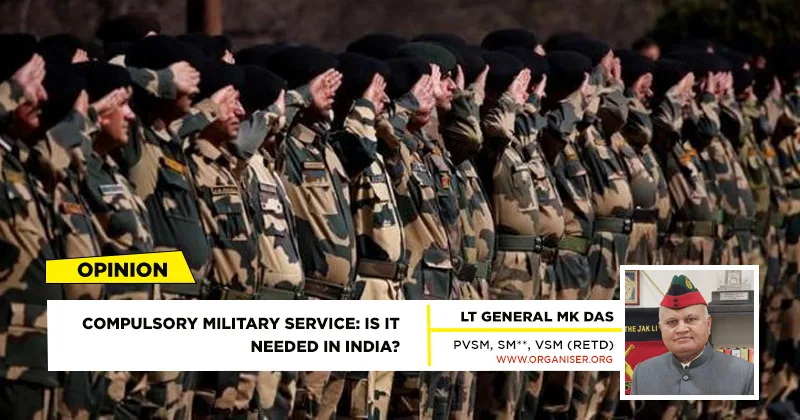
“Every citizen should be a soldier. This was the case with the Greeks and Romans, and must be that of every free state.” – Thomas Jefferson, third US President
Recently, there was a news about hundreds of ultra-Orthodox Jewish men protesting against Israel Supreme Court ruling ordering young religious men to enlist for military service. Military service is compulsory for most Jewish men and women in Israel. There is some exemption for politically powerful ultra- Orthodox followers under the excuse of study in the religious seminaries.
Compulsory military service often is called Conscription which is state-mandated enlistment of people in a national service, mainly a military service. The present form of conscription dates back to the French Revolution of 1790s, when a large military was needed. Most European nations followed a similar system later. In the United States, conscription is called Draft and it was employed first in the American Revolutionary War of 1775, later in both World Wars and till 1973 when it was officially ended.
India never had any system of conscription or mandatory military service, either during the British rule or since Independence. The Indian Constitution has a provision in the Article 23 that empowers the government for conscription in the interest of national security and public welfare. This provision, however, has not been applied in India even once, not even during the various wars that India has waged since Independence.
Indian Armed Forces (Army, Navy, Air Force) are totally volunteer service and the current strength is around 15 lakhs all put together. Indian Army itself has a strength of 12 lakh plus and it is the second largest standing Army after China. The strength of this volunteer force had peaked to 25 lakhs during the second World War under the British rule. Post independence, with the birth of Pakistan, the military was divided between two nations in the ratio of 60:40. Even in Pakistan, conscription has not been practiced, although it has been under the martial law many times over.
Armed Forces have always been an attractive career option in India, right from the ancient times. The lure of uniform continued during the Mughal era and British rule. The Rajputs, Marathas (particularly under Shivaji Maharaj), and Khalsas (Sikh dominated) paid high wages to the soldiers. Even the British were good paymasters and the able-bodied youth volunteered in large numbers to fight for them in World War 1 in Germany, Egypt, East Africa and Afghanistan. In World War 2, Indians fought against Germany, Italy, Japan, South Asia and North African campaign. Field Marshal Auchinleck, former Commander in Chief, India is on record admitted that the British “couldn’t have come through both the wars if they hadn’t the Indian Army.”
Post independence, there was a dip in the strength of the Indian Army, largely because of the financial constraints. It was post 1962 war and 1965 war that the strength increased. The present structure and the numbers are largely based on Kargil Review Committee report of 1999. Military Schools and Sainik Schools are major feeder to the officer cadre. The present government intends increasing the number of Sainik Schools to 100 and now even girls are joining them. The troops were selected from the open recruitment rallies and in some states, lakhs of candidates would turn up, indicating how attractive a career option it was for a physically fit youngster.
From June 2022, the government introduced the Agnipath Scheme. Under this scheme, Agniveers are first filtered through an online exam, followed by physical tests and medical examination. The Agniveers serve for a period of four years and 25 per cent would be retained at the end of their engagement. Balance 75 per cent would be laterally absorbed in the para military, police, private entities or can pursue any other career option. One of the aims of the scheme was to give an exposure to the youth to military life, akin to conscription. Considering the numbers involved in our country, this can only be partially achieved under the Agnipath scheme. There are murmurs of a review of the scheme.
At the national level, National Cadet Corps (NCC) has played a stellar role in shaping the youth towards a life in uniform. Under Prime Minister Modi, the NCC has received a major boost. But the NCC is a joint responsibility of the central and state governments. Unfortunately, some of the states have not supported the cause of NCC as a priority initiative. NCC has pan India presence and it has the potential to be an ideal substitute for compulsory military service. In addition, Territorial Army also gives an opportunity to select number of civilians to serve for a short duration.
The population of Israel is less than one crore. Surrounded by enemies and adversaries all around, they definitely need compulsory military service. Even a large country like Russia has mandatory military service. Russia had to push large number of reserves in their war against Ukraine. A large number of nations still have compulsory military service ranging from 1-3 years. In case of India, with such a large youth base, there is no requirement of any conscription, even during a war. We need young, fit and motivated soldiers who are regimented to serve the nation. Once our intake pattern is correct, then there are sufficient reserves in case of a prolonged war.
The advantages of military orientation and grooming are obvious. A large population base gets trained for a disciplined life which eventually prepares committed citizens towards the growth of the nation. A sense of patriotism and learning of skillsets of leadership are lifelong dividends. In many countries, even the political and business leaders are exposed to high level training programmes. But we know that all the youth may not like the hardship associated with such life, even if a short one. Even in the US during the days of draft, rich and influential could avoid military service. So ultra- Orthodox Jewish men trying to avoid enlisting is another example where a mode of conscription does not always succeed.
In my opinion, what we need amongst the citizens most is a sense of security consciousness including cyber security. In case of India, the best way is to impart certain basic skill sets of military training in the school and college days. As part of the nation building exercise, ex- servicemen and women can be hired by the schools and colleges. A committee of the competent uniformed professionals can work out the training curriculum and the resources required. The aim should be that the children are not burdened with extra periods and the military training becomes a fun and adventure activity. In my service career, such training imparted to the children under our jurisdiction paid rich dividends in their overall growth.
Indian Armed Forces have the distinction of remaining apolitical since independence and have risen to every challenge, both in fighting the conventional war and the fight against insurgency and terrorism. It has provided aid to the civil authority in trying circumstances. Our future conflicts and security challenges mandate that a large section of our population is exposed to military way of life, not through any conscription but through a sense of voluntary national service.