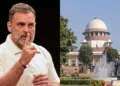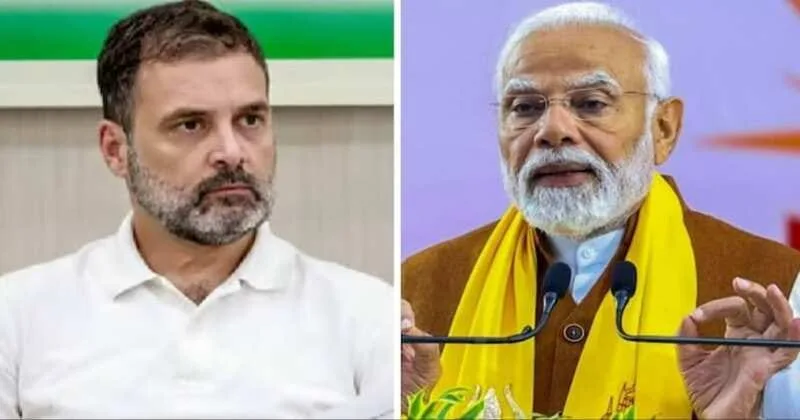
MUMBAI: The Bombay High Court has refused to quash criminal defamation proceedings against Leader of Opposition Rahul Gandhi arising from his 2018 remarks against Prime Minister Narendra Modi during the political battle over the Rafale fighter aircraft deal.
Justice N.R. Borkar on September 8 dismissed Gandhi’s petition challenging the summons issued by a Mumbai Metropolitan Magistrate on a complaint lodged by BJP member Mahesh Shrishrimal. The High Court, however, continued the protection granted to Gandhi for six weeks, enabling him to approach the Supreme Court.
The dispute traces back to September 2018, when Gandhi, then Congress president, attacked Prime Minister Modi over the Rafale deal. The complaint referred, among other statements, to Gandhi describing Modi as “Commander-in-Thief”, besides remarks which the complainant contended cast BJP members and those associated with the Prime Minister as thieves.
Mahesh Shrishrimal, a member of BJP Maharashtra Pradesh Committee, approached the magistrate alleging criminal defamation. On August 28, 2019, the magistrate issued summons to Gandhi under Section 500 of the Indian Penal Code, which prescribed punishment for defamation.
Gandhi subsequently approached the Bombay High Court through Writ Petition No. 4391 of 2021. His principal argument was that Shrishrimal was not an “aggrieved person” entitled to maintain the complaint. His lawyers contended that the remarks were directed against Prime Minister Modi and did not identify the BJP or any definite class of its members.
The complainant took the opposite position, maintaining that the allegations went beyond an individual political attack and also affected the reputation of BJP members. The Maharashtra Government opposed Gandhi’s attempt to terminate the prosecution at the threshold.
Rejecting Gandhi’s challenge, Justice Borkar held that the BJP, being a registered national political party, constituted an identifiable body. The High Court therefore declined to accept the contention that the prosecution necessarily failed because no definite or identifiable class had been targeted.
The Court further found no perversity or illegality in the Magistrate’s decision to issue summons and consequently declined to interfere. Whether Gandhi’s statements ultimately satisfy the ingredients of criminal defamation will now have to be tested in accordance with evidence before the trial court.
The ruling does not amount to a finding that Gandhi is guilty of defamation. It means that the case cannot be extinguished at the threshold on the grounds urged before the High Court.
The case nevertheless raises an important question concerning the limits of rhetoric in electoral politics. Robust criticism of a government, its policies and even its leadership occupies a protected and necessary space in a democracy. The High Court’s refusal to quash the proceedings, however, reinforces the proposition that the political character of a statement does not by itself immunise it from ordinary defamation law.
The Magistrate proceedings will remain deferred for six weeks, giving Gandhi an opportunity to carry his challenge to the Supreme Court.