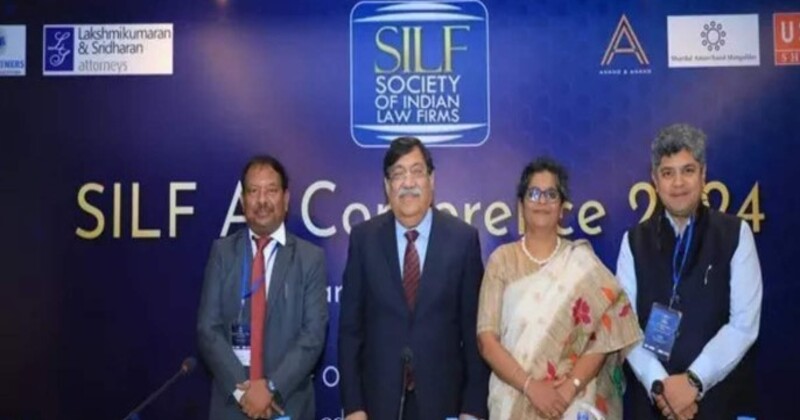
The Delhi High Court Judge, Justice Rajiv Shakdher, said on Saturday that the entire current hullabaloo around technology is nothing but an attempt to replicate human beings.Speaking at the AI Conference organised by the Society of Indian Law Firms (SILF), he further stressed that technology needs to be dominated by human beings because if you don’t do it, you would actually make something that is not in the control of human beings.
“We should look at the technology with caution and not give up on it,” Justice Shakdher said as he shared his perspective on AI and the opportunities and challenges it poses.
Speaking at the AI Conference, Justice Shakdher said technology is there before us and is here to stay.
“What you find in technology is a little less than what God would do. It has the strengths and weaknesses of a human being. Therefore, we see that the machine lies,” he said, referring to the Mata case (the first case of AI hallucinations where two lawyers used ChatGPT to prepare a filing but the bot delivered fake citations), adding that the problem with technology is that it is producing things that do not exist.
Earlier in the day, Justice Prathiba M Singh delivered keynote at the conference. “It is nice to be stupid and not always intelligent,” said Justice Singh as she shared a viral joke about Artificial Intelligence and human stupidity while adding that laws need to change to cover the regulation of AI-related technologies.
“If laws do not change, we might reach a point where laws become irrelevant. Because technology is on a marathon already. It is not going to stop,” she said. “The way I look at it…AI will take over almost everything we have understood about technology, known about technology,” she added.
Recalling an old seminar on the convergence of technology when mobile phones had not permeated society, Justice Singh said, “20 years from that seminar we have converged. Five years from now, we will be discussing how AI has changed the way we make medicines, the way we make buildings or changed the way judges give judgements”.
“We are lucky to be part of the generation that has stood in line for kerosene and sugar and now we are here.”
Drawing a distinction between an AI-assisted invention, AI-generated invention and AI as a co-inventor, Justice Singh said, “Provisions as they exist doesn’t permit AI to be an inventor. I believe there will be a time when law would need rethinking to accept AI as an inventor. But the question is, the idea of IP is to reward human creativity, the human spirit of creativity. It is a moral, ethical, and legal question. If u say no to AI inventions, in the future all inventions will be refused patent. It is a hare and a tortoise race. If you refuse patent to AI inventions, there is the threat of something being only a trade secret and will have us all rethink how the legislation will have to be.”
While batting for AI inventions, Justice Singh cautioned against AI hallucinations and said care is required when using AI for case law analysis. Advocating for responsible AI, she said the fabric of all innovations is woven with the threads of IP and human values. “Let us ensure that the tapestry we create remains intact, preserving these vital threads.”
Pointing the limitations of AI, Justice Singh said the accuracy and reliability of AI generated data is still in the grey area.She said that AI cannot substitute either human intelligence or the human element in the adjudicatory process and at best, the tool could be used for a preliminary understanding or for preliminary research and nothing more.
The AI Conference by SILF, under the presidency of Lalit Bhasin, saw the participation of 12 national and international law firms and 44 speakers, including experts from the legal, tech, industry and policy domains.
“Government policies and programmes are inspired by the spirit of AI for all. So the use of AI should not be limited to those who are elite, and technologically empowered, but it has to percolate down to the last man in the queue,” said Rajiv Mani, Secretary, Legislative Department, Ministry of Law and Justice.
“The initiative of the government, the digital revolution, which we have witnessed in the last 10 years, nearly, you know, reach down to the last man in the queue,” said Dr Mani, adding that the purpose of government’s tech initiatives is inclusivity.
Speaking at a technical session on Day 2 of the conference, Saikrishna Rajagopal, Managing Partner of Saikrishna & Associates, delved into how copyright in works generated via AI is treated in different jurisdictions.
Ryan Abbott, Partner, Brown, Neri, Smith & Khan, LLP, opined that the debate around AI and authorship was an “absolutely hot mess, particularly in the US because we have a special interest in inventorship. The real problem is that we should not care how people are inventing things; we should focus on inventing things.”
Raghavender GR, Senior Consultant (IPR), Department for Promotion of Industry and Internal Trade (DPIIT), Government of India, shared, “Just like criminal laws and patent laws are amended, we might have laws amended to make space for AI-assisted inventions.”
He, however, junked the need for granting IP rights on AI-generated inventions or inventions co-created with AI. Panel moderator Pravin Anand, Managing Partner at Anand and Anand, touched upon Indian courts granting legal rights to non-living entities like deities, forests, wildlife, etc. and wondered if similar treatment could be meted out to a machine.
To this, Raghavender responded, “There should be no Anthro morphism, putting life into machines. Joint authorship is a bad idea.”
Pushpendra Rai, former director of the World Intellectual Property Organisation, seconded the opinion, saying it was still very early to provide any kind of rights to anything that is anything but a human being. He also cautioned against overemphasising the importance of AI, which has been termed ‘unintelligent’ by scientists.
The panel touched upon the utilitarian theory to incentivize an invention that helps society, as opposed to focusing on whether it has been created with AI.
On this aspect, Matt Hervey, Partner, Head of Artificial Intelligence Law, Gowling Wragge Lawrence Graham & Co., UK, said no public good is worth eroding the human creativity or livelihood of human creators while also giving an idea of how AI inventions have no IP in the UK even as corporations, which are non-living entities, do have IPR.
The conference also saw representatives from the US, Denmark, UK and Australia discussing the AI regulations and IP regime in their countries.The final session of the conference was on “Evolving International Legal and Regulatory AI Landscape, Challenges and Ways Forward.”
Sharing his views in the session, Rohan Gupta, Director, Advisor to the Government of India for Global Partnership on AI, said the regulations and governance differ from region to region. “When you talk about the global north, there is a very prominent global south. The difference lies that the developed world can look at this, privacy and other aspects of AI, but the global south will focus on developmental aspects of AI and their sectoral needs like healthcare, pharma, agriculture, etc.”
“Right now, what we have seen is a focus on safe and secure AI. Only China is talking about the deployment of AI. The basic risk of AI remains the same overall. AI is borderless. But then each country builds upon it. Like what India did on DPDP. India is taking the lead, as we have seen in the G20,” he added.