ISRO launches X-Ray Polarimeter Satellite, will study X Ray emission from celestial sources
June 6, 2026
  • Read Ecopy
  • Circulation
  • Advertise
  • Careers
  • About Us
  • Contact Us
Android AppiPhone AppArattai
Organiser
  • ‌
  • Bharat
    • Assam
    • Bihar
    • Chhattisgarh
    • Jharkhand
    • Maharashtra
    • View All States
  • World
    • Asia
    • Europe
    • North America
    • South America
    • Africa
    • Australia
  • Editorial
  • International
  • Opinion
  • RSS @ 100
  • More
    • Op Sindoor
    • Analysis
    • Sports
    • Defence
    • Politics
    • Business
    • Economy
    • Culture
    • Special Report
    • Sci & Tech
    • Entertainment
    • G20
    • Azadi Ka Amrit Mahotsav
    • Vocal4Local
    • Web Stories
    • Education
    • Employment
    • Books
    • Interviews
    • Travel
    • Law
    • Health
    • Obituary
  • Subscribe
    • Subscribe Print Edition
    • Subscribe Ecopy
    • Read Ecopy
  • ‌
  • Bharat
    • Assam
    • Bihar
    • Chhattisgarh
    • Jharkhand
    • Maharashtra
    • View All States
  • World
    • Asia
    • Europe
    • North America
    • South America
    • Africa
    • Australia
  • Editorial
  • International
  • Opinion
  • RSS @ 100
  • More
    • Op Sindoor
    • Analysis
    • Sports
    • Defence
    • Politics
    • Business
    • Economy
    • Culture
    • Special Report
    • Sci & Tech
    • Entertainment
    • G20
    • Azadi Ka Amrit Mahotsav
    • Vocal4Local
    • Web Stories
    • Education
    • Employment
    • Books
    • Interviews
    • Travel
    • Law
    • Health
    • Obituary
  • Subscribe
    • Subscribe Print Edition
    • Subscribe Ecopy
    • Read Ecopy
Organiser
  • Home
  • Bharat
  • World
  • Operation Sindoor
  • Editorial
  • Analysis
  • Opinion
  • Culture
  • Defence
  • International Edition
  • RSS @ 100
  • Magazine
  • Read Ecopy
Home Bharat

ISRO launches X-Ray Polarimeter Satellite, will study X Ray emission from celestial sources

The satellite that was launched from Sriharikota spaceport on January 1, 2024 at 9.10 am, as scheduled, among others, would offer insights into space-based polarisation measurements of X-ray emission from various celestial sources

WEBDESKWEBDESK
Jan 1, 2024, 09:40 am IST
in Bharat, Sci & Tech
Follow on Google News
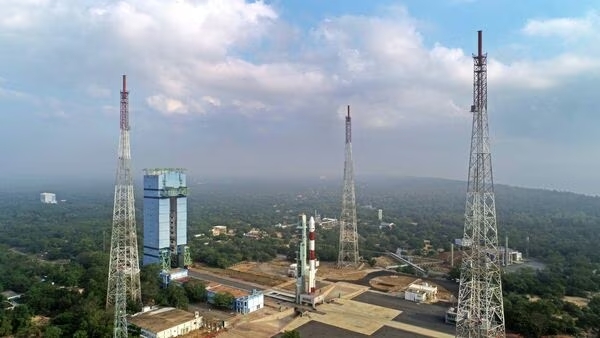
The launch of the X-Ray Polarimeter Satellite (XPoSat) is set for January 1 2024 (Mint)

The launch of the X-Ray Polarimeter Satellite (XPoSat) is set for January 1 2024 (Mint)

FacebookTwitterWhatsAppTelegramEmail

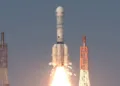
The Indian Space Research Organisation (ISRO) has successfully launched the X-ray Polarimeter Satellite on the very first day of the New Year, in continuation of its stellar space odyssey from the previous year.

The satellite that was launched from Sriharikota spaceport on January 1, 2024 at 9.10 am, as scheduled, among others, would offer insights into space-based polarisation measurements of X-ray emission from various celestial sources.

ISRO’s PSLV-C58 mission is to launch XPOSAT Satellite into an eastward low-inclination orbit. After injection of XPOSAT, the PS4 stage will be re-started twice to reduce the orbit into 350 km circular orbit to maintain in 3-axis stabilized mode for Orbital Platform (OP) experiments. The PSLV Orbital Experimental Module-3 (POEM-3) experiment will be executed, meeting the objective of 10 identified payloads, supplied by ISRO and IN-SPACe.

The XPOSat (X-ray Polarimeter Satellite) is India’s first dedicated polarimetry mission to study various dynamics of bright astronomical X-ray sources in extreme conditions.

According to ISRO, the XPOSAT satellite has two payloads:

POLIX: This will measure the polarimetry parameters (degree and angle of polarization) in medium X-ray energy range of 8-30 keV photons of astronomical origin. The payload is being developed by Ramam Research Institute (RRI), Bangalore in collaboration with U R Rao Satellite Centre (URSC). The instrument is made of a collimator, a scatterer and four X-ray proportional counter detectors that surround the scatterer. The scatterer is made of low-atomic-mass material which causes anisotropic Thomson scattering of incoming polarised X-rays. The collimator restricts the field of view to 3 degrees x 3 degree so as to have only one bright source in the field of view for most observations. POLIX is expected to observe about 40 bright astronomical sources of different categories during the planned lifetime of the XPoSat mission of about 5 years. This is the first payload in the medium X-ray energy band dedicated for polarimetry measurements.

XSPECT: Will give spectroscopic information in the energy range of 0.8-15 keV. An X-ray SPECtroscopy and Timing payload onboard XPoSat, which can provide fast timing and good spectroscopic resolution in soft X-rays. Taking advantage of the long duration observations required by POLIX to measure X-ray polarization, XSPECT can provide long-term monitoring of spectral state changes in continuum emission, changes in their line flux and profile, simultaneous long term temporal monitoring of soft X-ray emission in the X-ray energy range 0.8-15 keV. An array of Swept Charge Devices (SCDs) provide an effective area >30 cm2 at 6 keV with energy resolution better than 200 eV at 6 keV. Passive collimators are used to reduce the background by narrowing the field of view of XSPECT. XSPECT would observe several types of sources viz X-ray pulsars, blackhole binaries, low-magnetic field neutron star (NS) in LMXBs, AGNs and Magnetars.

The objective of the mission is to measure the polarisation of X-rays in the energy band 8-30keV emanating from about 50 potential cosmic sources through Thomson Scattering by POLIX payload. To carry out long-term spectral and temporal studies of cosmic X-ray sources in the energy band 0.8-15keV by XSPECT payload. To carry out polarisation and spectroscopic measurements of X-ray emissions from cosmic sources by POLIX and XSPECT payloads respectively in the common energy band.

The emission mechanism from various astronomical sources such as blackhole, neutron stars, active galactic nuclei, pulsar wind nebulae etc. originates from complex physical processes and are challenging to understand. The exact nature of the emission from such sources still poses deeper challenges to astronomers. The polarimetry measurements add two more dimension to understanding, the degree of polarization and the angle of polarization and thus is a diagnostic tool to understand the emission processes from astronomical sources.

In a stellar display of prowess, India soared to new heights in 2023 with the successful soft landing of Chandrayaan-3 on the south pole of moon and the launch of Aditya-L1, India’s first solar mission.

The primary objective of the Chandrayaan-3, the country’s first successful lunar landing mission, was to demonstrate a soft landing near the lunar south polar region and perform experiments using the instruments onboard the lander ‘Vikram’ and rover ‘Pragyaan’.

On August 23, Vikram Lander made its historic touchdown on the Moon and subsequently, the Pragyan rover was deployed to survey the uncharted lunar south pole.

These milestones not only secured India’s standing in the global space economy but also fueled the engines for the private space sector in India.

Among other feats India now aims for are the Gaganyaan Mission, setting up ‘Bharatiya Antariksha Station’ by 2035, and sending the first Indian to the Moon by 2040.

(With inputs from ANI)

Topics: ISROPSLV-C58/XPOSAT mission
ShareTweetSendShareSend
✮ Subscribe Organiser YouTube Channel. ✮
✮ Join Organiser's WhatsApp channel for Nationalist views beyond the news. ✮
Previous News

Welcome 2024: BJP’s sweeping victories and strategic manoeuvres shape the path to upcoming General Elections

Next News

Jammu & Kashmir: Coloured as ‘Tiranga’ Srinagar’s Lal Chowk welcomes 2024 with spectacular celebrations

Related News

India’s Chandrayaan-2 Helps Reveal Water Ice in the Moon’s Shadowed South Pole

How ISRO’s Chandrayaan-2 gifted the world moon water; The orbiter that changed lunar science forever

A representative image

National Jute Board expands ISRO-backed digital crop monitoring system to strengthen jute sector planning

Representative Image (This is an AI generated image)

National Technology Day 2026: Mapping India’s rise from nuclear power to digital leader

GalaxEye’s mission Drishti launch marks a defining leap for India’s private space sector with world’s first OptoSAR satellite

Mission Drishti: GalaxEye deploys India’s largest private satellite with breakthrough all-weather imaging capability

Representative Image

Indian broadcasters delink from Chinese satellites; Aims to consolidate strategic security in space technology

Representative Image of ISRO satellite helping in Agriculture

How ISRO is transforming farming with satellites, AI and Data

Load More

Latest News

Lucknow’s UP 112 Headquarters hosts West Bengal team for policing innovation study

UP 112 Model: West Bengal police visits Lucknow to replicate Yogi’s emergency response model

Representative Image

Pakistan: POJK to go for polls on July 27 under shadow of JAAC agitation

Saokat Molla with Mamata Banerjee

West Bengal: NIA foils escape bid, tracks former TMC MLA Saokat Molla through third-party mobile network

Saurav Das, Chief Spokesperson of CJP

Exposing CJP’s Saurav Das: Inside his controversial commentary on Article 370, Umar Khalid & nationalism

NIA Court sentences Zahid, Yasir, and Mohammad Idris in Punjab terror plot case

Punjab Hostel Terror Module Busted: NIA Court Sentences Zahid, Yasir, and Mohammad Idris sentenced to jail

Jameer Khan and Alla Bhakshu arrested in Pakistan-linked terror probe

Karnataka: Digital jihad trail exposed: Jameer Khan and Alla Bhakshu arrested, links traced to Pakistan

Union Home Minister Amit Shah addressing BSF personnel at the Lankamura Border Outpost along the India-Bangladesh border in West Tripura district on June 5, 2026

Amit Shah at Bangladesh Border: “India will have an impregnable security grid soon”

India slams Pakistan’s bid to hold elections in Gilgit-Baltistan, demands end to illegal occupation

Maharashtra government approves central wage structure for Pune Metro Contract Workers; Major victory for BMS

India seals robust 7.7% GDP Growth in FY26: Reflects economic resilience amid West Asia crisis & other global headwinds

Load More
  • Privacy
  • Terms
  • Cookie Policy
  • Refund and Cancellation
  • Delivery and Shipping

© Bharat Prakashan (Delhi) Limited.
Tech-enabled by Ananthapuri Technologies

  • Home
  • Search Organiser
  • Bharat
    • Assam
    • Bihar
    • Chhattisgarh
    • Jharkhand
    • Maharashtra
    • View All States
  • World
    • Asia
    • Africa
    • North America
    • South America
    • Europe
    • Australia
  • Editorial
  • Operation Sindoor
  • Opinion
  • Analysis
  • Defence
  • Culture
  • Sports
  • Business
  • RSS @ 100
  • Entertainment
  • More ..
    • Sci & Tech
    • Vocal4Local
    • Special Report
    • Education
    • Employment
    • Books
    • Interviews
    • Travel
    • Health
    • Politics
    • Law
    • Economy
    • Obituary
  • Subscribe Magazine
  • Read Ecopy
  • Advertise
  • Circulation
  • Careers
  • About Us
  • Contact Us
  • Policies & Terms
    • Privacy Policy
    • Cookie Policy
    • Refund and Cancellation
    • Terms of Use

© Bharat Prakashan (Delhi) Limited.
Tech-enabled by Ananthapuri Technologies