Decolonising Minds : Fulfilling Mahatma’s Vision
June 25, 2026
  • Read Ecopy
  • Circulation
  • Advertise
  • Careers
  • About Us
  • Contact Us
Android AppiPhone AppArattai
Organiser
  • ‌
  • Bharat
    • Assam
    • Bihar
    • Chhattisgarh
    • Jharkhand
    • Maharashtra
    • View All States
  • World
    • Asia
    • Europe
    • North America
    • South America
    • Africa
    • Australia
  • Editorial
  • International
  • Opinion
  • RSS @ 100
  • More
    • Op Sindoor
    • Analysis
    • Sports
    • Defence
    • Politics
    • Business
    • Economy
    • Culture
    • Special Report
    • Sci & Tech
    • Entertainment
    • G20
    • Azadi Ka Amrit Mahotsav
    • Vocal4Local
    • Web Stories
    • Education
    • Employment
    • Books
    • Interviews
    • Travel
    • Law
    • Health
    • Obituary
  • Subscribe
    • Subscribe Print Edition
    • Subscribe Ecopy
    • Read Ecopy
  • ‌
  • Bharat
    • Assam
    • Bihar
    • Chhattisgarh
    • Jharkhand
    • Maharashtra
    • View All States
  • World
    • Asia
    • Europe
    • North America
    • South America
    • Africa
    • Australia
  • Editorial
  • International
  • Opinion
  • RSS @ 100
  • More
    • Op Sindoor
    • Analysis
    • Sports
    • Defence
    • Politics
    • Business
    • Economy
    • Culture
    • Special Report
    • Sci & Tech
    • Entertainment
    • G20
    • Azadi Ka Amrit Mahotsav
    • Vocal4Local
    • Web Stories
    • Education
    • Employment
    • Books
    • Interviews
    • Travel
    • Law
    • Health
    • Obituary
  • Subscribe
    • Subscribe Print Edition
    • Subscribe Ecopy
    • Read Ecopy
Organiser
  • Home
  • Bharat
  • World
  • Operation Sindoor
  • Editorial
  • Analysis
  • Opinion
  • Culture
  • Defence
  • International Edition
  • RSS @ 100
  • Magazine
  • Read Ecopy
Home Education

Decolonising Minds : Fulfilling Mahatma’s Vision

It is the National Education Policy 2020 (NEP), unveiled by the Modi Government, that has laid the foundation of an education system that Mahatma Gandhi envisioned

Ajay KashyapAjay Kashyap
Dec 8, 2022, 05:30 pm IST
in Education
Follow on Google News
FacebookTwitterWhatsAppTelegramEmail

One thing that the Mahatma wanted to effectively change post-Independence, apart from the disbanding of the Indian National Congress, was the state of education in India. He wished for a complete overhaul of our education, which he was convinced that it was thrust down upon us, to make things easier for the British to keep ruling over India. After all the years gone by, it is the National Education Policy 2020 (NEP) that has laid the foundation of an education system that  Mahatma Gandhi envisioned.

Gandhi wrote in Gujarati about the changes he wanted to see in our education system, this was translated by VG Desai into English and appeared in Harijan on July 15 and August 5, 1950.

Gandhi knew that teachers must recognise the talent of each student from an early age, as encouraging the students to pursue their talents will reap great benefits for the country. He says “The special aptitudes of each child should be recognised in determining the kind of work he (or she) should do.”

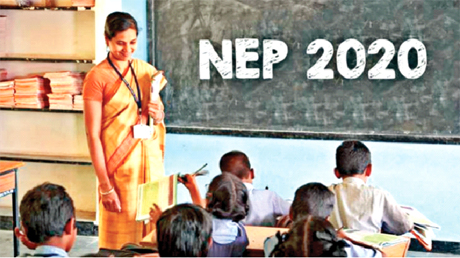
The NEP also recognises this need and focuses on critical thinking, inquiry and analysis-based teaching, which will help identify the talents of students from a young age itself. Many students and parents complain that some subjects or teaching patterns are carried out only for the sake of the curriculum, without providing any rationale for its inclusion and the future prospects of studying such subjects. Gandhi, however, was firm, he wrote “The reasons for every process should be explained when the process is being carried on.”

Inculcating Scientific Temper Among Students

In furtherance of this, the National Education Policy envisions development of scientific temper among students from junior school itself. It also states that there must be focus on digital literacy, coding and moral reasoning. Many of us have observed that despite having a grasp over subjects taught in schools, many students lack basic general knowledge. This perhaps was the case in pre-Independence era as well, as the Mahatma articulates, “General knowledge should be imparted to each child as he begins to understand things. Learning to read or write should come later.”

He was adamant that a child must only be taught subjects he wishes to study, adding that “Nothing should be taught to a child by force.” This remains true for so many students pushed into streams they do not wish to undertake in the 11th and 12th standard, or even those students who are forced by parental and peer pressure into fancy coaching institutes, which literally ruins the most important years of a child in school.

The 21st century belongs to India, and for this, our young minds need to be brought up and educated in the right manner. It is time we begin the process of decolonising our mind, which will happen by creating a structure of education keeping Gandhi’s suggestions in mind and India’s best interests at heart

Gandhi was a religious man, he had no qualms in calling himself a devout Hindu and hence, he suggested “Religious education is indispensable and the child should get it by watching the teacher’s conduct and by hearing him talk about it.” As controversial as it may seem in today’s India, it is imperative that we understand the reasoning behind the suggestion to introduce religious education. When people talk about India’s social fabric and the need to preserve it, this move to inculcate the best of religious teachings to students will not only make them a better individual and a citizen, but it will be a thread that will bind all Indians together.

The NEP lays the foundation of a New India, but these foundations are based on India’s ancient civilisational values of truth, honesty, non-violence and patriotism.

But above all suggestions, Mahatma Gandhi was uncompromising on the medium of education. He remarked “All education should be imparted through the mother tongue.” He added that “English should be taught only as one of the several languages.”

Macaulay’s Education Enslaved Indians

Adamant on his call for learning Indian languages, Gandhi wrote, “To give millions a knowledge of English is to enslave them. The Foundation that Macaulay laid of education has enslaved us.” He warned that “The foreign medium has caused brain fag, put an undue strain upon the nerves of our children, made them crammers and imitators, unfitted them for original work and thought, and disabled them for filtrating their learning to the family or the masses.”

The statesman that he was, Gandhi makes us think on the very fundamentals of modern education in India “No country can become a nation by producing a race of imitators. Think of what would have happened to the English if they had not an authorised version of the Bible.”

It is often said that a small section of the English-speaking elite in India control the entire narrative in our country. Gandhi envisioned that this would happen in the future. His words hold true even today, more than a century after he said and warned, “It is we, the English-knowing men, that have enslaved India. The curse of the nation will rest not upon the English but upon us.” To rid India of this curse, the NEP lays down guidelines for the medium of instruction to be the local language until Class 5. This one change will truly usher India into a new era.

Gandhi knew that the future of a strong, self-reliant India lies in Indians accepting its civilisational values, being unapologetic about our past and to move ahead without compromising on our culture and beliefs. He knew that this could only be achieved if substantial changes were made in our education system, for the present day system was introduced only to help the British enslave Indian minds.

The 21st century belongs to India, and for this, our young minds need to be brought up and educated in the right manner. It is time we begin the process of decolonising our mind, which will happen by creating a structure of education keeping Gandhi’s suggestions in mind and India’s best interests at heart.
Topics: Mahatma GandhiModi governmentScientific Temper Among StudentsNational Education Policy 2020 (NEP)
ShareTweetSendShareSend
✮ Subscribe Organiser YouTube Channel. ✮
✮ Join Organiser's WhatsApp channel for Nationalist views beyond the news. ✮
Previous News

Afghanistan under Taliban- 2:0 and India’s New Chapter in Central Asia 

Next News

PM Modi thanks “champion” BJP karyakartas after historic win in Gujarat

Related News

The Modi era is presented as a transformative phase in Indian politics, governance, and national identity, reflecting the aspirations of a rapidly evolving India

Modi Yug: How twelve years of governance reshaped India’s aspirations, identity & development trajectory

12 years of Modi Government: A new era of nation building

A large crowd of Bangladeshis residing in West Bengal gathers at the Hakimpur border crossing in the Basirhat subdivision of North 24 Parganas district to cross over to Bangladesh

Unnatural Demographic Change: Securing Bharat against the silent invasion

A representative image

Ayushman Bharat Crosses 90 Cr ABHA Accounts: How Modi govt is building the world’s largest digital health ecosystem

Congress is accused of opposing the Great Nicobar Project for political reasons despite its strategic, economic and national security significance for India

Great Nicobar Project: Does Congress prioritise politics over national interest?

Womens’ Reservation Bill : Senseless Sabotage

Load More

Latest News

History of Venezuela Earthquakes: How the oil rich nation remains engulfed in natural, political, economic & crises

(Left) Bharatiya Kisan Sangha National General Secretary Mohini Mohan Mishra ji (Right) Padma Shri awardee Shrirang Devba Lad address the media on the issue of BT cotton

Bharatiya Kisan Sangh demands centre to de-notify BT Cotton varieties BG-I & BG-II amid production slump

BJP councillors of the Tiruvananthapuram Corporation during the re-oath-taking ceremony

Keralam: BJP councillors retake oath after High Court verdict; CPM plea to cancel elections dismissed

Moshiur Khan alias Aman Khan ( Image Courtesy- Janam TV Keralam

Keralam: Another Bangladeshi national arrested from Islamic madrasa in Kollam with forged Indian documents

For 40 years, Bastar’s “Badi Didi” Dr. Budhri Tati walked across 570 villages to educate tribal girls and transform lives

Bastar’s ‘Badi Didi’: Inspiring story of Padma Shri Dr Budhri, who walked across 570 villages to educate tribal girls

The landmark India-UK FTA balances greater market access with domestic industry interests while opening new export opportunities for India's rapidly growing electric vehicle sector

India-UK FTA: How the trade deal opens new global markets for Made-in-India EVs

US Congressman Sanford Bishop(File Photo)

US: “We must stand against Hinduphobia”; Congressman Sanford Bishop hails Georgia’s anti-Hindu hate resolution

Tamil Nadu Higher Education Minister P. Viswanathan (Black T Shirt)

Tamil Nadu: TVK minister faces POCSO complaint over alleged inappropriate conduct with girl athletes in viral videos

Emergency Anniversary: Jaishankar says 1975 tested India's Democracy

Samvidhan Hatya Diwas: EAM Jaishankar recalls 1975 Emergency, lauds those who stood up for constitutional values

Ghar Wapsi in Khandwa: Azad Pathan after embracing Sanatan Dharma at Mahadevgarh temple becomes Ajay Kashyap

Load More
  • Privacy
  • Terms
  • Cookie Policy
  • Refund and Cancellation
  • Delivery and Shipping

© Bharat Prakashan (Delhi) Limited.
Tech-enabled by Ananthapuri Technologies

  • Home
  • Search Organiser
  • Bharat
    • Assam
    • Bihar
    • Chhattisgarh
    • Jharkhand
    • Maharashtra
    • View All States
  • World
    • Asia
    • Africa
    • North America
    • South America
    • Europe
    • Australia
  • Editorial
  • Operation Sindoor
  • Opinion
  • Analysis
  • Defence
  • Culture
  • Sports
  • Business
  • RSS @ 100
  • Entertainment
  • More ..
    • Sci & Tech
    • Vocal4Local
    • Special Report
    • Education
    • Employment
    • Books
    • Interviews
    • Travel
    • Health
    • Politics
    • Law
    • Economy
    • Obituary
  • Subscribe Magazine
  • Read Ecopy
  • Advertise
  • Circulation
  • Careers
  • About Us
  • Contact Us
  • Policies & Terms
    • Privacy Policy
    • Cookie Policy
    • Refund and Cancellation
    • Terms of Use

© Bharat Prakashan (Delhi) Limited.
Tech-enabled by Ananthapuri Technologies