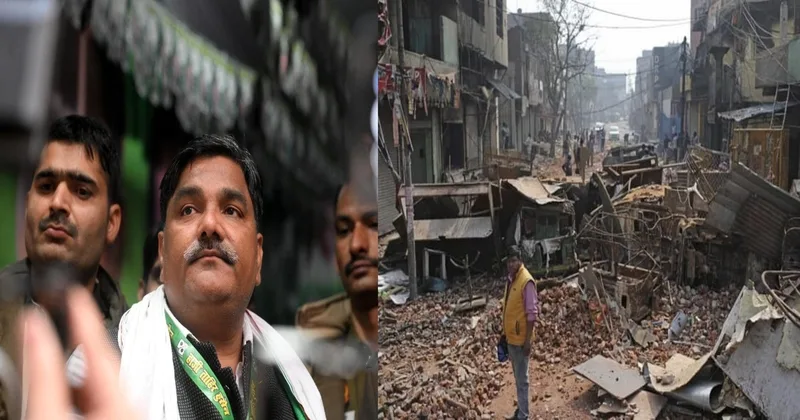
New Delhi: As the Karkardooma Court prepares to pronounce its verdict in the murder case of Intelligence Bureau staffer Ankit Sharma, attention has once again turned to the extensive investigation into the 2020 Northeast Delhi riots and the allegations against former AAP councillor Tahir Hussain.
Tomorrow, the Karkardooma court is set to deliver its verdict in the Ankit Sharma murder case. Tahir Hussain and his men had brutally killed him during the orchestrated 2020 Delhi anti-Hindu riot. In his disclosure statement, Tahir had admitted to attacking Hindus chanting “Maaro… pic.twitter.com/FoMNYa3uN7
— Nupur J Sharma (@UnSubtleDesi) June 3, 2026
The Delhi riots, which took place between February 24 and 25, 2020, left 53 people dead and hundreds injured. Entire neighbourhoods witnessed arson, vandalism, and communal violence, while homes, shops, religious structures and public property suffered extensive damage. Among the many cases investigated by Delhi Police, those involving Tahir Hussain emerged as some of the most significant because investigators alleged that he was not merely a participant but one of the key conspirators behind the violence.
One of the charge sheets filed by Delhi Police relates to FIR No. 114 and concerns the burning and looting of Hindu-owned establishments in the Khajuri Khas area. Among the properties mentioned is Aman E-Rickshaw, a business owned by Harsh Trading Company. According to the complainant, the shop was looted and set ablaze by a mob, causing losses estimated at around Rs 30 lakh.
Investigators alleged that the attacks were not spontaneous but were planned in advance. The charge sheet claims that specific Hindu-owned properties were identified and targeted during the violence.
According to the investigation, Tahir Hussain allegedly incited members of the crowd by claiming that Muslims had been attacked and that Muslim-owned shops had been burned near Sherpur Chowk. Police allege that these claims were used to mobilise and provoke crowds that later participated in violence.
Alleged Planning Before the Riots
The charge sheet further alleges that Hussain met activists Umar Khalid and Khalid Saifi at Shaheen Bagh on January 8, 2020. According to investigators, discussions during this meeting formed part of a larger conspiracy related to the unrest that later unfolded in Northeast Delhi.
Police also cited financial transactions, which they described as suspicious. According to the charge sheet, investigators traced several transactions linked to Hussain and alleged that some funds moved through shell companies. The investigation further claimed that financial assistance was expected from individuals associated with the Popular Front of India (PFI), an organisation that was later banned by the Government of India.
Another aspect highlighted by investigators concerns Hussain’s licensed firearm. Police stated that Hussain had deposited his pistol and 100 rounds of ammunition at Khajuri Khas police station in January but retrieved the weapon on February 22, just days before the riots began. According to the charge sheet, investigators later recovered only part of the ammunition and claimed that Hussain could not satisfactorily explain the whereabouts of the remaining rounds.
Moving Family Before Violence
According to the charge sheet, Hussain moved his family from his residence to his parental home in Mustafabad on the night of February 24, a detail that features prominently in the investigation’s reconstruction of the events preceding the riots.
Investigators claim that while his family was shifted citing safety concerns, Hussain himself remained at the building. The prosecution alleges that this move was consistent with preparations that had already been made for violence the following day. Police also alleged that multiple PCR calls were made to create a record, suggesting that Hussain himself was under threat. The charge sheet further claims that CCTV cameras in and around the area were deliberately disabled so that evidence of the violence would not be recorded.
The Disclosure Statement
Among the most discussed documents in the case is a disclosure statement attributed to Tahir Hussain and cited extensively in the charge sheets.
According to investigators, Hussain stated that his residence was selected as an operational base because it was one of the tallest structures in the locality. The height of the building allegedly provided a strategic advantage and allowed those gathered there to oversee the surrounding streets.
The statement also allegedly explains why construction materials such as bricks and stones could be accumulated at the property without attracting suspicion. Since construction work was already underway, investigators claim that stockpiling materials that could later be used as projectiles would not appear unusual. According to the charge sheet, Hussain further stated that preparations had begun days before the riots. Stones, bricks and other projectiles were allegedly gathered in advance, while supporters were instructed to remain prepared for any eventuality. Police allege that these preparations demonstrate planning rather than spontaneous participation in communal violence.
Slogans and Mobilisation
A significant portion of the prosecution’s narrative revolves around the slogans allegedly raised by groups gathered near Hussain’s residence. According to the disclosure statement cited in the charge sheet, crowds assembled near the premises on the afternoon of February 24 and raised slogans including “Allah Hu Akbar” and “Maaro Maaro Kaafiro Ko Maaro.” For investigators, these slogans are important because they allegedly indicate the communal nature of the violence that followed. The prosecution argues that references to “kafirs” reflected hostility directed toward members of a specific religious community.
According to investigators, those present allegedly hurled stones, threw petrol bombs and fired weapons at people and properties in the surrounding areas. The charge sheet claims that Hindu residents and Hindu-owned properties were specifically targeted during these attacks. The statement also names several individuals present at the building, including Hussain’s brother, Shah Alam, and associates such as Gulfam, Arshad, Abid, Shahid, and Irshad. According to investigators, some of these individuals were armed and participated in the violence from the premises. Police argue that the building functioned as a command centre and launch point for attacks carried out in the surrounding locality.
As the Karkardooma Court prepares to deliver its verdict in the Ankit Sharma murder case, the outcome will be closely watched across the country. Beyond the fate of the accused, the judgment is expected to shape public understanding of one of the most consequential episodes of communal violence in recent Indian history and the events that led to the death of a young Intelligence Bureau officer whose killing became one of the defining images of the 2020 Delhi riots.