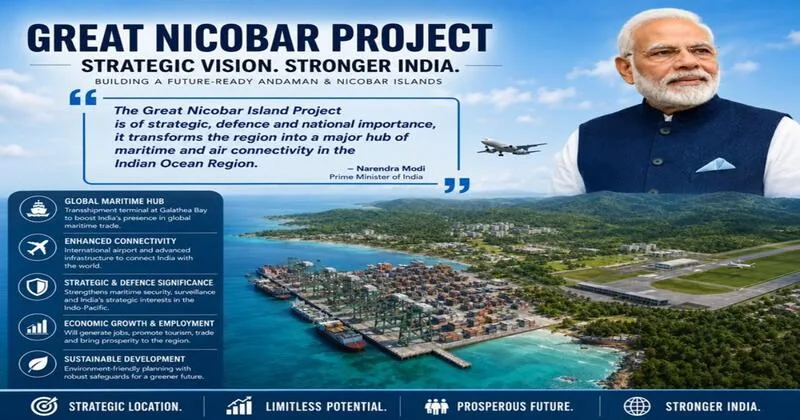
Today, as India establishes its identity on the global stage as an emerging superpower, the nation requires a robust strategic framework, modern infrastructure and enhanced global trade capabilities. Amidst the escalating geopolitical rivalry in the Indo-Pacific region, strengthening India’s maritime interests and national security is the need of the hour. In such a context, the Great Nicobar Project serves as the cornerstone of India’s strategic, economic and global future; yet, it is unfortunate that the Congress party continues to oppose this initiative.
In reality, at times citing environmental concerns, at others the interests of tribal communities, and now raising questions regarding national security, the Congress is attempting to stall a project destined to endow India with maritime prowess, commercial self-reliance and strategic resilience in the future. The pertinent question is: Does Congress truly harbour such deep concern for the environment and tribal communities, or is this merely a calculated strategy driven by a mindset intent on opposing the Modi government?
Not Opposition, but Politics Aimed at Stalling Development
Congress leader Jairam Ramesh recently wrote to Defence Minister Rajnath Singh, demanding a reconsideration of the Great Nicobar Project in its current form. He argues that components such as the transhipment port and the proposed township do not enhance military capabilities and could instead exert a negative impact on the environment and tribal communities. This raises a natural question: If Congress is truly so averse to development projects, why did it initiate thousands of major dams, ports, industrial corridors, highways and urban development schemes across the country during its decades-long tenure in power?
Did environmental and tribal interests not cross their minds back then? Was the environment not being harmed during that period? The unvarnished truth is that this opposition from the Congress is not rooted in principle, but is driven solely by political expediency. Had this very project been introduced by a Congress-led government, these same leaders would undoubtedly have hailed it as the “Gateway to India’s Future.”
केंद्रीय पर्यावरण, वन एवं जलवायु परिवर्तन मंत्री और केंद्रीय जनजातीय कार्य मंत्री को पत्र लिखने के बाद, मैंने अब ग्रेट निकोबार द्वीप परियोजना के संबंध में रक्षा मंत्री को भी पत्र लिखा है। pic.twitter.com/Tn74J5uPj3
— Jairam Ramesh (@Jairam_Ramesh) May 17, 2026
Great Nicobar: India’s Strategic Shield
The location of Great Nicobar Island holds immense significance within the Indian Ocean Region. It is situated merely about 40 nautical miles from the East-West international shipping lane. Being located in such close proximity to one of the world’s busiest maritime trade routes presents an invaluable strategic opportunity for India.
Today, a significant portion of India’s trade relies on foreign transhipment ports such as Colombo, Singapore and Klang. This implies that India’s commercial and strategic interests remain contingent upon the port policies of other nations. The Great Nicobar project represents a decisive step toward eliminating this dependency. We must recognise that an International Container Transhipment Terminal with a capacity of 14.2 million TEUs will render India self-reliant in maritime trade. Beyond being an economic initiative, this project serves as a measure to bolster India’s strategic presence in the face of China’s escalating maritime assertiveness.
Does the Congress party fail to perceive the measures India’s neighbouring nations are undertaking to augment their strategic and overall capabilities? At a time when China is relentlessly expanding its network of ports across the Indian Ocean Region, why does the Congress party find fault when India seeks to enhance its own strategic capabilities? The Congress contends that merely expanding INS Baaz, or other existing military assets, would suffice. However, should a vast and emerging nation like India truly advance with a mindset focused merely on “getting by”?
It is not an unreasonable expectation- surely, even Congress can grasp this, that a nation of 1.5 billion people like India requires large-scale infrastructure to cater to its future needs. If India aspires to emerge as a global leader in trade, naval power and maritime strategy, it must possess world-class ports, airports and modern urban infrastructure. The Congress appears to be overlooking the fact that national security is safeguarded not solely through military bases, but equally through robust economic and logistical capabilities. The transhipment port, the airport and the township, collectively, will provide India with a sustainable strategic advantage within the Indo-Pacific region.
Congress Spreads Misinformation in the Name of the Environment
Congress is persistently attempting to propagate the narrative that this project will cause large-scale environmental damage; however, the reality is quite different. This project has already secured all necessary environmental clearances under the EIA Notification of 2006 and the CRZ Notification of 2019. A comprehensive Environmental Impact Assessment (EIA) was conducted for this purpose, involving studies carried out by renowned institutions such as the Zoological Survey of India, the Indian Institute of Science, the Wildlife Institute of India, and SACON.
Under the scope of this project, 42 mandatory environmental conditions have been implemented. Only 1.82 per cent of the island’s forest cover will be utilised, and in exchange, compensatory afforestation will be undertaken across an area of 97.30 square kilometres. Furthermore, an area of 65.99 square kilometres will be preserved as a ‘Green Zone,’ where not a single tree will be felled. Would Congress care to explain how often such extensive environmental safeguards were witnessed in the projects executed during its own tenure?
Politics Over Tribal Interests Must Cease
Congress is alleging that this project will adversely affect the Shompen and Nicobarese communities; however, the factual reality is that the project contains no proposal for the displacement of any tribal community. On the contrary, the project ensures a net increase in the designated Tribal Reserve Area. In exchange for denoting 73.07 square kilometres of land, a new tract of 76.98 square kilometres is being newly declared as a Tribal Reserve Area. In other words, the total reserved area is set to increase.
Additionally, independent committees have been constituted to monitor tribal interests, and extensive consultations have been held with institutions such as the Ministry of Tribal Affairs, AAJVS and the Anthropological Survey of India. If the government were truly anti-tribal, would such a sensitive and oversight-driven framework have been established?
Making India Self-Reliant and Powerful Is Not a Crime
Today, the world is changing rapidly. Maritime trade, global supply chains and strategic sea lanes will determine the balance of power in the coming decades. If India is taking decisive steps in this direction, such moves should be welcomed rather than met with political opposition. The objective of the Modi government is clear: to make India self-reliant, strategically robust and economically powerful. It must be acknowledged that the Great Nicobar Project is an integral part of this very vision.
Development and Environment Go Hand in Hand
Indeed, the Great Nicobar Project demonstrates that development and environmental conservation are not mutually exclusive. A balance between the two can be established through the application of modern technology, scientific assessments and phased development. The proposed gas- and solar-based hybrid power plant, environmental management plan, disaster management framework and biodiversity conservation measures all serve to illustrate that the government is moving forward with a vision of long-term sustainable development.
The Congress Must Realise: National Interest Is Paramount
In this context, it must be asserted that the Great Nicobar Project is a project for India’s future. It represents far more than merely the construction of a port or an airport; it stands as a symbol of India’s power, prestige and self-reliance within the Indian Ocean Region. If the Congress party genuinely wishes to engage in politics that serve the national interest, it must cease its blind opposition to every national project. Let it be remembered: while constructive criticism is welcome and suggestions should certainly be offered, a mindset that seeks to obstruct development and weaken the nation cannot be deemed acceptable in any form.
India has now moved beyond the mindset of the 20th century. This is a ‘New India’, one that knows how to conserve the environment, respects the interests of indigenous communities, and simultaneously accords the highest priority to both national security and development. It is, therefore, only natural that the Great Nicobar Project stands as a symbol of this New India’s ambition, capability, and self-confidence, a project that must be brought to fruition at all costs, for therein lies the collective interest of all Indians.