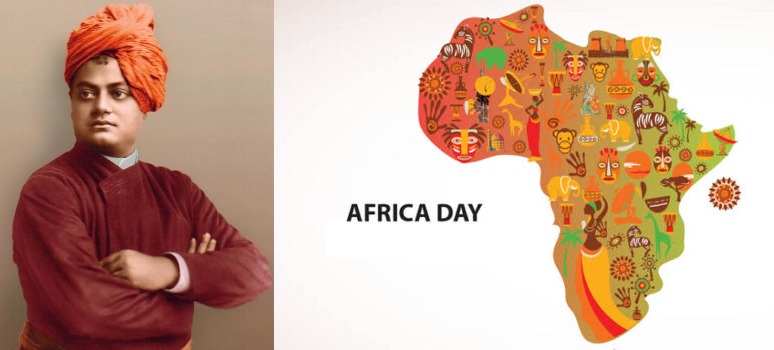
In the history of mankind, there have been rare instances where the introductory words spoken by a person have electrified the whole audience as much as Swami Vivekananda’s groundbreaking speech to the 1893 World’s Parliament of Religions. Beginning with the words “Sisters and Brothers of America,” the speech managed to not only eliminate the difference between Swamiji’s status as a person belonging to a different nation and religion but also made the audience realise they were in the audience of a great personality, who could really show them the path of universal brotherhood.
Moreover, in human history, we have rarely found leaders who are proud of their own regional identity and, at the same time, have universal concern for the human race across the globe. Their vision, Mission, concern and contribution appear equally for their country, as well as progress for humanity. Swami Vivekananda, the ‘Hindu Yogi’, as he was called in London 1 during his stay in the late nineteenth century, is one such figure in history. He was proud of ‘Hinduism’ – his religion and had an enormous love for his country and the culture. At the same time, he was dedicated to promoting the ‘Universal Brotherhood’. What is of more importance is that none of the work reveals any contradiction in his lectures, letters or his practical chores – which he performed during his lifespan and later continued through his organisation-Ramakrishna Mission. The organisation is named after his spiritual guide, Sri Ramakrishna Paramahamsa (1836-1886), which Swamiji founded in the year 1897.
Swami Vivekananda toured the globe, covering approximately a dozen countries, where he preached his universal message in the form of lectures and classes. Mostly titled under the concept of Vedanta and Yoga, which he never termed to be his own; but recognised primarily as an outcome of the great Indian literary works like Vedas, Upanishads, and Shrimad Bhagvat Gita. After Swamiji’s demise in 1902, Ramakrishna Mission expanded its service work through its centres established worldwide with the motto ‘Atmano Mokshartham Jagad-hitaya Cha’, which means ‘or one’s salvation, and for the welfare of the world’, which was given by Swamiji himself. These centres are run by monks of the organisation who, with the support of local devotees (Sadhakas), carry out numerous human excellence and social welfare activities. Swamiji’s vision and Mission were for the entire world, so the African continent also did not escape from his mind. The Chicago speech by Swamiji in 1893 has been often referred to by African leaders in present times to remind their citizens of the values which Swamiji’s speech stood for and are the most critical in today’s times–compassion, brotherhood, tolerance, and acceptance.
African nations, which find themselves in the throes of sectarianism, fanaticism and persecution, have to turn towards Swamiji’s views and thoughts that focus on the key values highlighted therein to make this world a better place. During his lifetime, Swamiji was only able to visit Egypt (in the African continent) when he was on his first visit to the west. But his concern for the continent is well evident from his letter written to Swami Shivananda (direct disciple of Sri Ramakrishna Paramahamsa and Swamiji’s brother monk) from Jaipur (present-day capital of Rajasthan state of India) dated 27th December 1897 in which Swamiji writes “Mr. Setlur of Girgaon, Bombay, whom you know very well from Madras, writes to me to send somebody to Africa to look after the religious needs of the Indian emigrants in Africa. He will, of course, send the man and bear all expenses. The work will not be congenial at present, I am afraid, but it is really the work for a perfect man. You know the emigrants are not liked at all by the white people there. To look after the Indians and at the same time maintain cool — headedness so as not to create more strife — is the work there. No immediate result can be expected, but in the long run, it will prove a more beneficial work for India than any yet attempted.” So Swamiji was himself keen to start work on the African continent. Vivekananda was an influential personality, both within and outside India. In South Africa, during colonial rule, Indian and Hindu culture was nearly non-existent. During this time, Vivekananda’s teachings and writings came as a fresh breather and provided relevance to those colonial societies and uplifted the Indian Diaspora. Swami Vivekananda’s teachings were able to instil a sense of pride in the marginalised Indian minority community. Swami Vivekananda was not against or in favour of any particular religion. His teachings encompass the right of different practices to coexist. Vivekananda taught and wrote almost exclusively in English, and he used this fact to reach a far wider audience. He paved the way for a rejuvenated India and brought about fresh synergy and renewed pride amongst the Indian diaspora worldwide.
Today the Indian Mission has four centres and six sub-centres in the continent, with centres at Vacoas (Mauritius), Lusaka (Zambia), Durban, and Phoenix (South Africa), and sub-centres at St. Julien D Hotman in Mauritius, Chatsworth, Ladysmith, Newcastle, Pietermaritzburg, and Johannesburg in South Africa. We also come across Shri Sarada Devi Ashram, a monastic centre for women in Durban, South Africa. These centres and sub-centres carry out regular spiritual activities and humanitarian and social service across more significant sectors like health, education, agriculture, and others. Apart from this, events focusing on children and youth are also organised for their holistic growth and wellbeing. Ramakrishna Mission also has its own publication. It is quite evident that from the underprivileged section to the competent section, the Mission contributes to society at large.
Swami Vivekananda’s vision serves as a beacon of light in modern times. He is considered a ‘source of truth’ for African nations. It has also paved a path for many leaders to help them implement strategies, formulate policies and take corrective steps to bring their citizenry together and help build bridges with other nations. Across the continents, we have nations fighting each other externally, and their people divided over the notion of caste, colour, and creed internally. Swamiji, in his speech, emphasised two vital requirements for world peace – brotherhood and universal acceptance; and it would not be an exaggeration to state that these are what not only the African continent but the world needs the most. If only people start imbibing the values which Swamiji stood for, if only nations start focusing on compassion and tolerance, this world will become a better place for everyone.
(Dr Neha Sinha is an Assistant Professor-II Amity Institute of International Studies, Noida & Nikhil Yadav is a Research Scholar JNU & Youth Head, Vivekananda Kendra, North Zone)