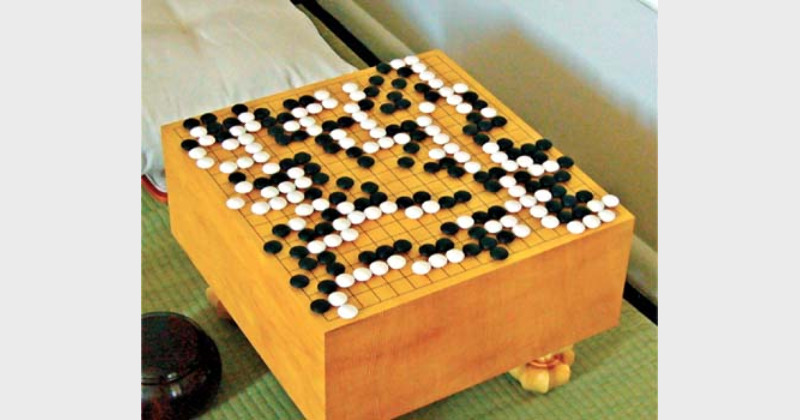
Lack of proper understanding of Chinese strategic thinking stands in the way of countries losing initiative to China. A study of Sun Tzu’s Art of War and traditional game of GO can bridge this gap. Sun Tzu’s work is considered the epitome of Chinese way of war and diplomacy while the traditional game of GO reflects Chinese strategic thinking, warfare, military tactics, and diplomatic bargaining.
-Dr Bommaraju Sarangapani
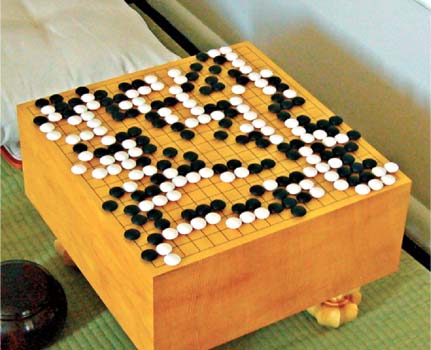
Weiqi – The Popular Madarine Board game ‘GO’ has a
strong influence on Chinese Strategic Thinking
strong influence on Chinese Strategic Thinking
China, being the birthplace of stratagems, relies more on strategy and stratagems rather than on its brutal force and advanced striking power. Its dealings with the rest of the world have never been straight forward. Many nations are being led into the Chinese trap both in economic and military diplomacy. Lack of proper understanding of Chinese strategic thinking stands in the way of countries losing initiative to China. It has the largest number of ancient military writings. What is common to all of these is that they all emphasize strategy and stratagems.
The ‘Art of War’
Sun Tzu’s ‘Art of War’ is undoubtedly the epitome of the Chinese way of war and diplomacy. Preserving the vital interest of a state without the use of force is its first principle. To achieve this goal, Sun Tzu places great emphasis on strategy and stratagems. Sun Tzu explores several ideas on warfare and the conduct of war, of which three are incredibly unique- broad conception of the art of war, emphasis on strategy and stratagem, and dialectic view on the way to fight. “Warfare is almost always the option of last resort. Wit trumps weapons. The preferred and superior approach is to convince your enemy, by whatever means, that you are invincible. Any subsequent battlefield encounter thus becomes a mere ratification of results already obtained.” states The Art of War. It views war in its broader context. It treats the political, diplomatic, and logistical preparation for war, war fighting, and the handling of the aftermath of war as well as integral parts of the war. The Art of War has also a different perspective on strategic concepts such as weak vs. strong, more vs. few, defense vs. offense, regular vs. extraordinary (Qi and Zheng), direct vs. indirect, division vs. unity, laboring vs. resting, advance vs. retreat, far vs. near, and the relativity and mutual transformation of these strategic situations. Sun Tzu focuses on exploiting the opposite of the enemy’s strategy and action.
Therefore, when capable, feign incapacity; when active, inactivity. When near, make it appear that you are far away; when far away, that you are near. Offer the enemy a bait to lure him; feign disorder and strike him. When he concentrates, prepare against him; where he is strong, avoid him. Anger his general and confuse him. Pretend inferiority and encourage his arrogance. Keep him under stress and wear him down. When he is united, divide him. Attack when he is unprepared; sally out when he does not expect you.
‘GO’ Approach in Chinese strategic thinking
These and other aspects of Chinese strategic thinking have been beautifully brought out by David Lai in a 2004 monograph (Learning from the Stones: A GO Approach to Mastering China’s Strategic Approach Concept, Shi) published by the Strategic Studies Institute, US Army War College. According to Dr. Henry Kissinger, Chinese military theory and objective of the game Weiqi (Mandarin for ‘board game of surrounding’) are manifestations of the same philosophy- to surround the opponents’ pieces and capture more territory. THis strategy is known as ‘encirclement’. Kissinger’s analysis also leans heavily on the work of David Lai, who was on the faculty of the US Air War College.
Dr. Lai uses the ancient game of GO as a metaphor for the Chinese approach to strategy. He shows that this is very different from the linear method that underlies American strategy. According to him, the game (GO) is a” living reflection of Chinese philosophy, culture, strategic thinking, warfare, military tactics, and diplomatic bargaining.” The author also sheds light on the remarkable connection between GO and the strategic concepts in Sun Tzu’s Art of War.
Shi – A putative strategy
Sun Tzu emphasizes the need for avoiding a direct confrontation and advises exercising control over areas where the adversary is weak. This must be done while waiting for an opportune time to strike from a position of strength, either by deceiving or outmaneuvering the adversary. The objective should always be winning a war without fighting in a cost-effective manner. Shi is a very important concept used by Sun Tzu in his classic. It has no western equivalent term.it is a strategy that China follows to exploit the strategic configuration of power to its advantage.it has four key aspects.
As per Sun Tzu when capable, feign incapacity; when active, show inactivity. When near, make it appear that you are far away; when far away, that you are near. Offer the enemy a bait to lure him; feign disorder and strike him
The first aspect of Shi is the idea of Qi and Zheng. “Zheng is the regular way of doing things, or in military terms, the regular order of battle. A commander deploys troops in regular (Zheng) ways. However, the commander must mobilize his troops to engage the enemy in extraordinary (Qi) ways. Yet qi is a variable and its variations are inexhaustible”. The second aspect of Shi is the idea of having an overwhelming force with irresistible unleashing power. The third aspect of Shi is about developing a favorable situation with great potential to achieve the political objectives with circulating narratives for that purpose. Taking the initiative and maintaining it is the last aspect. Sun Tzu argues that deception, stratagem, intelligence, deterrence, and so on are vital to victory. He advises Chinese national leaders- political and military alike, make strategic thinking and employment of tactical skills part of their second nature. To cultivate it, one must learn and practice the Chinese board game GO which bears striking resemblance to the Chinese way of war and diplomacy.
The basic objective of the game is to secure more space on the board (or more territory). The players do so by encircling more space on the board. The competition for more territory thus leads to invasion, engagement, confrontation, and war fighting. Sun Tzu’s thoughts and the essential features of the Chinese way of war are all played out in the game. As the game unfolds, it becomes a war with multiple campaigns and battlefronts. Or in terms of international affairs, it is a competition between two nations over multiple interest areas.
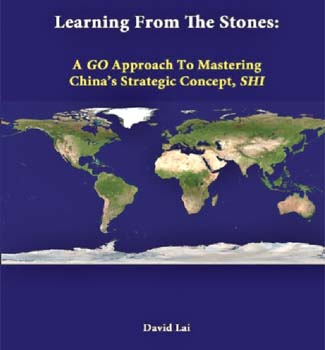
David Lai’s monograph provides good understanding
of Chinese Strategic Thinking
of Chinese Strategic Thinking
Thus, its concepts and tactics are living reflections of Chinese philosophy, strategic thinking, stratagems, and tactical interactions. This game, in turn, influences the way Chinese think and act. David Lai explores the connection between the four key aspects of Shi and the board game Go in his monograph. He gives illustrative examples of how China used its strategy of Shi in the present-day world and explains them in terms of the moves and counter moves of the board game.
Character of Chinese military
David Lai argues that the character of Chinese military and the way of war and diplomacy resembles the flow of water. Water has no constant shape. There is nothing softer and weaker than water, yet nothing is more penetrating and capable of attacking the hard and strong. The flow of water, carrying with it the Shi, can wash away anything standing in its way. David Lai points out that with over 2,000 years of influence from Sun Tzu’s teaching, along with the influence of other significant philosophical and military writings, the Chinese are particularly comfortable with viewing war and diplomacy in comprehensive and dialectic ways and acting accordingly.
Indeed, many of these observations have become proverbial components of the Chinese way of war and diplomacy, according to David Lai.
“The most notable ones are Bing yi zha li (war is based on deception), Shang-bing fa-mou (supreme importance in war is to attack the enemy’s strategy), Qi-zheng xiang-sheng (mutual reproduction of regular and extraordinary forces and tactics), Chu-qi zhi-sheng (win through unexpected moves), Yin-di zhi-sheng (gain victory by varying one’s strategy and tactics according to the enemy’s situation), Yi-rou ke-gang (use the soft and gentle to overcome the hard and strong), biShiji-xu (stay clear of the enemy’s main force and strike at his weak point), Yi-yu wei-zhi (to make the devious route the most direct), Hou-fa zhi-ren (fight back and gain the upper hand only after the enemy has initiated fighting), Sheng-dong ji-xi (make a feint to the east but attack in the west), and so on”.
He cautions that all these special Chinese four-character proverbs are strategic and dialectic in nature. All bear some character of flowing water. However, without solid and credible capability, the play of strategy is empty. Chinese are aware of this and are determined to develop both economically and militarily.
Indians should spend some time learning about Chinese strategic thinking and stratagem skills. As Sun Tzu puts it “know your opponent and know yourself, in a hundred battles you will never be in peril” A little knowledge of GO will take our leaders towards understanding the essence of Chinese way of war and diplomacy .This becomes particularly relevant in the context of the on- going nation- wide discussion. Will July 1962 repeat itself after the recent Chinese’ forced withdrawal from the Galwan Valley?
(The writer is a retired Professor of Economics at Hindu College, Machilipatnam)