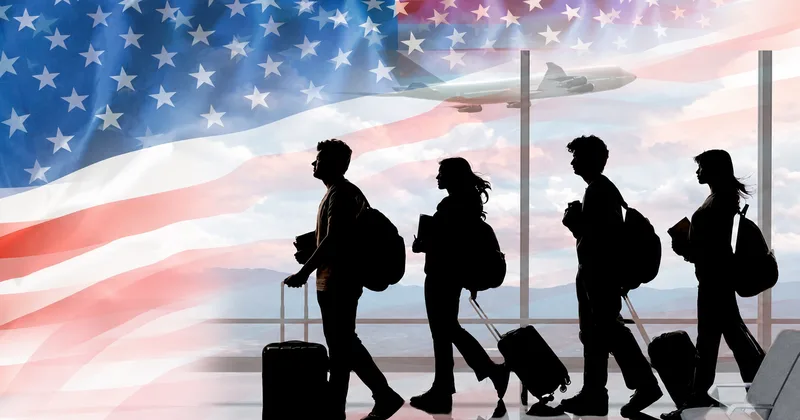
The universities across the United States is losing applications from the Indian students due to tighter immigration rules, uncertainty over post-study work opportunities and rising costs. Indian students are evidently rethinking and reassessing their overseas education decision. In this direction, applications from India to US undergraduate programmes fell 15 per cent for the 2026-27 admission cycle.
Indian applications fall as international demand weakens
The decline in Indian applications is part of a broader downturn in international interest in American higher education. As per the data, while overall undergraduate application volumes rose for the 2026-27 academic year, applications from international students fell 10 per cent.
India registered a 15 per cent fall, making it one of the countries witnessing the sharpest decline. The trend is significant because India has emerged as the largest source of international students in the US. More than 3.63 lakh Indian students were enrolled in American institutions during the 2024-25 academic year.
The decline also appears to be uneven across US universities. Highly selective institutions with strong global reputations and employment outcomes saw international applications decline by only around 1 per cent, while institutions with acceptance rates above 75 per cent recorded a fall of roughly 21 per cent.
The pattern suggests that students and families are becoming more selective, potentially favouring universities whose reputation, career prospects and earning potential are strong enough to justify the rising cost, stringent visa norms and immigration uncertainty associated with studying in the US.
Four-year visa limits and OPT uncertainty weigh on students
A major source of concern is the Trump administration’s overhaul of rules governing the stay of international students and exchange visitors.
The US government has moved to replace the traditional “duration of status” system with fixed periods of authorised stay, with a general four-year limit. Students who need additional time to complete their programmes would have to seek an extension through US Citizenship and Immigration Services.
The changes could particularly affect students enrolled in longer or more complicated academic programmes. They also create additional uncertainty for students who travel outside the US and subsequently seek to return. These herculian procedures have made US, a less attractive destination for students in the recent times.
The new immigration framework of the Trump administration is scheduled to take effect on September 15, prompting several American universities to issue advisories and organise information sessions for international students and scholars. Institutions including Harvard, Columbia University, the University of Chicago, Georgetown University and Ohio State University have communicated with affected students. The new rules also reduce the grace period for F-1 students after completing their studies from 60 days to 30 days.
Concerns over H-1B visa & USD 1 lakh fee on Optical Practical Training
For Indian students, another major concern is the future of Optional Practical Training or OPT. The programme allows eligible international graduates to work in the US after completing their studies, generally for up to 12 months, with an additional 24 months available for certain STEM graduates.
The Trump administration is considering a $100,000 fee for foreign students seeking to use OPT. Such a measure could substantially increase the cost of an American degree for students who factor post-study employment into their decision to study in the US.
The uncertainty extends to the H-1B pathway as well, which many international graduates rely on to continue working in America. The Department of Homeland Security has proposed an additional $103,265 charge for certain H-1B applications subject to the annual cap, although the proposal would not apply to cap-exempt filings.
US faces economic and enrolment fallout
The decline in applications is raising concerns about a potentially larger fall in international enrollment in American higher education. A separate assessment projected that US colleges and universities could see up to 1.1 lakh fewer international student registrations in Fall 2026 because of tighter visa policies and continuing uncertainty.
The estimated international student population is projected to fall from around 11.69 lakh in Fall 2025-26 to approximately 10.57 lakh in 2026-27. The financial implications could be substantial. International students contributed an estimated $41.77 billion to local US economies during Fall 2025-26, with that contribution projected to decline to around $38.37 billion in 2026-27. Another estimate has put the potential reduction in economic activity at around $3.4 billion.
The impact would extend beyond universities, affecting local economies that depend on international students for spending on accommodation, food, transport and other services. Tighter visa conditions, uncertainty surrounding OPT, higher costs and concerns over long-term immigration pathways are prompting students to reassess the overall value of a US degree.
Only 39 per cent of surveyed US institutions reported stable or increased application numbers from Indian students for the coming academic year, a notable change given that Indian students accounted for nearly one-third of all international students in the US in 2024-25. The higher education in the United States is thus emerging as a less attractive destination under Trump administration and a less potential education space especially for the Indian students, who have been forming the skilled workforce and contribute to the US economy significantly in the long-run.