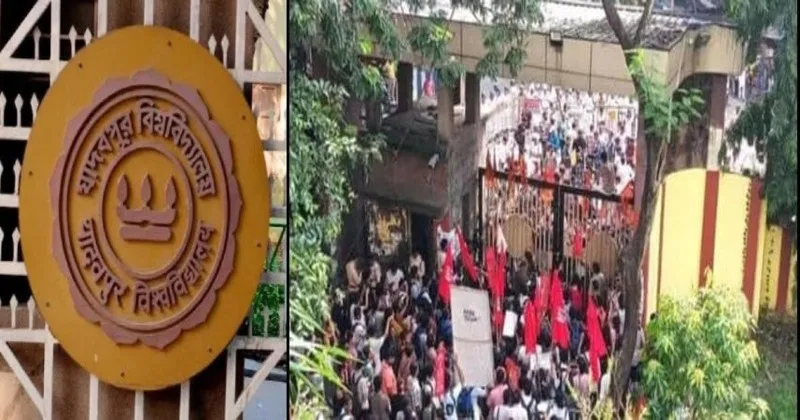
A clash broke out at Jadavpur University (JU) on August 19, late Wednesday night between two rival student groups—the Akhil Bharatiya Vidyarthi Parishad (ABVP) and the Students’ Federation of India (SFI). As the violence spilled beyond the campus on August 20, Thursday, the university’s historic emblem, originally designed by legendary artist Nandalal Bose, was damaged.
Jadavpur University has always been a highly politicised institution in West Bengal. Although, in recent years, we have seen Jadavpur emerge as a hub of anti-national activism and propaganda, one cannot deny its rich history, legacy and present-day glory.
The history of Jadavpur University cannot be separated from the history of India’s nationalist movement. Its institutional roots lie in the Swadeshi movement of 1905–06, when Bengal’s partition generated a powerful demand for national self-reliance—not merely in politics and economics, but also in education. The National Council of Education (NCE), Bengal, was established in 1906 with the explicit objective of imparting literary, scientific and technical education “on national lines” and under national control.
Jadavpur University itself acknowledges that tracing its history means tracing a part of India’s freedom movement. Among the most prominent figures associated with this experiment was Sri Aurobindo Ghose, who became the first Principal of the Bengal National College, inaugurated in August 1906. His association was not merely ceremonial: the institution represented the nationalist conviction that education should cultivate self-confidence, indigenous knowledge and a spirit of service to the nation. Aurobindo’s intellectual and political commitment to the Swadeshi movement made him one of the defining figures of this early phase of national education.
Currently, Jadavpur University has witnessed an intense student confrontation. According to university sources, the dispute reportedly began over a General Body (GB) meeting of the Faculty of Engineering and Technology Students’ Union (FETSU) held on Wednesday. The disagreement continued late into the night, as supporters of rival student groups confronted one another across the campus.
But a new narrative has emerged following the damage to Jadavpur University’s iconic emblem, designed by the legendary artist Nandalal Bose. But what does this emblem actually represent? The Jadavpur University emblem is far more than a mere institutional symbol. Designed by Nandalal Bose, it represents knowledge, spiritual growth and cultural refinement. The three flames symbolise three dimensions of human development: intellectual training, the cultivation of emotions and imagination and spiritual development.
The flames are encircled by lotus petals, representing fine arts and culture. In other words, the emblem reflects an understanding of education that is broader than examination, employment or professional achievement. It connects knowledge with character, imagination, culture and spiritual development. The lotus, too, cannot simply be reduced to a contemporary political signifier. It is an ancient Indian cultural symbol, carrying meanings that long predate present-day political parties. To interpret every lotus or saffron reference exclusively through the lens of contemporary electoral politics is itself a form of historical reductionism.
Ironically, sections of the Leftists, which have historically been critical of spiritual and Dharmic traditions, are now attempting to construct a new narrative around the incident, branding it as “saffron hooliganism”. This raises an important question: is the symbolism of the emblem itself being overlooked amid a politically convenient narrative?
The comparison being drawn by some to earlier episodes of political propaganda—such as narratives that emerged in the aftermath of the 2008 Mumbai attacks. However, such comparisons should be made cautiously and only on the basis of verifiable evidence. The focus should ultimately remain on the facts: who damaged the emblem, why it was damaged and whether the incident is being politically exploited to advance a particular narrative.
According to Dr. Debajit Dutta, Associate Professor in the Department of History at Jadavpur University, “Iconizing a particular symbol is an important strategy in any movement.” He also pointed out the Left’s hypocrisy, stating, “Those who have long been accustomed to portraying all symbols of Indian culture as manifestations of backwardness, communalism, or domination have suddenly found the lotus petal acceptable. There is little reason to believe that this can be explained simply as a mere coincidence.”
West Bengal Finance Minister Dr Swapan Dasgupta also posted a video message. He described the physical clash between the two groups as “very unfortunate,” stating that such incidents bring a bad name to the state and, to some extent, tarnish the image of Jadavpur University. (X Handel post:
My observations on the agitation in and around Jadavpur University. pic.twitter.com/6ZTj94ygZ2
— Swapan Dasgupta (@swapan55) August 21, 2026
A university that emerged from the nationalist movement should be capable of accommodating ideological diversity. Its students may support the Left, the Right, the Centre or remain politically unaffiliated. But the minimum requirement must be respect for intellectual disagreement, institutional property and students view on Nation. The answer to campus politics cannot be the depoliticisation of universities. Rather, it should be the civilisation of politics within universities—where ideas compete, arguments prevail and violence is rejected. The present controversy should therefore become an opportunity to ask a larger question: What kind of political culture does Jadavpur University want to represent in the twenty-first century?
A campus can be fiercely political without becoming violent. It can be radical without becoming destructive. It can challenge the state without becoming anti-national. And it can celebrate tradition without becoming politically reactionary. Jadavpur’s own history provides the answer. Its founders believed that education was essential to national regeneration. Its emblem celebrates knowledge, imagination, culture and spiritual development. Its contemporary intellectual reputation rests upon debate and inquiry.
As Bharat moves towards the vision of Viksit Bharat@2047, universities such as Jadavpur University must become centres of innovation, research, intellectual freedom and nation-building. Their role should extend beyond ideological confrontation to preparing young Indians to contribute meaningfully to India’s technological, economic, social and cultural transformation.
Political disagreement is natural in a democracy, but reducing every institutional incident to partisan propaganda undermines the university’s larger purpose. Those who reject the very idea of Bharat, yet attempt to politically appropriate the damage to its historic emblem, risk turning an institutional issue into a convenient political narrative. Jadavpur’s legacy demands a higher standard.