Melbourne: Urging Australian investors to make long-term investments in India’s rapidly growing economy, Prime Minister Narendra Modi stated that both nations could elevate their strategic partnership to new heights in future-oriented sectors such as manufacturing, clean energy, critical minerals, mining, infrastructure, aviation, logistics, advanced technology and artificial intelligence (AI).
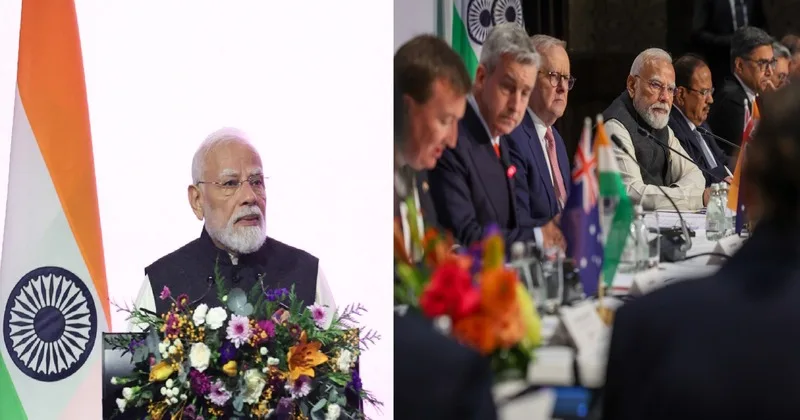
On the second day of his visit to Australia, Prime Minister Modi, alongside Australian Prime Minister Anthony Albanese, jointly addressed the Australia-India CEO Forum and the Economic Roadmap Business Program in Melbourne. In his address, he described India as the most trusted and rapidly emerging hub for global investment and called upon the Australian industry to forge long-term partnerships.
Prominent industrialists, top CEOs, major Australian pension and retirement funds, institutional investors and vice-chancellors of leading universities from both countries participated in the event. The program aimed to impart fresh momentum to India-Australia economic cooperation, identify new investment opportunities, and further strengthen the partnership between the two nations in the fields of trade, technology and innovation.
Addressing the joint press meet with PM Albanese.@AlboMP https://t.co/CZ96A4au2x
— Narendra Modi (@narendramodi) July 9, 2026
India and Australia as trusted partners
Prime Minister Modi began his address by reflecting on the current global situation. He noted that the world is navigating a period marked by uncertainty, supply chain disruptions and an energy crisis. In such times, there is a global need for India and Australia to step forward as “natural and trusted partners”. He emphasized that shared democratic values, a common vision for the Indo-Pacific region and strong political trust provide enduring strength to this partnership.
From ECTA to CECA: A new trajectory for trade relations
Describing the Economic Cooperation and Trade Agreement (ECTA) signed in 2022 as a significant milestone in the economic ties between the two nations, the Prime Minister noted that exports from India to Australia have nearly doubled since the agreement came into effect, providing industries in both countries with access to new markets. Terming this achievement merely the beginning, he called for the early finalization of the proposed Comprehensive Economic Cooperation Agreement (CECA). According to him, while both governments have prepared the “runway” for economic partnership, it is now the responsibility of the industry to fly the aircraft of investment and innovation along this path.
Held wide-ranging discussions with Prime Minister Albanese in Melbourne this afternoon. The India-Australia Comprehensive Strategic Partnership of 2022 has continuously expanded the scope of our cooperation. We have now decided to accelerate work on the Comprehensive Economic… pic.twitter.com/484H9hi6Pf
— Narendra Modi (@narendramodi) July 9, 2026
India emerges as a prime hub for global investment
Inviting Australian investors to make long-term investments in India, Prime Minister Modi stated that India’s rapid economic growth, policy reforms, digital transformation and stable governance are creating a secure and profitable environment for investors.
He emphasized that India seeks not merely capital but long-term partnerships built on investor trust. Specifically inviting Australian superannuation and pension funds, which manage assets exceeding four trillion dollars, to invest in India, he affirmed that India regards pension savings as the “sacred trust” of millions of families and remains committed to safeguarding them.
Glad to meet in Melbourne, Prime Minister Albanese.@AlboMP pic.twitter.com/AIutwo2F5b
— Narendra Modi (@narendramodi) July 9, 2026
New avenues for cooperation in clean energy and the nuclear sector
Prime Minister Modi identified the energy sector as a cornerstone of future partnerships. He highlighted India’s rapid progress toward its goals of establishing 500 gigawatts of renewable energy capacity by 2030 and achieving net-zero emissions by 2070. He described Australia’s capital, technology and resources as vital contributors to India’s growth journey, particularly in areas such as hydrogen, solar and wind energy and the manufacturing of clean energy equipment.
Referring to the recently passed SHANTI Act, he noted that India has opened up new opportunities for the private sector in the nuclear energy domain and has set a target of generating 100 gigawatts of nuclear power by 2047. He stated that Australia’s vast uranium reserves could elevate cooperation between the two nations in this sector to historic heights.
Immense opportunities in manufacturing, infrastructure and industry
Prime Minister Modi noted that India has now become the world’s second-largest producer of crude steel, and the two countries can jointly establish global leadership in low-carbon steel, green aluminium and clean manufacturing. He highlighted that approximately 34 kilometers of national highways and over eight kilometers of railway tracks are being constructed in India daily, a testament to the country’s pace, scale and sustainability. He called upon Australian investors to actively participate in projects related to ports, airports, roads, railways and urban infrastructure.
Today’s talks have unparalleled outcomes in areas such as renewable energy, climate action, nuclear energy, critical minerals, technology, education and more. Another highlight is the issuing of an important declaration to strengthen defence and security cooperation. Equally… pic.twitter.com/hOeTANEp1W
— Narendra Modi (@narendramodi) July 9, 2026
From Artificial Intelligence to Semiconductors: A focus on future technologies
Prime Minister Modi stated that India is no longer confined to a traditional economy but is moving towards global leadership in future technologies. He noted that the Government of India has provided support exceeding $10 billion for the AI Mission, Quantum Mission and semiconductor programs. He highlighted the India-Australia partnership in sectors such as artificial intelligence, data centers, quantum computing, digital public infrastructure and semiconductor manufacturing as a foundation for developing global solutions. Additionally, PM Modi urged the industry to ramp up joint investments and research, particularly in areas like rare earths, lithium, batteries, electric vehicles, electronics, defense supply chains and advanced technologies.
Addressed the Australia-India CEO Forum in Melbourne this morning. Since 2023, this forum has gained remarkable momentum, reflecting the growing confidence in our economic partnership.
I thank PM Anthony Albanese for joining the interaction and sharing his vision for taking our… pic.twitter.com/6GDcsAkJUv
— Narendra Modi (@narendramodi) July 9, 2026
Education and Skill Development: A new model of talent partnership
Prime Minister Modi described education as the long-term foundation of the relationship between the two nations. Welcoming the growing presence of Australian universities in India, he remarked that the establishment of campuses by Deakin University and the University of Wollongong in GIFT City symbolizes the rising global confidence in India. He stated that the goal for both nations should not merely be student exchange, but transforming “student mobility” into a “talent partnership.” Collaboration in higher education, research, innovation and skill development will cultivate the human resources necessary for the future global economy.
An innovative proposal for state-to-state partnerships
A standout feature of Prime Minister Modi’s address was the proposal for direct economic partnerships between Indian states and Australian provinces. He emphasized that the partnership between the two countries should not be limited to national capitals but should extend to states, universities, industries and local entities.
Citing examples, he noted that Western Australia’s critical minerals capacity could be linked with the manufacturing bases of Odisha and Gujarat. Similarly, the clean energy and agricultural expertise of Queensland and Tasmania could be integrated with the industrial and food processing sectors of Punjab, Tamil Nadu and Andhra Pradesh. Meanwhile, the finance, education, and medical innovation sectors of New South Wales and Victoria can collaborate with their counterparts in Maharashtra, Karnataka and Telangana to develop global solutions. He also highlighted the potential for cooperation in defense, space and manufacturing between South Australia and the Indian states of Uttar Pradesh and Kerala.
Always good to catch up with Mr. Scott Morrison, former Prime Minister of Australia. We had a great conversation on the India-Australia friendship.@ScoMo30 pic.twitter.com/72UtdxdSev
— Narendra Modi (@narendramodi) July 9, 2026
From democratic values to economic strength
Prime Minister Modi stated that the relationship between India and Australia extends beyond mere commercial interests. Shared democratic values, a commitment to a rules-based global order, stability in the Indo-Pacific region and growing people-to-people ties provide a robust foundation for this economic partnership. He expressed confidence that this collaboration would not be limited to bilateral trade alone but would also make a significant contribution to global economic stability and growth.
A clear message on India’s global economic role
An analysis of PM Modi’s recent visit to Australia reveals that his two addresses in Melbourne clearly signal that India has emerged as a market attracting global investment and has become a key hub in the restructuring of the global economy. By showcasing India’s economic strength, technological prowess, policy stability and democratic credibility, he invited the Australian industry to forge a long-term partnership.
India-Australia meetings are much like cricket:
The agenda is as focused as a One-Day International.
The decisions are as fast as T20 cricket.
The partnership is as long-lasting and deep as a Test match. pic.twitter.com/ENW5w9KNXM
— Narendra Modi (@narendramodi) July 9, 2026
His message is clear: if Australian capital, technology and natural resources combine with India’s vast market potential, manufacturing strength and innovation ecosystem, both nations can elevate their economic ties to new heights. Furthermore, they would play a pivotal role in shaping global supply chains, clean energy, advanced technology and the economy of the future. This message from Melbourne effectively serves as an economic roadmap for the next decade of India-Australia relations, redefining shared prosperity, mutual trust and a common future.