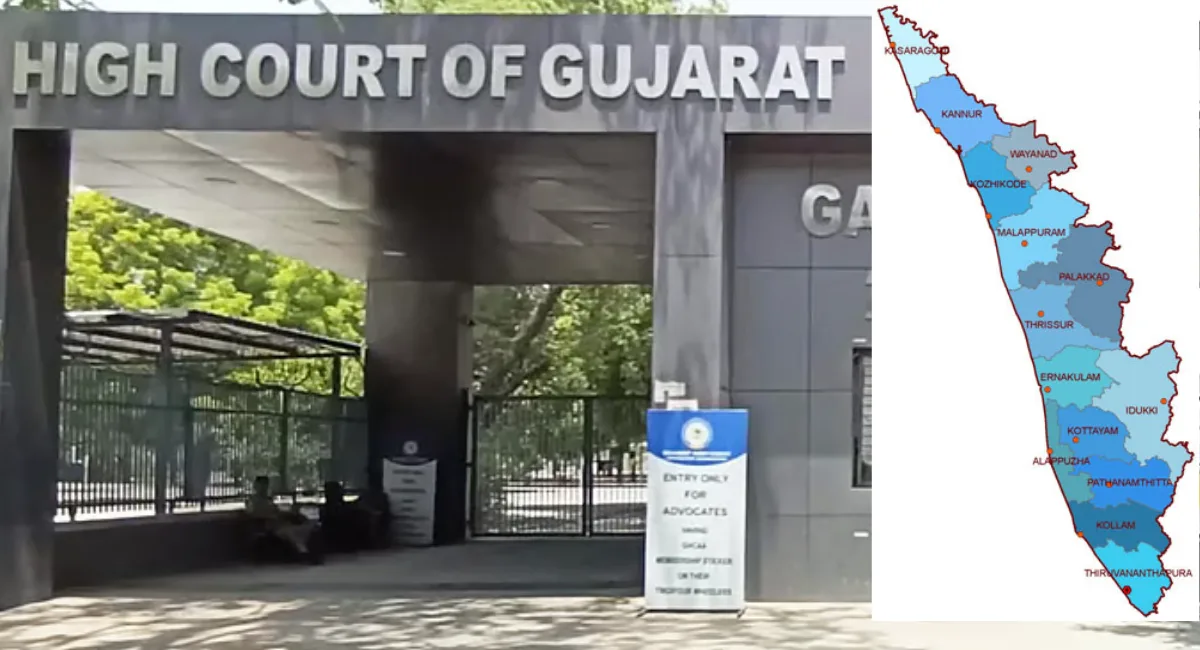
The Gujarat High Court has upheld the Special Court’s judgement in the 2008 Ahmedabad serial blasts case, bringing renewed focus on Kerala’s PFI-linked strongholds, particularly Eerattupetta in Kottayam district and Kondotty in Malappuram district.
Among the 38 convicts whose death sentences have been confirmed are three Keralites—Shibili (47) and Shaduli (45), siblings from Eerattupetta and sons of Peedikkal Abdul Kareem, and E.T. Safarudheen (43), son of Zainudheen, from Kondotty in Malappuram district. Another Keralite, Kunjanikkara Perunthalli Mohammed Ansar (45) from Aluva, has been awarded life imprisonment.
The verdict has once again drawn attention to regions that have repeatedly figured in investigations into Islamic radicalisation and terror-linked activities.
The blasts were plotted by terrorists, killing 56 people and injuring 246 others. Special Judge A.R. Patel pronounced the judgement on February 18, 2022. The punishment awarded to the terrorists has now been upheld by the Division Bench.
The terrorists left no stone unturned to escape punishment.
Eerattupetta is infamous for religious fundamentalist activities. In September 2021, Pala Bishop Mar Joseph Kallarangatt sparked a massive regional controversy after claiming during a sermon that Christian youths were being targeted by “love jihad” and “narcotic jihad” cartels. This led to intense debates and public protests.
Specifically, in September 2021, over 200 workers from various Muslim organisations organised a protest march to the Bishop’s House in Pala, demanding the withdrawal of his statements.
These demonstrations were met with counter-marches by Christian groups supporting the Bishop. Ultimately, the local authorities maintained the law and order, and no physical breaches or violent attacks on the Bishop’s residence occurred. Eerattupetta is hardly 11 km from Pala.
The National Investigation Agency (NIA) has arrested several individuals linked to the Popular Front of India (PFI) from Eerattupetta.
During nationwide crackdowns on the PFI, NIA sleuths conducted extensive raids in Eerattupetta. Notably, the agency arrested E.P. Ansari, an SDPI (the political outfit of the outlawed PFI) municipal councillor from Eerattupetta.
The action was part of a larger coordinated operation targeting PFI members for allegedly radicalising youth, organising armed training camps, and raising terror funds to spread violent jihad.
Today, the name Eerattupetta is often associated with the PFI and religious fundamentalism.
The conviction of individuals from Kerala, particularly from regions that have repeatedly figured in terror-related investigations, has once again brought the issue of Islamist radicalisation in the state into focus.
Simultaneously, growing demands for the reorganisation of Malappuram district, recurring arrests of Kerala Muslims in terror-related cases across different parts of the country, and the alleged influence of Islamic fundamentalist organisations have fuelled concerns over the infiltration of jihadi elements into sections of society.
The influence of certain Muslim individuals and institutions, coupled with developments in the Gulf region, particularly those linked to Islamist extremist networks, has emerged as a matter of concern.
Public events in which Hamas leaders have addressed gatherings, as well as programmes organised in solidarity following the deaths of Hamas leaders in Gaza, have further intensified these concerns. The propagation of narratives such as “Islam is in danger”, the alleged radicalisation of youth towards Islamist terrorist networks, and cases in which women were reportedly converted and recruited into ISIS-linked networks have raised serious questions about the spread of extremist Islamic ideology and the security challenges it poses.