Madhya Pradesh is known as the heartland of India. This is not merely a phrase. The heartbeat of this land can truly be heard not only in its rivers, forests and hills, but also in its caves, forts, temples and rock surfaces, where centuries have left their signatures. Whether it is the ancient world preserved in the form of paintings in the Bagh Caves of Dhar, the historic Ginnorgarh Fort standing atop a hill amid the forests of Ratapani, the Bateshwar-Padawali-Kakramath temple complex spread across the ravines of Chambal, or the magnificent Varaha carved into stone near Vidisha, Madhya Pradesh’s heritage has now taken another significant step towards global recognition.
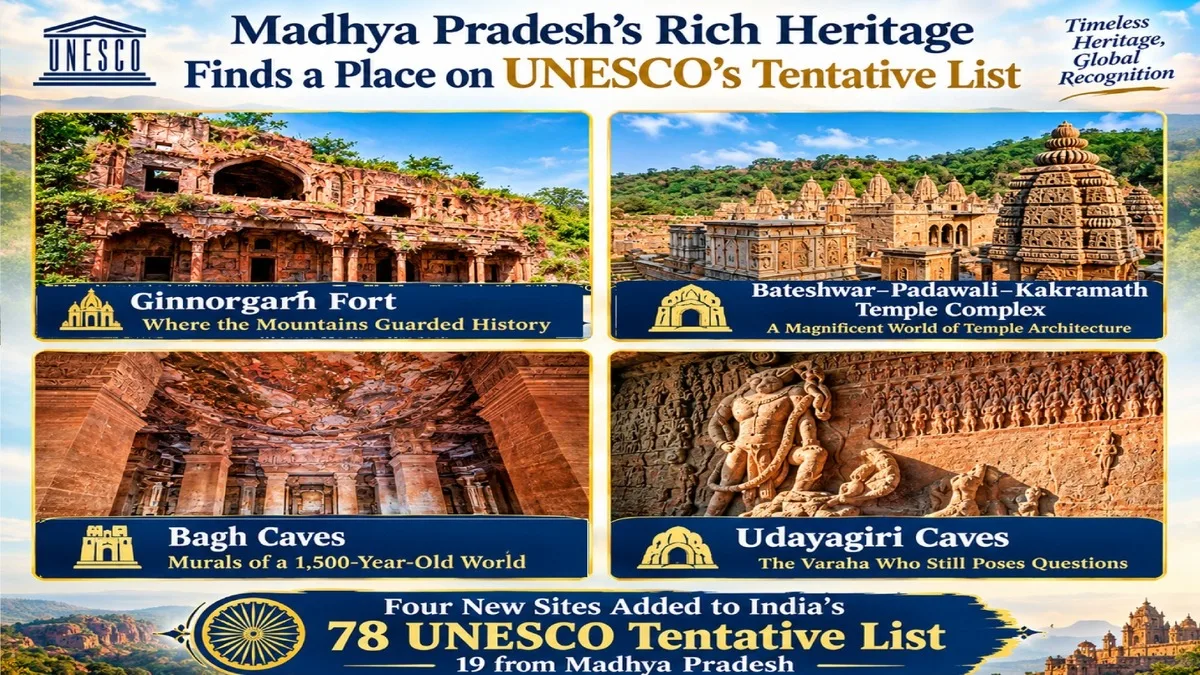
Four more historic sites from Madhya Pradesh have been added to UNESCO’s Tentative List. These include the murals of the Bagh Caves, Ginnorgarh Fort, the Bateshwar-Padawali-Kakramath temple complex and the Udayagiri Caves. With these additions, Madhya Pradesh now accounts for 19 of India’s 78 sites on the Tentative List. The figure itself reflects the extraordinary breadth of the state’s historical, cultural, architectural and natural heritage.
Dr T. Ilaiyaraaja, Secretary of Tourism and Managing Director of the Madhya Pradesh Tourism Board, has described the inclusion as an important achievement towards the global recognition of the state’s rich cultural and archaeological heritage. According to him, the development will give Madhya Pradesh’s tourism profile greater prominence on the international stage and create more opportunities for visitors from across the world to discover its distinctive culture and history.
The Colours of a 1,500-Year-Old World at the Bagh Caves
Situated along the Bagh River amid the hills of the Vindhya region in Dhar district, the Bagh Caves appear like a living chapter of history. This group of nine rock-cut caves developed between approximately the fourth and sixth centuries CE. Their greatest distinction lies in the murals, through which the rhythm of life from that era can still be seen.
Cave No. 4, popularly known as Rang Mahal, is particularly renowned for its paintings. Scenes depicting royal courts, processions, musicians, dancers and everyday social life provide a remarkable picture of the society of the time, preserved for centuries through stone and colour. Although the Bagh murals share technical similarities with the Ajanta tradition of mural painting, they possess a distinct regional character of their own. These paintings provide an important window into the artistic sensibilities, social life and cultural environment of Gupta-era India.
At Ginnorgarh, the Mountain Itself Became a Shield
Ginnorgarh, situated in the forested Ratapani region near Bhopal, opens another chapter in the heritage of Madhya Pradesh. The site represents an important example of the political and administrative organisation of Gond rule. Developed on a hill, the fort combined natural defences with fortified structures, royal buildings and sophisticated water-management systems. Around 65 stepped wells and four lakes bear testimony to the importance attached to water conservation and management at the time.
The wider landscape of Ginnorgarh presents an integrated picture of Gond political organisation, military strategy, architecture and indigenous water-management practices. It also emerges as an important site for understanding the role played by tribal kingdoms in the history of central India.
A Magnificent World of Temple Architecture Hidden in the Chambal Ravines
The very mention of Chambal evokes images of ravines and difficult terrain. Yet amid this rugged landscape, the Bateshwar, Padawali and Kakramath temple complex in Morena district tells a remarkable story of Indian architecture, one that has long deserved wider recognition.
Developed between the eighth and eleventh centuries, the complex bears witness to the gradual evolution of Nagara temple architecture in central India. Bateshwar contains a vast group of more than 200 temples. Padawali is renowned for its intricate carvings and architectural ornamentation, while Kakramath draws attention through its monumental character.
Viewed together, the three sites reveal the evolution of temple-building techniques, sculpture, craftsmanship and royal patronage. Standing amid the Chambal ravines for centuries, these temples demonstrate that the region’s identity lies not only in its dramatic natural landscape, but also in its extraordinary architectural heritage.
The Varaha of Udayagiri Still Seems to Pose Questions to History
The Udayagiri Caves, near Vidisha, constitute one of the most impressive links to the ancient history of Madhya Pradesh. Comprising around 20 rock-cut caves, the site is deeply associated with the religious and political expression of the Gupta period. Temples, sculptures, inscriptions, ancient routes and the natural landscape appear interconnected here. Among them, the colossal carving of Lord Vishnu in the form of Varaha attracts particular attention.
Carved into the rock, this monumental figure expresses Vaishnavite religious thought while also reflecting Gupta-era ideas of kingship and cosmic order. Elements associated with both Hindu and Jain traditions further deepen the cultural diversity of Udayagiri.
Four New Names Added to a Long Heritage List
The addition of four new sites from Madhya Pradesh to UNESCO’s Tentative List represents another milestone in a long journey. In 2025, the Ashokan inscription sites associated with the Mauryan Routes, the Chausath Yogini Temple, the Gupta-era temples of northern India, and the group of Bundela palaces and forts were added to the list. In 2024, the Gwalior Fort, Burhanpur’s Khooni Bhandara, the rock-art sites of the Chambal Valley, Bhojpur’s Bhojeshwar Mahadev Temple, the Gond monuments of Ramnagar and the historic group at Dhamnar were included.
Earlier, in 2021, Bhedaghat-Lameta Ghat and Satpura Tiger Reserve found a place on the list. Orchha’s historic group was added in 2019, India’s iconic sari weaving clusters in 2014, and the group of monuments at Mandu in 1998. Taken together, these names demonstrate that the history of Madhya Pradesh cannot be confined to a single period, faith or dynasty. The state carries Buddhist art, Gupta-era culture, Gond rule, medieval temple architecture and natural heritage within its landscape.
At the same time, the cultural wealth of Madhya Pradesh extends far beyond tangible heritage. The Narmada Parikrama represents the state’s spiritual traditions and popular faith. Bhagoria reflects the joy, community life and traditions of tribal society. Gond painting has taken expressions of nature and indigenous beliefs to an international audience. The Maihar Band represents a distinctive tradition of Indian instrumental music. The traditional iron-smelting techniques of the Agaria community tell a story of indigenous knowledge and ancient metallurgical skills. The distinctive cuisine of Nimar represents the region’s culinary traditions and local flavours.
Beyond the Tentative List, the Real Test is Conservation
It is important to remember that inclusion on UNESCO’s Tentative List is not the same as being inscribed on the World Heritage List. It is an important preliminary stage towards a future nomination. The next phase will place considerable emphasis on conservation, scientific documentation, management and presentation of these sites in accordance with global standards. The Madhya Pradesh Tourism Board has played a role in advancing these heritage sites under the UNESCO World Heritage programme, while the national-level process has progressed through the Archaeological Survey of India.
The four new names are, in essence, four different stories. At Bagh, colours speak. At Ginnorgarh, the mountain narrates history. In Chambal, temples seem to converse through stone And at Udayagiri, the mighty Varaha appears to challenge time itself.
This, perhaps, is what makes Madhya Pradesh truly distinctive. Here, history is not locked away in the pages of books. It breathes in the forests, flows along the rivers, stands upon the hills and continues to reveal itself through the carvings of ancient temples. The four new additions to UNESCO’s Tentative List are yet another powerful record of this living world of history, bringing before the world a heritage of which Madhya Pradesh can rightly be proud.