Centuries before anyone spoke of “digital manufacturing” Indian craftsmen were already building objects layer by layer. The lost-wax casting that produced the Chola bronzes, and the forging that gave Delhi’s Iron Pillar its rust-defying strength, were acts of patient, the additive creation long before the word existed in English. That lineage matters today, because India is once again building things one layer at a time, now the chisel has become a laser and the mould has become a digital file.
Additive Manufacturing (AM), popularly known as 3D printing, has moved from hobbyist curiosity to strategic technology, and India’s National Strategy for Additive Manufacturing (NSAM), launched in February 2022, has already trained over 1,54,000 people and backed 56 AM start-ups.
But to understand where India stands, it helps to first understand where this technology came from and how the world’s other major blocs, the United States and China, are racing along the same track.
What exactly is additive manufacturing?
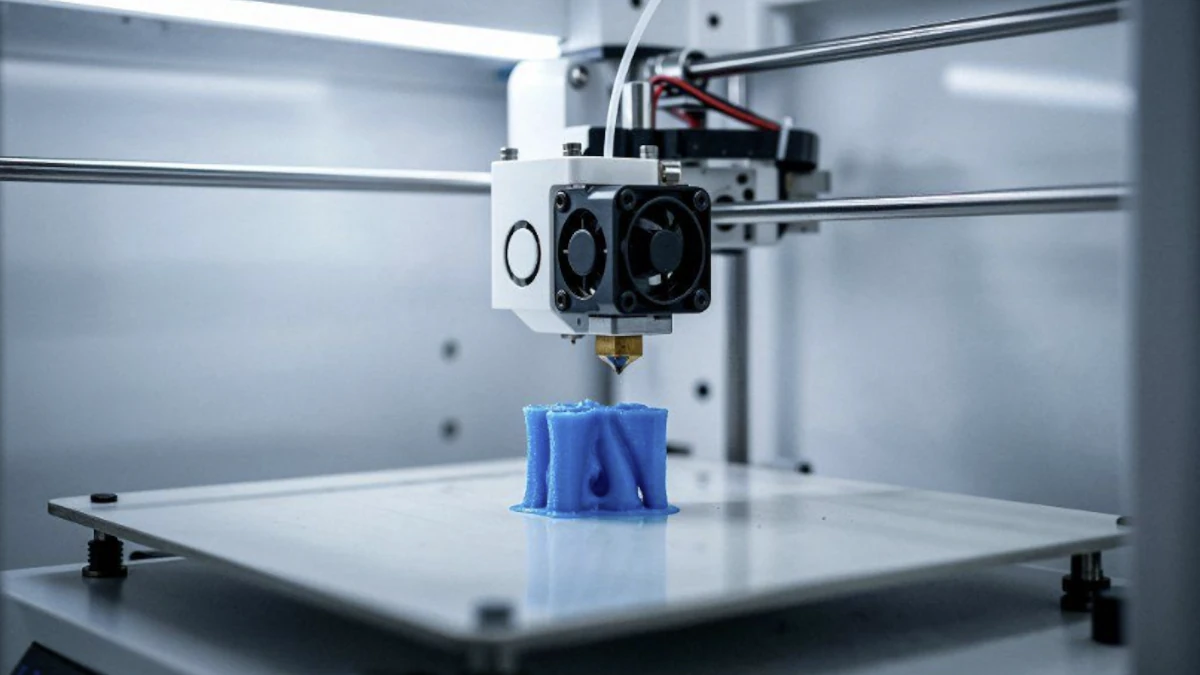
Traditional manufacturing is subtractive, a block of metal or plastic is cut, drilled or milled until the desired shape remains with the rest discarded as waste. Additive Manufacturing inverts this logic entirely. A digital file controls the process from start to finish, building an object upward, layer by microscopic layer rather than carving it downward.
The journey from screen to object follows a fairly consistent sequence. First comes the virtual design, a three-dimensional model created in Computer-Aided Design (CAD) software, scanned from a physical part, or increasingly, generated by Artificial Intelligence from a handful of mobile-phone photographs.
This design is then converted into an STL file: a mesh of triangular surfaces that tells the printer exactly what shape to build. Specialised slicing software divides that model into hundreds or thousands of horizontal layers, mapping out a precise toolpath.
The sliced file is fed to the AM machine, which reads each layer in sequence and deposits material accordingly, fusing each one to the last until a complete three-dimensional object emerges, after which post-processing makes it market-ready. More than forty distinct additive processes are now in commercial use or active research.
The material palette has grown just as fast as the processes themselves. Thermoplastics such as ABS, polycarbonate and polylactic acid remain the workhorses, with water-soluble polyvinyl alcohol used to build temporary supports that later dissolve away.
Metals ranging from stainless steel and titanium to gold and silver now go through AM machines for aerospace and defence parts, while ceramics such as zirconia and alumina, biomaterials including calcium phosphate and stem-cell derived bio-inks, are being explored for bone grafts and printed human tissue.
This convergence of computing, design software and materials science is precisely why AM is treated as a frontier technology rather than a mere manufacturing tool.
The Birth of a Technology: From a California Garage to a Global Race
The additive manufacturing story has a precise birth certificate, though the full story is less tidy than the popular telling. In 1984, American engineer Chuck Hull, working at a small firm making UV coatings, filed a patent for a process he named Stereolithography (SLA) a method of using an ultraviolet laser to cure liquid photopolymer resin into solid plastic, layer upon layer.
He was not entirely alone on that frontier, barely three weeks earlier, a group of French researchers had filed a similar patent of their own, only to abandon it for lack of perceived commercial promise, while Japanese researcher Hideo Kodama had already published the underlying concept a year prior. It was Hull who carried the idea to market.
His patent was granted in 1986, the same year he co-founded 3D Systems in California to commercialise it, giving the world its first industrial 3D printer. Three years later, engineer Scott Crump introduced Fused Deposition Modelling (FDM), extruding melted thermoplastic through a nozzle and founding Stratasys to build on it a technique that would eventually put desktop 3D printers within reach of schools and small workshops everywhere.
For nearly three decades, the technology remained confined largely to rapid prototyping, a faster way to build a sample part before committing to expensive tooling. The real shift came in the last decade, as metal printing matured enough to produce flight-worthy aerospace components, medical implants and load-bearing defence hardware.
What began as a niche prototyping tool in a Californian lab is now a matter of national industrial strategy. The global AM industry was valued at roughly US$21.9 billion in 2024, growing over 9 percent annually and projected to multiply several-fold within the next decade an expanding pie that explains why three of the world’s largest economies are now racing for a larger slice of it, each in a strikingly different way.
Three Nations, Three Models
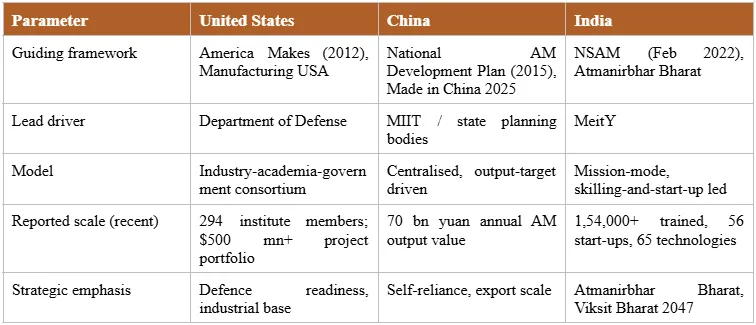
The United States built its AM ecosystem around America Makes, the National Additive Manufacturing Innovation Institute, established in 2012 under the Department of Defense’s Manufacturing USA network.
It functions as a membership-driven consortium of industry, academia and government reporting a record 294 members and a research portfolio exceeding $500 million as of 2024.
Washington approach is defence-anchored with recent funding pushes, including tens of millions of dollars for the Defense Advanced Research Projects Agency work on additively manufactured microsystems, are explicitly tied to military readiness and the Pentagon’s Indo-Pacific industrial-base strategy.
Chinese model is state-directed and scale-obsessed. Beijing’s Ministry of Industry and Information Technology released its first national additive manufacturing development plan in 2015, embedding the technology within the sweeping “Made in China 2025” industrial policy.
Official figures from the Ministry show the sector annual output value climbing from roughly 20.8 billion yuan to around 70 billion yuan across the recently concluded Five-Year Plan period, with the draft fifteenth Five-Year Plan now targeting nearly 150 billion yuan by 2030.
The emphasis throughout has been on reducing dependence on foreign AM technology and scaling domestic machine exports. India’s NSAM charts a third course one that is civilisational in ambition rather than purely commercial or military.
Anchored in Make in India and Atmanirbhar Bharat, it sets explicit, time-bound targets, a 5 percent share of the global AM market, nearly US$1 billion added to GDP, 50 India-specific AM technologies, 100 new start-ups with a lakh newly skilled workers and capability built across 10 manufacturing sectors, delivered through seven specialised centres spanning Hyderabad to Mandi.
The American consortium model or China’s industrial-output targets, NSAM folds school-level skilling through Rs 20-lakh Atal Tinkering Labs reaching students from Grade VI onward directly into a strategy that treats AM as a building block of Viksit Bharat.
Where India stands
What distinguishes India’s entry into this race is not the size of its cheque book where America’s defence-funded institute and China’s trillion-yuan industrial machinery both dwarf NSAM’s current scale but the civilisational continuity it brings to a frontier technology.
A country that built the Iron Pillar without rust-proofing chemistry, and cast temple bronzes without modern metallurgy, is now training lakhs of young Indians to build rocket engines, bone grafts and disaster-resilient housing one digital layer at a time.
Agnikul Cosmos’s single-piece, AM-printed rocket engine and the Indian Army’s twelve-week AM-printed dwelling in Ahmedabad are early proof that the strategy is translating into hardware, not just paperwork.
NSAM 2.0 now being conceptualised, aims to deepen this further sharpening intellectual property generation, building globally competitive AM technologies for commercialisation, and expanding defence applications.
As the Emerging Science, Technology and Innovation Conclave convenes in New Delhi this October, the question is no longer whether India can compete with the American and Chinese AM blocs, but how quickly its mission-mode strategy can convert its early, India-specific technological gains into the kind of manufacturing self-reliance that Atmanirbhar Bharat was always meant to deliver.