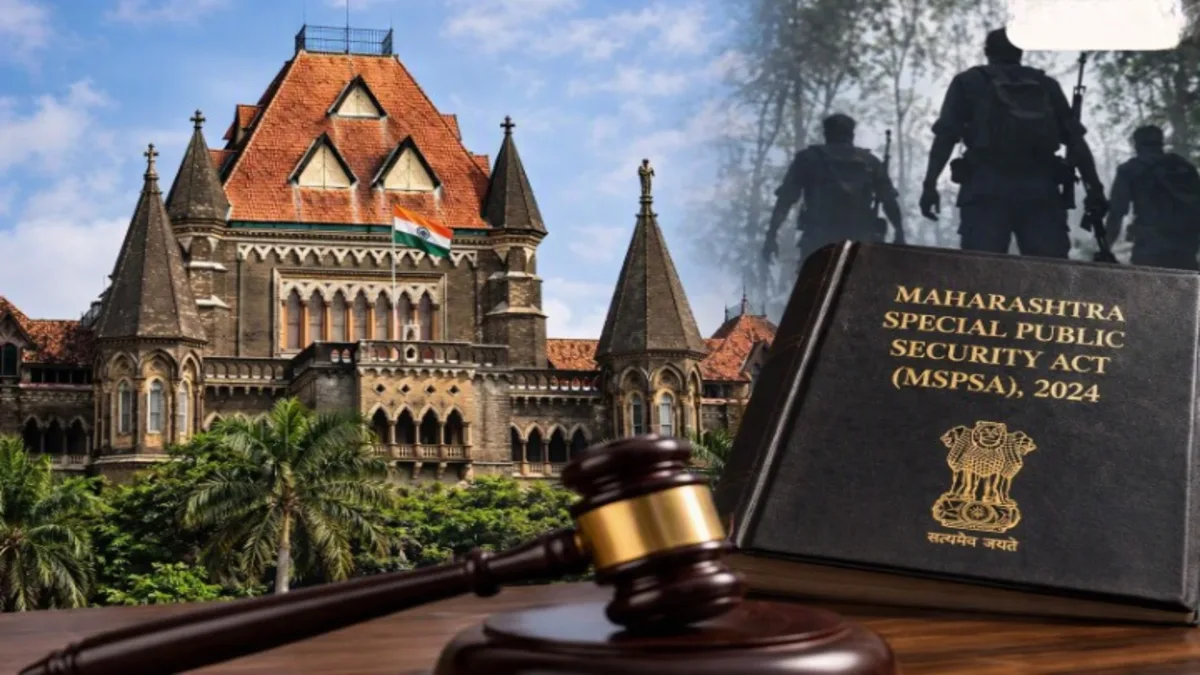
MUMBAI: The Maharashtra Government has defended the Maharashtra Special Public Security Act (MSPSA) before the Bombay High Court, submitting that the legislation was enacted to deal with the alleged growth of urban networks associated with Maoist organisations and their support structures.
The submission was made before the High Court while it was hearing challenges to the constitutional validity of the legislation, including a petition filed by the Maharashtra unit of the Indian National Congress.
According to the State, Maharashtra’s large urban population has made it a centre for networks through which organisations influenced by Maoist ideology may operate under different names and organisational structures. The Government maintained that an effective legal framework was required to act against organisations allegedly having links or nexus with unlawful activities connected to Left-Wing Extremism.
The State told the Court that insurgent movements do not function only through armed cadres. According to its submission, such movements also depend upon logistical networks, safe houses, financial channels and institutional fronts. The legislation, it argued, seeks to address these support structures before they translate into violence or disruption of public order.
The Government further pointed out that States including Andhra Pradesh, Telangana, Madhya Pradesh and Chhattisgarh have enacted laws dealing with unlawful organisations and maintained that Maharashtra required a similar statutory mechanism.
The MSPSA provides for action against organisations declared unlawful under the legislation. Certain provisions of the law, including powers relating to premises allegedly used for unlawful activities, have come under challenge before the High Court.
The petitioners have questioned the scope of the legislation and the powers granted to the authorities under it. The constitutional challenge has therefore brought questions concerning public order, individual rights and the extent of the State’s preventive powers before the Bombay High Court.
The Maharashtra Government, however, has maintained that the legislation is aimed specifically at unlawful activities associated with Maoist organisations or similar bodies and is not intended to interfere with organisations legitimately pursuing social objectives.
The State has also defended the terminology used in the legislation, arguing that organisations allegedly linked to extremist activities may operate under the description of bodies established for social purposes. It submitted that the statutory language was framed keeping in mind what it described as the changing methods of such organisations.
The case is significant as the High Court will have to examine the constitutional validity of a State law intended to deal with unlawful organisations before the provisions are tested against fundamental rights and existing legal safeguards.
The matter is expected to come up for further hearing before the Bombay High Court on October 13.
The case is Indian National Congress (Maharashtra) v. State of Maharashtra, Writ Petition No. 2981 of 2026.