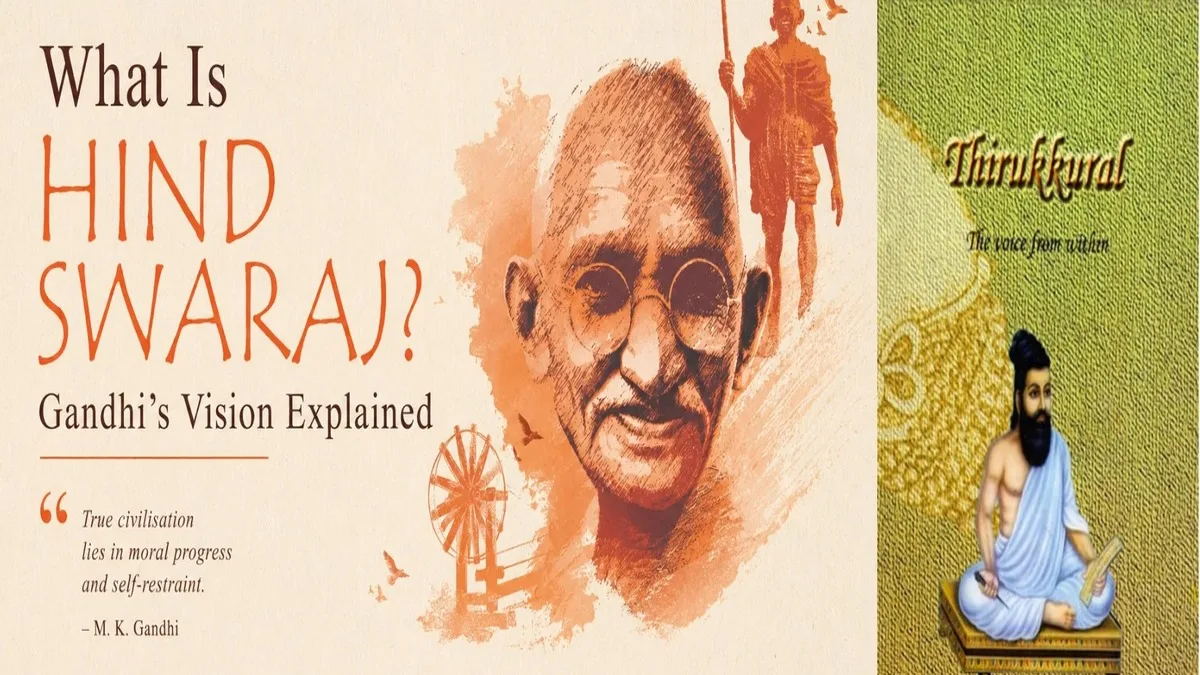
Mahatma Gandhi wrote Hind Swaraj in 1909 aboard the SS Kildonan Castle; it is a seminal manifesto on civilisation, morality, and political liberation. Framed as a dialogue between “Editor” (himself) and the “Reader,” he completed it in just ten days in November 1909 while sailing back from London to South Africa. Hind Swaraj goes beyond the demand for political independence. It argues that genuine freedom (Swaraj) is self-rule achieved through mastery over one’s senses, ethical conduct and non-violent soul-force.
Thirukural, the essence of Bharatiya Civilisation
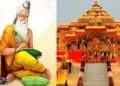
Written centuries before Hind Swaraj, the Thirukkural is essentially a prism through which one can view the glory of Bharatiya Civilisation, culture, and literature. It is divided into 3 volumes (Aram: Dharma and Moksha, Porul: Artha, Inbam: Kama), containing 133 chapters and 1330 verses, with each chapter containing 10 verses. It is written in the couplet style, with each verse containing 4 words in the first line and 3 in the second. Thirukkural’s three-volume structure follows the four Purushartha way of our civilisation, with the last Purushartha, Moksha, being folded into the first volume, Aram.
Mahatma Gandhi was intimately aware of Thiruvalluvar’s work. Leo Tolstoy had quoted the Thirukkural extensively in his 1908 essay, A Letter to a Hindu, which Gandhi translated and published in South Africa. Examining Hind Swaraj through the lens of Thirukural reveals a deep philosophical alignment across core civilisational questions.
Jawaharlal Nehru’s critical views on Gandhi’s Swaraj doctrine
Before we dive deep into how Hind Swaraj aligns with the Thirukural, it would be interesting to see what Nehru thought of it. He thought Hind Swaraj was a product of Gandhi’s moral passion rather than practical reasoning.
“All this seems to me utterly wrong and harmful doctrine, and impossible of achievement. Behind it lies Gandhiji’s love and praise of poverty and suffering and the ascetic life. For him progress and civilisation consist not in the multiplication of wants, of higher standards of living, but in the deliberate and voluntary restriction of wants, which promotes real happiness and contentment, and increases the capacity for service.” (An Autobiography, 1936, Chapter LXI, Desolation)
“Again I think of the paradox that is Gandhiji. With all his keen intellect and passion for bettering the downtrodden and oppressed, why does he support a system, and a system which is obviously decaying, which creates this misery and waste? He seeks a way out, it is true, but is not that way to the past barred and bolted?” (An Autobiography, 1936, Chapter LXII, Paradoxes)
In reality, Gandhi wasn’t against modernisation or industrialisation. He distinguishes between false modernity: materialist, exploitative, violent modernity and true civilisation, which is ethical, self-restrained and duty-bound. His is more a critique of industrial excess than a rejection of progress. His is a vision of sustainable, human-centric development, one that today’s world and its leaders are screaming about.
A civilisation rooted in righteousness
In chapter 13, “What is a civilisation?”, he says, “I believe that the civilisation of India has evolved is not to be beaten in the world. Nothing can equal the seeds sown by our ancestors.”
“Civilisation is that mode of conduct which points out to man the path of duty. Performance of duty and observance of morality are convertible terms. To observe morality is to attain mastery over our mind and our passions.”
Here Gandhi notes that the Gujarati equivalent for civilisation means “good conduct” (righteousness)
This directly mirrors what Thiruvalluvar says in Glorification of Righteousness. Here righteousness (Aram) is defined as internal mastery over our mind and passions.
அழுக்காறு அவாவெகுளி இன்னாச்சொல் நான்கும்
இழுக்கா இயன்றது அறம். (35)
“Avoid envy, greed, anger and harsh words: That is the way to acquire righteousness”*
Gandhi further states, “They saw that happiness was largely a mental condition. A man is not necessarily happy because he is rich, or unhappy because he is poor. The rich are often seem to be unhappy, the poor to be happy. Millions will always remain poor. Observing this, our ancestors dissuaded us from luxuries and pleasures.”
In essence, righteousness is the real wealth. Which is what we see in Glorification of Righteousness.
சிறப்புஈனும் செல்வமும் ஈனும் அறத்தினூஉங்கு
ஆக்கம் எவனோ உயிர்க்கு. (31)
Righteousness leadeth unto heaven and it bringeth wealth also: what is there more profitable than righteousness?*
Satya: Truth as the supreme virtue
For Gandhi, truth is not just factual accuracy; it is absolute divinity (Truth is God). He insisted that inner truthfulness must govern thought, word and deed, even when confronted with political expedience.
Thirukkural, in the chapter, Truthfulness, says thus:
வாய்மை எனப்படுவது யாதெனின் யாதொன்றும்
தீமை இலாத சொலல். (291)
What is truthfulness? It is the speaking of that which is free from even the slightest taint of evil.*
The primacy of agriculture
Gandhi envisioned an India built on village self-sufficiency (Grama Swaraj). He called farmers the real backbone of India.
Thiruvalluvar articulated it thousands of years ago in a chapter about farming (Uzhavu)
சுழன்றும்ஏர்ப் பின்னது உலகம் அதனால்
உழந்தும் உழவே தலை. (1031)
Roam where they will, men must at last stand behind the plough for their food: in spite of every hardship, therefore, husbandry is the chiefest industry.*
உழுவார் உலகத்தார்க்கு ஆணிஅஃ தாற்றாது
எழுவாரை எல்லாம் பொறுத்து. (1032)
Husbandmen are the linchpin of the society: for they support all those that take to other work, not having the strength to plough.*
Public morality and righteous governance
Gandhi rejected Machiavellian politics. He argued that political power is only valid if grounded in Dharma. Wealth gained without virtue, or power wielded unjustly, corrupts a society. Thiruvalluvar shares a similar view on statecraft in the chapter Just Government.
குடிதழீஇக் கோலோச்சும் மாநில மன்னன்
அடிதழீஇ நிற்கும் உலகு. (544)
Behold the noble prince who ruleth the people of his dominions with loving care: sovereignty will never depart from him.*
Critique of modern materialism and greed
Gandhi condemns modern commercialism, warning that it makes bodily comfort and sensory gratification the sole purpose of life, reducing human beings to economic units.
“The condition of England at present is pitiable. I pray to God that India may never be in that plight… This civilisation takes note neither of morality nor of religion.”
“This civilisation is irreligion, and it has taken such a hold on the people in Europe that those who are in it appear to be half mad. They lack real physical strength or courage. They keep up their energy by intoxication.”
Thiruvalluvar says thus in The Vanity of all Things:
நில்லாத வற்றை நிலையின என்றுணரும்
புல்லறி வாண்மை கடை. (331)
There is no greater folly than the infatuation that looketh upon the transient as if it were everlasting.*
Its votaries calm themselves by saying: ‘Such will be the condition of the whole world.’ … It is eating into the vitals of the people.”
In The Killing of Desire, Thiruvalluvar says:
ஆரா இயற்கை அவாநீப்பின் அந்நிலையே
பேரா இயற்கை தரும். (370)
Desire is never filled: but if a man giveth it up he attaineth perfection even at that very moment.*
In summary
We can see that in Hind Swaraj, Mahatma Gandhi produced a diagnostic critique of 20th-century colonial modernity. In doing so, he arrived at the same moral conclusions Thiruvalluvar systematised centuries earlier: that political freedom without ethical mastery is an illusion, and that lasting peace cannot be built through violence, exploitation, or unrestrained desire.
*As translated by VVS Aiyar in “The Kural or The Maxims of Thiruvalluvar”.