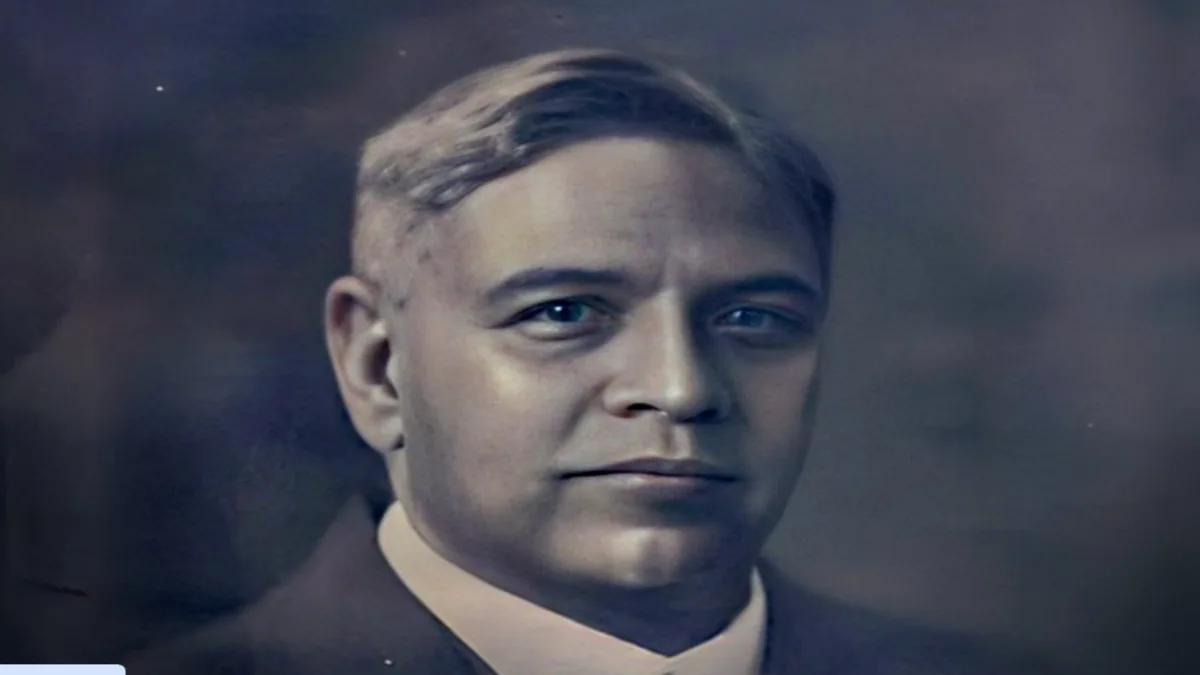
In the mid-nineteenth century, in the dust-laden courtyard of an impoverished, humble home in Netra village—located in the Diamond Harbour subdivision near Jaynagar in South 24 Parganas—a young boy watched helplessly as his mother, Revati Devi, succumbed agonisingly to an incomprehensible and incurable illness. The light of modern medical science had not yet reached those rural hinterlands; there were no experienced physicians, no accurate diagnosis, nor even the most basic medicine. The heartbreaking cries of that motherless child standing beside the funeral pyre transformed on that day into a profound spiritual and uncompromising nationalist resolve. Looking through tear-filled eyes at the leaping flames of the pyre, young Nilratan took a solemn oath: “I shall learn medical science, I shall strive to understand why my mother died prematurely, and I shall save the children of this unfortunate motherland from such helpless, unmedicated, and untimely deaths.”
Born on October 1, 1861, this fiercely brilliant and self-reliant boy would grow up to become Sir Nilratan Sircar—a pioneer of modern Indian medicine, a principal architect of national education, and a titan of Swadeshi industrialisation.
When we look back today, we see not merely the life-portrait of a successful physician, but the saga of a nation-builder breaking colonial shackles to forge a new India. Walking miles on foot through mud and water from his village to school, gaining admission to Campbell Medical School with the modest assistance of a benevolent patron, and earning his L.M.F. in 1879 and subsequently his M.D. degree with a gold medal from the University of Calcutta in 1890 through sheer determination and sharp intellect—the life of Nilratan Sircar was an extraordinary struggle. In an era of British colonial rule when European physicians viewed Indians as inherently incompetent in medical science, young Nilratan not only outshone them intellectually, but also demanded fees equal to those of white doctors, hoisting high the banner of national self-respect.
Deeply steeped in Swami Vivekananda’s ideal of ‘Shivajnane Jiva Seva’ (service to living beings as service to Shiva) and Practical Vedanta, and inspired by the monotheistic humanism of the Sadharan Brahmo Samaj, Sir Nilratan Sircar turned his entire life into a grand national sacrifice. On the one hand, he was the deeply trusted personal physician and close family intimate of Kabiguru Rabindranath Tagore—who held boundless faith in his medical mastery and wisdom. On the other hand, as the President of the first Governing Body of Acharya Jagadish Chandra Bose’s ‘Bose Institute’, he laid the administrative and financial foundations of modern India’s scientific research. During the turbulent days of the Anti-Partition Swadeshi Movement in 1906, alongside Taraknath Palit and Satish Chandra Mukherjee, he established the National Council of Education and the Bengal Technical Institute (which is today’s Jadavpur University). To guarantee India’s economic sovereignty, he established the historic ‘National Tannery’ and the Banga Laxmi Cotton Mill in Beleghata.
Yet, what a tragic historical irony! The very titan who rose through an unrelenting struggle against poverty to construct the independent framework of Indian science, medicine, education, and industry became, in the post-independence era, the target of a organized Leftist political-ideological assault on his monumental legacy. Over the past several decades, Communist and Naxalite intellectual circles, Left-wing historiographical centers, and their ideological adherents systematically carried out a campaign to erase or vilify the legacy of Sir Nilratan Sircar. Fitting him into the narrow mold of the Marxist ‘comprador bourgeois’ label—ranging from Rajani Palme Dutt’s India Today and Sumit Sarkar’s The Swadeshi Movement in Bengal to the Subaltern Studies collective and Comrade E.M.S. Namboodiripad’s party documents—this hero of Swadeshi industrialization was branded as a ‘representative of anti-national capitalism’. During the extremist Naxalite rampage of 1969–1970, under Saroj Dutta and Charu Majumdar’s ‘statue-smashing movement’, the institutions and philosophy bearing Nilratan Sircar’s name were deliberately targeted. Subsequently, during more than three decades of Left Front rule, NRS Medical College and Hospital was reduced to a breeding ground for trade unionism, CITU party cadre control, and administrative decay.
Swadeshi Science and Industry
To understand why Communists and Naxalites viewed the legacy of Sir Nilratan Sircar with deep hostility, one must first comprehend what Nilratan Sircar actually constructed for the institutional framework of modern India.
His life began in the village of Netra in South 24 Parganas, rising through the arduous struggles of a motherless child. When he earned his M.D. from the University of Calcutta and began independent medical practice, European physicians held a complete monopoly in Bengal. Historian Sujata Mukherjee, writing the biographical entry on Nilratan Sircar in Banglapedia: National Encyclopedia of Bangladesh (Second Edition, Asiatic Society of Bangladesh, Dhaka, 2012), notes that by demanding consultation fees equal to those of European doctors, Sircar elevated the professional dignity and parity of Indian physicians to unprecedented heights.
Yet, medicine was not merely his profession; it was his vehicle for nation-building. When Sir Jagadish Chandra Bose established Asia’s first multidisciplinary research center, the ‘Bose Institute’, in 1917, Sir Nilratan Sircar was nominated as the Chairman of its first Governing Body. According to archival records preserved at the Bose Institute, Sir Nilratan Sircar presided over the historic Governing Body meeting of the Bose Institute on September 8, 1919. Biographer Patrick Geddes, in his authoritative work The Life and Work of Sir Jagadish C. Bose (Longmans, Green and Co., London, 1920), provides a detailed account showing how the scientific movement in contemporary Bengal flourished under the administrative and social guardianship of nationalist thinkers like Nilratan Sircar.
Nor was his institutional leadership confined to the Bose Institute. In 1906, during the height of the Swadeshi Movement, Taraknath Palit and Sir Nilratan Sircar co-founded the ‘Society for the Promotion of Technical Education’, which established the ‘Bengal Technical Institute’. This very institution later evolved into today’s world-renowned Jadavpur University. Historians Haridas Mukherjee and Uma Mukherjee, in their documentary work The Origins of the National Education Movement (Jadavpur University, Calcutta, 1957), demonstrated how Nilratan Sircar forged technical education as a fundamental pillar of national sovereignty.
Furthermore, for two full decades from 1922 to 1941, he served as the President of the ‘Medical Education Society of Bengal’, managing Carmichael Medical College (now R.G. Kar Medical College and Hospital). His pivotal role as President of the Indian Association for the Cultivation of Science (IACS) from 1939 to 1941, and his establishment of the Journal of the Indian Medical Association (JIMA) in 1930 as its founding editor, represent timeless contributions to Indian science and medicine. Subsequently, at various seminars organized by the ‘Calcutta Medical Club’ and JIMA, Vice-Chancellor Syama Prasad Mookerjee appeared as chief guest and patron, advocating for the national dignity of Indian physicians.
In the industrial realm, his contributions were equally luminous. In 1905, amidst the roaring waves of the Swadeshi Movement, he established the ‘National Tannery’ and the ‘National Soap Factory’ in Beleghata. Historian Sumit Sarkar, in his landmark work The Swadeshi Movement in Bengal, 1903–1908 (People’s Publishing House, New Delhi, 1973), acknowledged that the Swadeshi industrial enterprises of Nilratan Sircar and Prafulla Chandra Ray constituted a major stream of India’s movement for economic self-reliance. Rajat Kanta Ray, in his Industrialization in India: Growth and Conflict in the Private Corporate Sector, 1914–47 (Oxford University Press, Delhi, 1979), analyzed how Sircar’s leather and chemical enterprises mounted a formidable resistance against British commercial monopoly.
Sanatan Thought, Swadeshi ‘Hindutva’
The month of Ashwin, 1905. All of Bengal was ablaze against Lord Curzon’s decision to partition Bengal. Thousands of people marched barefoot to the ghats of the Ganges in Kolkata, as the immortal strains of Bankim Chandra Chattopadhyay’s ‘Vande Mataram’ echoed through the air. This movement was not merely a political protest; it was a historic proclamation of pained India’s Hindu cultural ethos and identity.
At the forefront of this Swadeshi mahayajna stood Sir Nilratan Sircar. Deeply inspired by Swami Vivekananda’s ‘Shivajnane Jiva Seva’ and Bankim Chandra’s maternal ethos in Anandamath, Sircar realized that political independence could not be achieved through speeches alone—it required economic and technological sovereignty. He grasped that if Hindu society was to be protected from colonial exploitation, it had to be anchored upon a powerful economic foundation of indigenous industry.
Sir Nilratan Sircar repeatedly emphasized in his writings and addresses that India’s Sanatan Hindu tradition and spiritual ethos formed the true driving force of the Swadeshi Movement. Following his passing in May 1943, an obituary published in Kolkata’s renowned periodical The Calcutta Municipal Gazette (Vol. 38, No. 2, May 1943) quoted his words: “No form of religion has any life-value to-day which fails to yield a living inspiration and social service, more especially the service of the lowly and the over-burdened, the afflicted, the downcast, the oppressed and the fallen.” In his eyes, this was the true spiritual and social manifestation of Sanatan Hindu Dharma.
January 2, 1920. The historic Senate House convocation stage of the University of Calcutta. Standing on the dais, the Vice-Chancellor, Sir Nilratan Sircar, delivered a historic address to the graduating students and Indian society. At a time when the British colonial government sought to restrict Indians to an education system designed merely to produce clerks, Nilratan Sircar declared from the Vice-Chancellor’s chair the goal of modern India’s scientific and technological sovereignty.
In that historic Convocation Address, he declared that to liberate India’s soul, reliance on European technology must end. Indians must manufacture medicines, vaccines, industrial goods, and scientific instruments in their own laboratories. He explicitly stated that reviving the glorious scientific legacy of ancient India’s Aryabhata, Varahamihira, Charaka, and Sushruta within modern research laboratories constituted the highest form of patriotism. A contemporary article published in The Modern Review (August 1935 issue) documented how Vice-Chancellor Syama Prasad Mookerjee later created special funds at the University for ‘Indian Medicine’ and scientific research—a vision originally conceptualized by Sir Nilratan Sircar. Both Sircar and Dr. Syama Prasad Mookerjee firmly believed that unless modern medical science was synthesized with India’s traditional knowledge systems, India’s healthcare system could never achieve true self-reliance.
Furthermore, giving administrative and institutional shape to the immense benefactions of Sir Taraknath Palit and Sir Rashbehari Ghosh, Sircar established the University College of Science (Rajabazar Science College). Sircar’s foundational role in creating the research environment for Nobel laureate physicist C.V. Raman was gratefully remembered by Professor G. Venkataraman in his biography Journey into Light: Life and Science of C.V. Raman (Indian Academy of Sciences, Bangalore, 1988). In various essays published in The Modern Review, Sircar wrote that scientific pursuit was not an alien concept to Indians, but the modern manifestation of the Sanatan rishis’ eternal quest for truth.
Simultaneously, he provided free medical treatment to the poorest sweepers and working-class people of Sealdah and Beleghata. His role in establishing Kolkata’s ‘Chittaranjan Seva Sadan’, ‘Jadavpur Tuberculosis Hospital’, and the ‘Calcutta Medical Club’ was monumental. An article published in The Indian Messenger (Vol. 131, December 2013), the journal of the Sadharan Brahmo Samaj, documented how Sir Nilratan Sircar set a historic precedent of social reform by extending free medical care to the underprivileged and oppressed sections of Hindu society.
Communal Award and the Struggle for Hindu Rights
The 1930s marked a deeply critical juncture in Bengal’s political history. In 1932, British Prime Minister Ramsay MacDonald’s announcement of the ‘Communal Award’ represented a calculated plot to reduce the majority Hindu community of Bengal to a politically disenfranchised minority. Re-evaluating the history of the great personalities who raised their voices during this period to defend the rights of Hindu Bengal, wage legal battles, and preserve Hindu social existence is of paramount importance.
A vital historical fact and documented truth must be clarified here. In modern historical discourse and political commentary, a major name-based confusion frequently arises. In the 1930s, the eminent jurist and politician who created a storm in defense of Hindu rights as Law Member of the Viceroy’s Executive Council and leader in the anti-Communal Award movement was Sir Nripendra Nath (N.N.) Sircar. On the other hand, the pioneer of modern medicine, educator, and architect of the Swadeshi Movement was Sir Nilratan Sircar.
Historical records delineate the distinct contributions of these two eminent ‘Sircars’. The historical compilation edited by B.N. Dutta Roy, Sir N.N. Sircar’s Speeches and Pamphlets (Book Company, Calcutta, 1934), records Nripendra Nath Sircar’s legal speeches and defense of Hindu rights. Historian Chandiprasad Sarkar, in his research monograph The Bengali Hindu Homeland Movement: 1932–1947 (Minerva Associates, Calcutta, 1991), discussed in detail how the veteran Sir Nilratan Sircar, Dr. Prafulla Chandra Ray, and the young Syama Prasad Mookerjee stood united on a common platform against the economic and political discrimination wrought by the Communal Award.
Although Sir Nilratan Sircar remained detached from electoral party politics, he recognized that the Communal Award was not merely about political seat distribution—it was a conspiracy to dismantle Bengal’s education, literature, healthcare, and nationalist institutions. Reports published in contemporary Bengali journals such as Prabasi and Bharatvarsha reveal that Nilratan Sircar regularly hosted discussions at his Sealdah residence with leaders like Syama Prasad Mookerjee, Dr. B.S. Moonje, and Pandit Madan Mohan Malaviya.
When Syama Prasad Mookerjee assumed the leadership of the All India Hindu Mahasabha in 1939 and subsequently issued a clarion call for Hindu rights and nationalist consciousness in Bengal, one of his primary moral and intellectual pillars was the network of medical and educational institutions built by Sir Nilratan Sircar. In the sunset years of his life, Sircar reposed immense faith in Syama Prasad, believing that Mookerjee’s political vision would safeguard the achievements won through the Swadeshi Movement.
The highest national recognition of Sir Nilratan Sircar’s nationalist legacy appears in his biographical entry authored by historian Sujata Mukherjee in Banglapedia: National Encyclopedia of Bangladesh (Asiatic Society of Bangladesh, Dhaka, 2012) and within the archival records of the Nehru Archive. On Sircar’s birth centenary in 1961, India’s first Prime Minister, Jawaharlal Nehru, paid rich tribute, writing: “I should like to pay my tribute to a great physician, a great nationalist and a great man.”
Sir Nilratan Sircar and Dr. Syama Prasad Mookerjee
In the annals of modern India’s national resurgence and Bengal’s intellect, science, and political rights, the connection between Sir Nilratan Sircar and Dr. Syama Prasad Mookerjee (1901–1953) was not merely a relationship between two eminent men of two generations; it was an indestructible bridge of a shared nationalist mission and civilizational philosophy.
May 1924. A sudden bolt from the blue stunned all of Bengal. In Patna, the ‘Tiger of Bengal’, Sir Ashutosh Mookerjee, passed away unexpectedly. Ashutosh’s untimely demise left not only the University of Calcutta but the entire nationalist educational movement of India completely orphaned. Ashutosh’s grieving family and his twenty-three-year-old son, Syama Prasad Mookerjee, were burdened with immense anxiety.
In this historical hour of crisis, Sir Nilratan Sircar stepped forward as a senior, fatherly guardian to stand beside Syama Prasad. Nilratan Sircar had shared a long, deep friendship and mutual respect with Sir Ashutosh. From 1919 to 1921, when Sir Nilratan served as Vice-Chancellor of the University of Calcutta, Ashutosh had been the soul of the University’s Post-Graduate Council in Teaching.
Historian Dinesh Chandra Sen, in his memoir Ashutosh Smriti (Calcutta, 1925), and the centenary volume Hundred Years of the University of Calcutta (Calcutta University Press, 1957), meticulously document how, following Sir Ashutosh’s passing, Sir Nilratan Sircar guided and encouraged young Syama Prasad to enter the university’s administrative and institutional affairs. Dr. Syama Prasad Mookerjee, in his autobiographical work Leaves from a Diary (Oxford University Press, New Delhi, 1993), recalled with deep emotion how Sir Nilratan Sircar encouraged him to become a member of the Calcutta University Syndicate and provided constant guidance at every step. Syama Prasad wrote that after losing his father, Sir Nilratan’s affectionate presence gave him the strength to remain steadfast in education and public service. When Sir Nilratan guided young Syama Prasad into governance roles, it was not mere personal affection; it was the historic passing of the torch of nationalist leadership to a worthy next generation.
In 1934, when Dr. Syama Prasad Mookerjee assumed charge as the youngest Vice-Chancellor of the University of Calcutta at the age of thirty-three, his primary guide on the dais was former Vice-Chancellor Sir Nilratan Sircar. As documented in Patrick Geddes’ classic biography The Life and Work of Sir Jagadish C. Bose (Longmans, Green and Co., London, 1920), when challenges arose regarding the financial and administrative autonomy of the Bose Institute and the Science College, Vice-Chancellor Syama Prasad Mookerjee acted upon the seasoned counsel of Nilratan Sircar.
When Sir Nilratan Sircar passed away in Almora on May 18, 1943, contemporary newspapers like Amrita Bazar Patrika (May 19, 1943) and The Calcutta Municipal Gazette (May 1943 issue) published Dr. Syama Prasad Mookerjee’s moving tribute. Later, on August 19, 1950, through the initiative and concurrence of West Bengal Chief Minister Dr. B.C. Roy and Syama Prasad Mookerjee, the historic ‘Campbell Medical School’ was renamed ‘Sir Nilratan Sircar Medical College and Hospital’ (NRS Medical College).
During the turbulent days of 1946–1947, when Dr. Syama Prasad Mookerjee waged the historic struggle for the ‘Bengali Hindu Homeland Movement’ to ensure West Bengal remained part of India, he repeatedly invoked the necessity of preserving the educational, scientific, and industrial institutions built by Sir Nilratan Sircar, Sir Ashutosh Mookerjee, and Acharya Prafulla Chandra Ray.
The Lens of Class Struggle and the ‘Comprador Bourgeois’ Label
The question then arises: how did Left-wing intellectuals manage to cast a shadow of obscurity over such a monumental hero of Indian culture and science? The answer lies rooted in the Marxist-Leninist class-struggle analysis of history.
Following its establishment in 1925, and later through the CPI(M) formed in 1964 and radical Naxalite factions, the Communist Party applied a rigid class framework to evaluate India’s nationalist history. In this Marxist historiography, the nationalism of the nineteenth and twentieth-century bhadralok class was portrayed merely as middle-class self-interest compromising with imperialism.
The most influential written articulation of this theory is found in British-Marxist theorist Rajani Palme Dutt’s foundational work India Today (Victor Gollancz, London, 1940). Palme Dutt argued that the Swadeshi Movement and India’s professional middle class (including doctors, lawyers, and industrialists) constituted a petty-bourgeoisie lacking organic links to the peasantry and working class, using nationalism as a cloak to consolidate class capital.
This same perspective was echoed in CPI leader E.M.S. Namboodiripad’s book A History of Indian Freedom Struggle (Social Scientist Press, Trivandrum, 1986). Namboodiripad argued that Indian nationalist leaders and professionals who accepted knighthoods, held positions in colonial university administrations, or founded industrial enterprises were essentially ‘comprador bourgeoisie’—collaborators with colonial capitalism.
Through this narrow ideological lens, a visionary architect like Sir Nilratan Sircar was permanently branded by Leftists as a ‘suspect class enemy’. The historical reality—that he achieved success through personal merit, commanded equal respect from Europeans, accepted a knighthood, yet poured his personal wealth into scientific research and free medical care—could not be accommodated within Marxist historiography. To acknowledge this truth would crumble their simplistic narrative that “bhadralok leaders were imperialist lackeys.” Consequently, Sircar’s peerless contributions were relegated to a suppressed footnote in mainstream Leftist history.
Subaltern Studies, Academic Propaganda, and Textbook Distortion
Following the rise of the CPI(M)-led Left Front government in West Bengal in 1977, complete authority over higher education, universities, archives, and historical research passed into the hands of Left-wing intellectuals. Dwaipayan Bhattacharyya, in his insightful analysis Government as Practice: Democratic Left in a Transforming India (Cambridge University Press, Cambridge, 2016), demonstrated how the CPI(M) utilized state power to systematically erase nationalist reformers and professionals from curricula and textbooks, replacing them with party-approved narratives of Communist peasant and trade union movements.
A primary vehicle for this academic campaign was the ‘Subaltern Studies’ project operating out of the Centre for Studies in Social Sciences, Calcutta (CSSSC) during the 1980s. Ranajit Guha, in his preface to Subaltern Studies: Writings on South Asian History and Society (Vol. I, Oxford University Press, Delhi, 1982), explicitly declared the project’s intent to dethrone “elite” nationalist leaders to write the history of the subaltern classes.
Under the guise of academic research, this Subaltern project systematically diminished the historical significance of elite nationalist institution-builders. Partha Chatterjee, in his internationally cited work The Nation and Its Fragments: Colonial and Postcolonial Histories (Princeton University Press, Princeton, 1993), claimed that bhadralok nationalists like Nilratan Sircar used the language of colonial modernity primarily to assert cultural hegemony over the lower classes and working masses.
Similarly, Dipesh Chakrabarty, in Provincializing Europe: Postcolonial Thought and Historical Difference (Princeton University Press, Princeton, 2000) and his essay “Conditions for Knowledge of Working-Class Conditions” (Economic and Political Weekly, May–June 1983), argued that the history of nationalist professionals and industrialists was merely the history of capital, obscuring the history of the working class.
The direct impact of this ideology was visible in the history textbook revisions carried out by the West Bengal Board of Secondary Education in 1980, 1988, and 1995. Historian Sekhar Bandyopadhyay, in Caste, Protest and Identity in Colonial India (Oxford University Press, New Delhi, 2011), noted how this historiography suppressed institutional excellence in favor of select political movements. As a result, while younger generations read extensive chapters on Karl Marx, Vladimir Lenin, or Mao Zedong, the names of Sir Nilratan Sircar, Sir Taraknath Palit, or Sir R.N. Mookerjee were virtually erased from school syllabi.
Naxalite Rampage and the Murder at Jadavpur University
Where parliamentary Communists sought to erase Sir Nilratan Sircar’s legacy through curricula and theory, radical Naxalites in the late 1960s attempted the same through violence, statue-smashing, and physical destruction of institutions.
Inspired by Mao Zedong’s ‘New Democratic Revolution’ and Cultural Revolution, the CPI(ML) under Charu Majumdar unleashed a reign of terror in Bengal between 1969 and 1972. Researcher Rabindra Ray, in his authoritative work The Naxalites and Their Ideology (Oxford University Press, Delhi, 1988), documented how Naxalites followed Majumdar’s ‘annihilation of class enemies’ line, targeting not only police and landlords, but also Bengal’s intellectuals, teachers, and nationalist institutions.
Sumanta Banerjee, in his history In the Wake of Naxalbari: A History of the Naxalite Movement in India (Subarnarekha, Calcutta, 1980), showed how Naxalites declared war on the figures of the Bengal Renaissance and Swadeshi era. In Naxalite ideology, figures like Raja Rammohun Roy, Ishwar Chandra Vidyasagar, Rabindranath Tagore, Prafulla Chandra Ray, and Nilratan Sircar were branded as ‘bourgeois class enemies’ and ‘imperialist lackeys’.
Saroj Dutta (writing under the pseudonym ‘Shashanka’), the chief cultural theorist of the CPI(ML), penned two famous essays in the party organ Deshabrati in 1970: “In Support of Statue-Smashing” and “On Vidyasagar”. Dutta argued that until the youth smashed the statues of “bourgeois icons” like Vidyasagar, Tagore, or Nilratan Sircar, a genuine proletarian revolution was impossible. In August 1970, Charu Majumdar himself hailed this student ‘statue-smashing movement’ in Deshabrati and Liberation as a manifestation of revolutionary class hatred.
The practical consequences were horrific. In March 1970, Naxalite mobs ransacked the Vice-Chancellor’s offices at Presidency College and Calcutta University. On March 24, 1970, they vandalized Jadavpur University—the modern incarnation of the Bengal Technical Institute co-founded by Sir Nilratan Sircar. On October 20, 1970, the marble statue of Ishwar Chandra Vidyasagar at College Square was decapitated with hammers, and on the same day, the statue of world-renowned chemist Acharya Prafulla Chandra Ray was smashed. On December 30, 1970, the Vice-Chancellor of Jadavpur University, Professor Gopal Chandra Sen, was brutally murdered on campus with iron rods and knives by Naxalite assassins.
That the Vice-Chancellor of the very university built through Nilratan Sircar’s toil and resources was murdered, and the statue of his comrade Acharya P.C. Ray smashed, stands as chilling proof of the Naxalite drive to obliterate Sircar’s institutional legacy.
NRS Medical College — the Violent Conflict of 2019
The most direct and tragic political assault on Sir Nilratan Sircar’s memory occurred within his namesake institution—’Nil Ratan Sircar Medical College and Hospital’ (NRS Medical College).
Beginning as Sealdah Medical School in 1873, Nilratan Sircar entered as a student in 1877 and received his diploma in 1879. On August 19, 1950, independent India’s nationalist government renamed the institution ‘Nil Ratan Sircar Medical College and Hospital’ in honor of his monumental contributions.
However, during thirty-five years of Left Front rule, this national institution was converted into a stronghold of CITU and CPI(M) party cadre politics. Prasanta Roy, in his research paper “Left Parties and Trade Unions in West Bengal” (Journal of Indian School of Political Economy, Vol. 14, No. 3, 2002), documented with empirical data how CITU established absolute party control over non-teaching staff, ward boys, and administrative departments. Consequently, medical professionalism, physician autonomy, and patient care were subordinated to party interests.
The culmination of this long administrative decay erupted violently in June 2019 at NRS Hospital. On the night of June 10, 2019, a 75-year-old patient, Mohammed Shahid, passed away at NRS Hospital. On the night of June 11, nearly 200 armed outsiders arrived in trucks and launched a brutal attack on NRS interns and junior doctors. Dr. Paribaha Mukhopadhyay suffered a fractured skull from a heavy stone thrown by the mob and was admitted to the ICU in critical condition; another doctor, Dr. Yash Tekwani, was severely injured.
A premier medical college, with Sir Nilratan Sircar’s name carved at its entrance, saw armed mobs rampage through its premises while police stood by passively—a spectacle that shocked the global medical community. In protest, NRS doctors shut the gates and initiated a strike.
The response of the state political leadership was even more shocking. Reports in The Tribune India and Outlook India (June 13, 2019) recorded that Chief Minister Mamata Banerjee visited SSKM Hospital and issued a four-hour ultimatum to the striking doctors, alleging the protest was a “political conspiracy”. She publicly remarked: “I condemn the agitation… The strike by junior doctors is a political conspiracy.”
In protest against this political deflection, the Principal of NRS Medical College, Prof. Saibal Kumar Mukhopadhyay, and Vice-Principal Sourav Chattopadhyay resigned. Over 300 senior and junior doctors across West Bengal submitted mass resignations. The Indian Medical Association (IMA)—founded by Sir Nilratan Sircar himself—called a nationwide medical strike. Thousands of doctors in Chandigarh, Delhi, Mumbai, and Bengaluru wore black badges in solidarity with NRS doctors.
To see the namesake institution of a man who spent his life providing free medical care to the poor turned into an arena of political violence, and to have doctors’ grievances dismissed as political conspiracy, marked the ultimate political desecration of Sir Nilratan Sircar’s legacy.
The Weaponization of the Knighthood
The cheapest yet sharpest weapon of character assassination deployed by Communist propaganda against Sir Nilratan Sircar was his knighthood. On June 26, 1918, the Crown conferred a Knighthood upon him for his extraordinary contributions to medicine and science (published in The London Gazette, August 2, 1918).
Left-wing columnists weaponized the title ‘Sir’ to brand him an “imperialist lackey” or “collaborator in nationalist disguise”. Yet history proves that after receiving his knighthood, Sircar never compromised on funding Swadeshi movements, operating the National Tannery, or maintaining the administrative autonomy of the Bose Institute and Science College.
C.A. Bayly, in The Local Roots of Indian Politics: Allahabad 1880–1920 (Oxford University Press, 1975), demonstrated how Indian professionals in the late 19th and early 20th centuries utilized colonial titles and social prestige as shields to protect national institutions.
John Gallagher and Anil Seal, in their joint study “Imperialism and Nationalism in India” (Modern Asian Studies, Vol. 15, No. 3, 1981), showed that accepting colonial honors did not equate to imperialist co-optation. Figures like Sir Nilratan Sircar, Sir Jagadish Chandra Bose, and Sir C.V. Raman used this recognition to validate Indian scientific and medical competence globally.
The Leftist strategy against Sircar was a classic example of what Noam Chomsky and Edward S. Herman defined in Manufacturing Consent: The Political Economy of the Mass Media (Pantheon Books, New York, 1988) as “Propaganda by Omission”.
This mechanism operated through four channels:
Strategic Omission: CPI(M) organs like Ganashakti or Deshabhitaishee completely omitted Sircar’s and P.C. Ray’s contributions in special issues on Swadeshi history.
Class Reframing: Whenever mentioned, Sircar was framed merely as a “tycoon doctor” or “feudal-bourgeois figure”.
Counter-Narrative Construction: Displacing institutional builders to elevate party trade union leaders as sole historical icons.
Institutional Capture: Arun Mazumdar, in The Politics of Left in Indian States (Academic Foundation, 2008), detailed how West Bengal universities systematically appointed Left-leaning faculty to cultivate generations trained to disregard traditional nationalist architects.
Unconquerable Legacy of NRS
Have thirty-five years of political propaganda, textbook erasure, character assassination over a knighthood, or the decay at NRS Hospital succeeded in erasing Sir Nilratan Sircar from history?
The answer is an emphatic no.
Sir Nilratan Sircar built institutions that transcend ephemeral political ideologies. NRS Medical College continues to treat thousands of poor patients daily free of cost; the Bose Institute advances world-class scientific research; Jadavpur University stands as a premier center of technical education; and the Indian Medical Association (IMA) remains the steadfast guardian of Indian physicians.
Economists Maitreesh Ghatak and Sanchari Roy, in “West Bengal’s Trajectory: An Assessment” (Economic and Political Weekly, Vol. 47, No. 42, 2012), demonstrated empirically how West Bengal plummeted in industrial, health, and institutional metrics during thirty-four years of Left rule. The state paid a heavy price in institutional decay for undermining the foundations of professional integrity, industrial enterprise, and education laid by Sircar.
Nobel laureate Amartya Sen, in The Argumentative Indian: Writings on Indian History, Culture and Identity (Farrar, Straus and Giroux, New York, 2005), argued that India’s true modernity lies in its institutional reconstruction and rational thought. Sir Nilratan Sircar was a premier pioneer of that rational, institution-building India.
Parliamentary Communism or radical Naxalite ideology may brand Sir Nilratan Sircar a ‘bourgeois’ or ‘imperialist lackey’, but when history holds court, the ultimate verdict rests in his hospitals, his factories, and his scientific laboratories.
Those whose history is erasure can never erase the architects of creation. Sir Nilratan Sircar was, is, and shall forever remain an unconquerable icon in the history of India’s self-respect.