NEW DELHI: “वृक्ष कबहुँ नहिं फल भखै, नदी न संचै नीर। परमारथ के कारने, साधुन धरा शरीर।” The timeless couplet captures a philosophy that defined the life of Ashok Singhal a life in which personal achievement took a back seat to service, organisation and the larger cause of society.
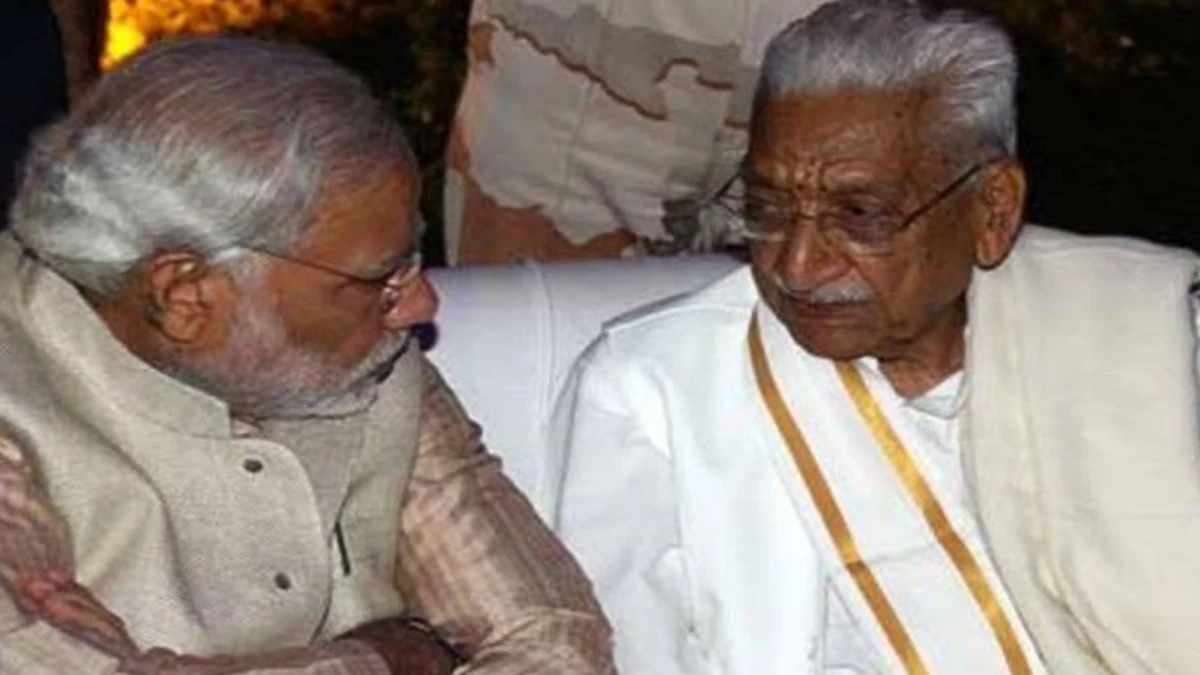
As the nation marks the birth centenary of Ashok Singhal, beginning September 27, attention has once again turned to a personality whose life intersected with some of the most significant social, cultural and organisational movements of modern Bharat. Prime Minister Narendra Modi, in his September 27 Mann Ki Baat address, remembered Singhal as a former International Working President of the Vishwa Hindu Parishad who dedicated his life to culture, society and the nation.
Shri Ashok Singhal was formidable…firm in conviction and remarkable in his simplicity.
He combined spiritual commitment with tireless organisational work and an unwavering dedication to social unity.
Penned a tribute to him.https://t.co/Duq6gaFVo0
— Narendra Modi (@narendramodi) September 28, 2026
For those who worked closely with him, however, Singhal was more than a public figure associated with a major movement. He was an organiser who travelled extensively, a mentor to Karyakartas, an advocate of social harmony, a supporter of education and Vedic learning, and a deeply spiritual personality with a strong connection to saints and seers.
A handwritten letter that became a lifelong memory
One of the earliest memories of Singhal goes back to 1981, when a young Narendra Modi was carrying out organisational responsibilities. A handwritten letter from Singhal arrived with details of an upcoming programme and tasks that needed to be completed.
For a young Karyakarta, that letter was significant. In the decades that followed, Modi would have numerous opportunities to interact with Singhal and witness his working style at close quarters.
Singhal was known for his relentless schedule. He travelled to remote parts of the country, including tribal regions of Gujarat, driven by the question of what more could be done for people living on the margins.
Natural disasters brought another dimension of his work to the fore. Whenever calamity struck, he would either reach the affected region himself or mobilise Karyakartas for relief and rehabilitation. His work following the 2001 Kutch earthquake remains among the experiences remembered by those who worked alongside him.
From a prosperous family to a life of renunciation
Singhal came from an accomplished and prosperous family. His father, Shri Mahavir Ji, was a distinguished administrator. His brother BP Singhal became a police officer and later a Member of Parliament, while another brother, VP Singhal, served as Chief Secretary of Tripura when the state had recently been formed. Other members of the family made their mark in commerce and agriculture.
But Ashok Singhal chose a markedly different path.
Growing up in Prayagraj, he spent long periods at the Sangam. The rivers drew his attention, but so did the saints, seers and devotees who gathered there. Those encounters deepened his understanding of Bharat’s cultural traditions and strengthened his desire to devote his life to society.
That calling eventually brought him to the Rashtriya Swayamsevak Sangh (RSS), where he embraced responsibilities with discipline, enthusiasm and a strong sense of duty.
The organiser with the voice that could command a crowd
Singhal’s organisational influence rested not merely on his position but on his ability to build institutions, mobilise people and sustain movements through persistence. He possessed a powerful voice and an oratorical style capable of holding large gatherings. Yet those who knew him closely also remember his simplicity and his concern for fellow Karyakartas.
His relationship with the Sant Samaj was another defining feature of his public life. Saints and seers across the country respected him, valued his counsel and maintained a close association with him.
Two international events illustrated his organisational reach.
In 1993, the Vishwa Hindu Parishad organised a convention in the United States to mark 100 years since Swami Vivekananda’s historic Chicago address. The scale of taking such an event overseas, coordinating different stakeholders and building a common platform demonstrated Singhal’s organisational capabilities.
Then, in 2000, the World Hindu Conference in Port of Spain, Trinidad and Tobago, became another occasion where his presence energised participants. His words of appreciation for fellow Karyakartas were remembered as a source of encouragement and motivation.
The Ram Janmabhoomi movement and an enduring image
No account of Ashok Singhal’s public life can overlook his central role in the Ram Janmabhoomi movement. His address at the Boat Club Rally in 1991 became one of the defining moments associated with the movement. So too did the image of Singhal injured and bleeding during its turbulent phase.
His supporters and associates regard his contribution as an important part of the long campaign that eventually culminated in the construction of the Ram Mandir in Ayodhya.
Prime Minister Modi, while recalling Singhal on his birth centenary, similarly connected the energy and direction he brought to the Ram Janmabhoomi movement with the grand temple that stands in Ayodhya today. Modi also recalled thinking of Singhal while participating in the Ram Mandir’s Pran Pratishtha ceremony.
Beyond the movement: A strong message of social harmony
Singhal’s legacy was not confined to religious and cultural mobilisation. He repeatedly emphasised social unity, equality and dignity. His belief was that society could not be divided by distinctions of status and that every individual deserved respect.
That thinking was reflected in his decision concerning the laying of the first brick of the Ram Mandir. Kameshwar Choupal, a grassroots VHP Karyakarta from Bihar belonging to a marginalised section of society, was chosen for the task.
His efforts to strengthen social bonds also extended to the Dom Raja of Kashi, whom Singhal sought to honour during a Dharm Sansad in Kashi and with whom he subsequently worked on community initiatives.
These episodes formed an important part of the wider social philosophy associated with his work: cultural awakening, in his vision, was inseparable from social cohesion.
Education, Vedic learning and the music in his voice
Education was another cause close to Singhal’s heart. An alumnus of BHU, he was known as a good student and a voracious reader. He was closely associated with the Ekal Vidyalaya initiative, which sought to take basic education to remote villages, particularly among tribal communities.
He also encouraged younger Karyakartas to read extensively, believing that intellectual preparation was essential for meaningful social work. But there was another, less frequently discussed side to his personality his love for music.
Those who attended meetings with him in Nagpur recall him singing the Ekal Geet, often transforming the atmosphere of an otherwise organisational gathering. Even at the age of 90, Singhal surprised those attending his birthday celebrations in 2015 by singing “हे मातृभूमि मेरी, हे पितृभूमि मेरी”, an episode that subsequently drew wide attention.