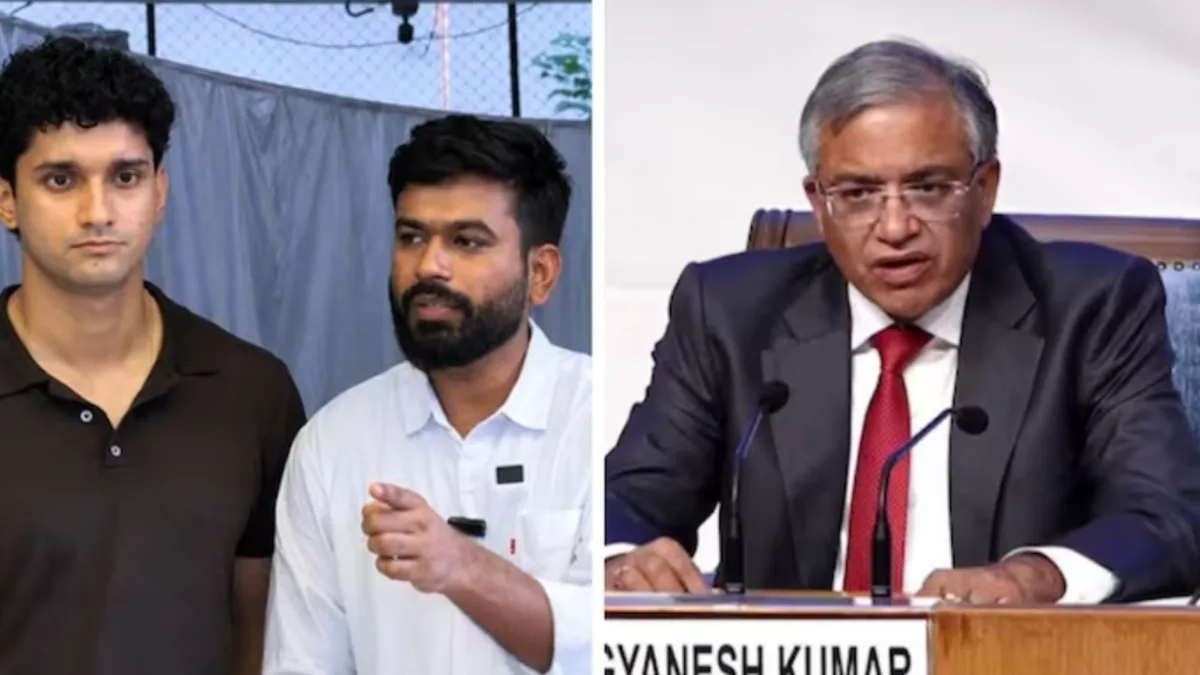
The cockroaches are back in the kitchen. The latest political controversy surrounding the Election Commission of India (ECI) began after the Cockroach Janta Party (CJP) gave Chief Election Commissioner Gyanesh Kumar 48 hours to resign, threatening nationwide protests if he did not. The demand followed allegations & claims by the private media investigation reporting that Election Commissioners Sukhbir Singh Sandhu and Vivek Joshi had formally objected, on at least 14 occasions over 10 months, to decisions and processes within the poll panel.
That certainly provides political ammunition to the Opposition. Rahul Gandhi and other Opposition leaders have already raised questions about the Election Commission’s handling of the Special Intensive Revision (SIR) of electoral rolls. But the more important question is whether the investigation by private media platform, by itself, establishes wrongdoing. It does not.
The report is significant because it reveals internal disagreement at the highest level of the country’s electoral machinery. That deserves public scrutiny. But a disagreement among constitutional functionaries is not automatically evidence of illegality, electoral manipulation or institutional capture.
The Election Commission is a multi-member constitutional body. Its structure exists precisely because important decisions should be deliberated collectively. The fact that an Election Commissioner records an objection is not proof that democracy has been compromised. In fact, the ability to record dissent can itself be regarded as an important institutional safeguard.
The investigation says Sandhu and Joshi objected to several decisions concerning voter registration, deletion and restoration of names, changes to Form 6 and the management of electoral-roll data. Some objections reportedly alleged that particular steps were “unauthorised” or “illegal”. Those are serious assertions. They should not be dismissed merely because they originated as internal notes. At the same time, an internal allegation remains an allegation until the underlying facts are independently established.
The ECI’s response is equally important. The Commission said that they formed part of normal internal deliberation and that decisions taken by the Commission, including those concerning SIR, were unanimous. The statement was issued collectively by all three commissioners. This distinction matters.
The Supreme Court’s 1995 judgment in T.N. Seshan v. Union of India recognised that the law contemplated unanimity “as far as possible” in the functioning of a multi-member Election Commission, while providing for a majority decision where unanimity could not be achieved. Therefore, recording a dissent during deliberations is not equivalent to a final institutional disagreement. Nor does an objection automatically invalidate the eventual decision.
The West Bengal numbers similarly require careful interpretation. The fact that deletions in some constituencies exceeded victory margins may appear politically explosive. But numbers alone do not establish causation. One must establish who was deleted, why they were deleted, whether the deletions were legally justified, how many successfully appealed and whether the pattern demonstrates intentional partisan discrimination.
Indeed, subsequent reporting shows that the ECI told the Supreme Court that 22.21 lakh of the 27.16 lakh voters removed in West Bengal had filed appeals for reinstatement. The Commission attributed deletions to categories including absent, shifted, dead and duplicate voters, while the process itself remains subject to scrutiny and appeals.
Electoral institutions must operate under an unusually high standard of transparency because the credibility of elections depends not merely on correct outcomes but on public confidence in the process. The real question is whether the evidence currently available demonstrates intentional electoral manipulation. That requires more than internal disagreement, political allegations or suggestive statistics.
Democracy requires intellectual discipline. An internal note is not a judicial finding. A technical failure is not automatically a conspiracy. A disagreement is not proof of institutional collapse. The Opposition is entitled to investigate, question and demand accountability. The ECI is equally obligated to explain itself with documentary clarity. The kitchen should certainly be inspected. But before declaring that there is a fire, we should establish where the smoke is coming from.