The Ayushman Bharat Pradhan Mantri-Jan Arogya Yojana (AB PM-JAY) has completed eight years since its launch, with the government reporting more than 48.51 crore Ayushman cards issued and around 13.25 crore hospital admissions supported under the scheme.
Launched on September 23, 2018, the scheme was introduced as a major government health assurance programme aimed at reducing the financial burden of hospital treatment for economically vulnerable families.
As of September 21, 2026, around 33 per cent of India’s population had Ayushman cards under PM-JAY. The government said the scheme had funded treatment worth approximately Rs 2.03 lakh crore as of August 31, 2026.
The treatment has been provided through a network of more than 38,000 empanelled public and private hospitals across the country.
At its core, PM-JAY provides cashless hospitalisation cover of up to Rs 5 lakh per family per year for eligible beneficiaries. The scheme currently covers 1,961 procedures across 27 medical specialties.
Eight years of expanding health coverage
PM-JAY was designed to provide financial protection to families that may otherwise struggle to afford secondary and tertiary healthcare.
The scheme covers beneficiaries identified through the Socio-Economic Caste Census (SECC) 2011, using specified deprivation and occupational criteria.
Over the years, however, the government has expanded the programme to include additional categories of beneficiaries.
In March 2024, around 37 lakh families of ASHAs, Anganwadi workers and Anganwadi helpers were brought under the scheme. By September 21, 2026, more than 44.81 lakh Ayushman cards had been generated for beneficiaries in these categories.
The expansion has also included specific groups covered through separate government initiatives.
These include eligible construction workers and their dependants, road accident victims covered under PM-RAHAT, transgender persons covered under the SMILE initiative, eligible children covered under PM CARES for Children, waste pickers and identified sanitation workers under NAMASTE, and Particularly Vulnerable Tribal Groups covered under PM-JANMAN.
Senior citizens brought into the fold
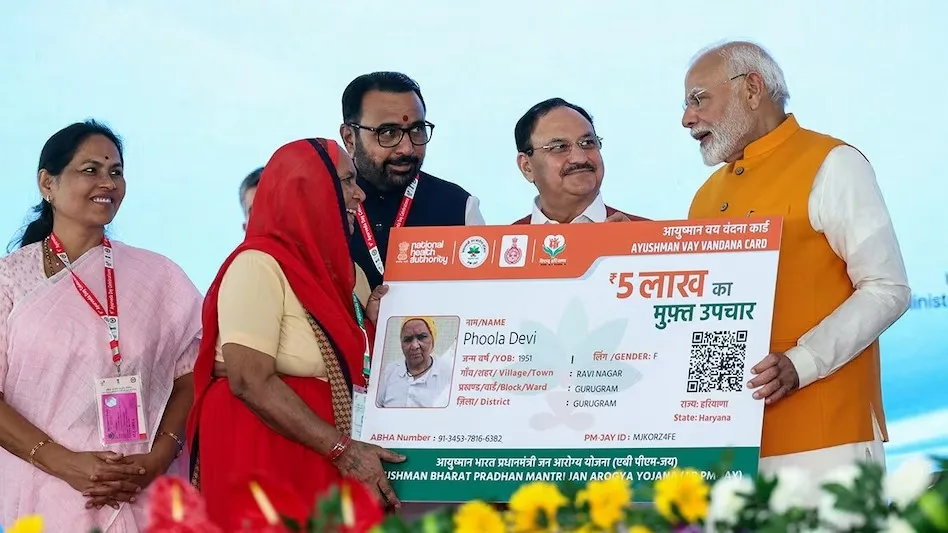
One of the biggest expansions of PM-JAY came in September 2024, when the government extended the scheme to cover all senior citizens aged 70 years and above, irrespective of their economic status under the specified programme framework.
The expansion was estimated to benefit around six crore senior citizens.
The government has introduced the Ayushman Vay Vandana card for this group.
As of September 21, 2026, more than 1.36 crore Ayushman Vay Vandana cards had been generated for senior citizens aged 70 years and above.
The expansion is significant because healthcare costs can increase substantially with age, particularly when people require hospitalisation or treatment for chronic and serious conditions.
Cashless treatment across a large hospital network
A central feature of PM-JAY is its cashless treatment mechanism.
Eligible beneficiaries can access treatment at empanelled public and private hospitals without having to make upfront payments for covered procedures, subject to the scheme’s terms.
The government has progressively expanded the hospital network to improve access to treatment across different regions.
More than 38,000 hospitals are currently part of the PM-JAY network, giving beneficiaries access to a wide range of healthcare providers.
The scheme covers procedures across 27 medical specialties, allowing beneficiaries to receive treatment for a broad range of medical conditions.
The government says the programme has funded treatment worth around Rs 2.03 lakh crore, reflecting the scale of healthcare utilisation since its launch.
PM-JAY is part of a wider Ayushman Bharat framework
PM-JAY is not a standalone programme. It forms one part of the broader Ayushman Bharat framework.
The government describes the framework through four major components:
Ayushman Bharat Pradhan Mantri-Jan Arogya Yojana
Ayushman Arogya Mandirs
Ayushman Bharat Digital Mission
PM-Ayushman Bharat Health Infrastructure Mission
Together, these initiatives are intended to address different stages of healthcare, from preventive and primary care to hospital treatment, digital health services and health infrastructure.
Ayushman Arogya Mandirs take primary healthcare closer to communities
The Ayushman Arogya Mandirs (AAMs) focus on providing comprehensive primary healthcare closer to people’s homes.
Their services include screening and management of common diseases, maternal and child healthcare, oral healthcare, eye care, ear-nose-throat services and mental health support.
The centres also provide first-level emergency and trauma care, essential medicines and diagnostic services.
An important part of the network is the use of technology to connect patients with healthcare professionals through telemedicine.
The government said more than 50 crore teleconsultations had been conducted through e-Sanjeevani, including consultations facilitated through Ayushman Arogya Mandirs, as of September 17, 2026.
The centres have also recorded cumulative footfall of more than 540 crore.
This primary healthcare network is intended to reduce the need for patients to travel long distances for basic medical services and help identify illnesses at an earlier stage.
Digital health gets a major push
The second major component of the Ayushman Bharat framework is the Ayushman Bharat Digital Mission (ABDM).
Launched in September 2021, ABDM seeks to create an interconnected digital health ecosystem in which health information can be accessed and shared through interoperable digital systems.
A key part of the initiative is the Ayushman Bharat Health Account (ABHA).
As of September 17, 2026, more than 97.61 crore ABHA IDs were operational, with over 119.95 crore health records linked to these accounts.
The digital infrastructure also includes the Healthcare Professionals Registry, Health Facility Registry and Unified Health Interface.
More than 5.78 lakh verified healthcare facilities and over 11 lakh healthcare professionals were registered on the digital platform as of the latest reported figures.
The aim is to make healthcare records and services more portable and improve coordination between patients, doctors and healthcare facilities.
Building India’s health infrastructure
The fourth major pillar is the PM-Ayushman Bharat Health Infrastructure Mission (PM-ABHIM).
The mission was launched on October 25, 2021, with a budget allocation of Rs 64,180 crore for 2021-26.
Unlike PM-JAY, which focuses primarily on financial protection for hospital treatment, PM-ABHIM is focused on strengthening the country’s health infrastructure.
Its objectives include improving disease surveillance, strengthening laboratories and expanding critical healthcare capacity.
The programme includes support for 23,224 rural health and wellness centres, 13,736 urban health and wellness centres, 3,389 block public health units, 744 integrated public health laboratories and 631 critical care hospital blocks.
These facilities are intended to improve India’s ability to respond not only to routine healthcare needs but also to disease outbreaks and public health emergencies.
From financial protection to a wider health system
The eight-year journey of Ayushman Bharat reflects an attempt to address healthcare at multiple levels.
PM-JAY provides financial support for hospitalisation. Ayushman Arogya Mandirs focus on primary and preventive care. ABDM is building a digital layer connecting patients, professionals and facilities, while PM-ABHIM is aimed at strengthening physical health infrastructure.
The scale of the programme has also grown through the inclusion of new beneficiary groups, particularly senior citizens and workers in selected categories.
With 48.51 crore Ayushman cards, 13.25 crore hospital admissions and treatment worth around Rs 2.03 lakh crore, PM-JAY has become a major component of India’s public healthcare architecture.
The government’s broader objective is to create a continuum in which people can access primary healthcare close to home, receive digital health services, and obtain financial protection when specialised hospital treatment is required.
As the scheme enters its ninth year, the focus is likely to remain on expanding coverage, increasing awareness among eligible beneficiaries, strengthening healthcare infrastructure and ensuring that the growing network of public and private hospitals can meet demand.