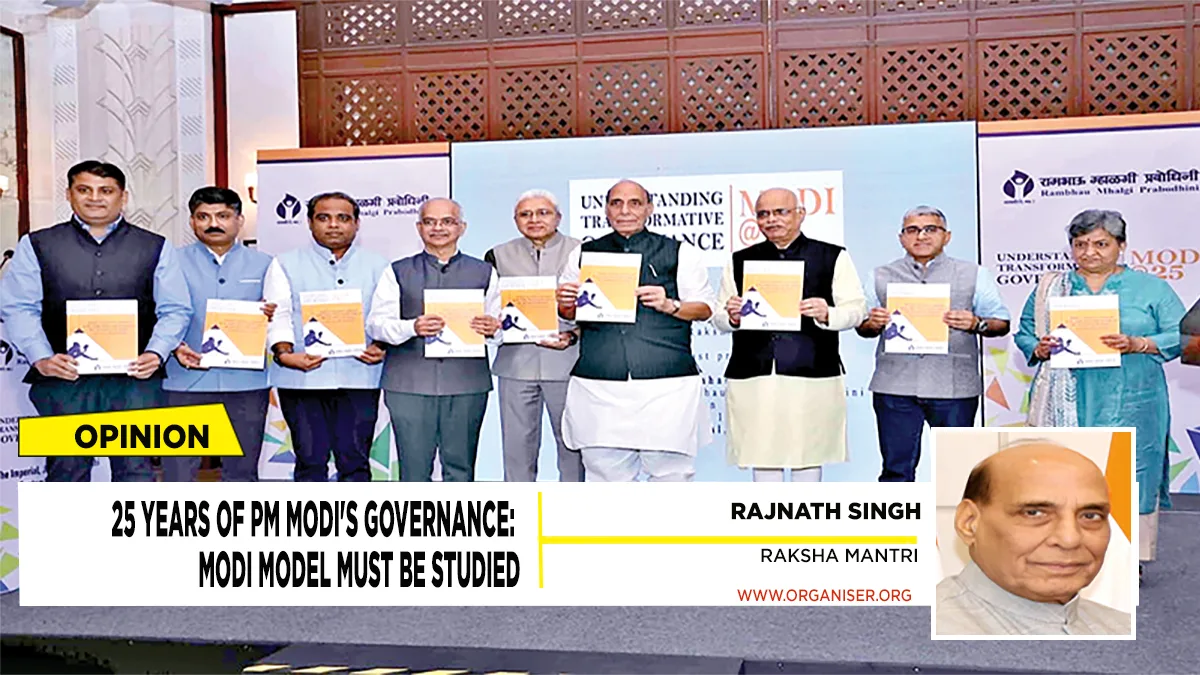
At the centre of this achievement is the governance model that PM Narendra Modi first developed as the Chief Minister of Gujarat and implemented at the national level after becoming Prime Minister.
Gujarat suffered massive destruction in the earthquake of 2001. It was during such a difficult time that PM Modi took charge as the Chief Minister of Gujarat. People felt that rebuilding Gujarat would be extremely difficult. However, Prime Minister Narendra Modi proved all those people wrong.
He transformed Gujarat’s development from “a Test match into a One Day Cricket Match”. His clear message to Ministers and officials was that files and development projects should not be kept pending or delayed. Instead, quick decisions must be taken to improve people’s lives and accelerate Gujarat’s development. He presented such an example of “Less Government, More Governance” in Gujarat that it became a model. This is still clearly visible in his way of working.
Governance on the Ground
PM Modi believes that the real test of good governance and policy takes place on the ground. When he became Prime Minister, he asked all Secretaries to visit the districts where they had received their first postings. He asked them to see for themselves what had changed there over the years and what improvement Government policies had brought to the lives of ordinary people. In other words, PM Modi believes that good governance should not be visible only in files; its positive impact should also be visible in the field.
He believes in “A Little Less Talk and a Lot More Action.” The result is that today, when the entire world is surrounded by uncertainties, Bharat is progressing under Modi Ji’s leadership with a growth rate of 7.8 per cent.
Today, Bharat’s UPI is the world’s largest real-time payment system. Today, Bharat is reaching new heights in space technology. Today, Bharat is the world’s second-largest mobile phone manufacturer. Moreover, more than approximately 99 per cent of mobile phones used in Bharat are now Made in India.
The biggest secret behind the success of Modi Ji’s governance model is that he considers every individual an equal partner in the development journey. Let me give you an example. When Modi Ji was the Chief Minister of Gujarat, he used to organise training camps for all Government employees
From needles to ships, toys to tanks, drones to aircraft, and containers to semiconductors, everything is being manufactured in Bharat today. Good governance and democracy complement each other. When governance becomes weak, people’s trust in democratic institutions begins to decline. And when democracy and democratic institutions become weak, accountability also weakens. This leads to poor governance.
Prime Minister Narendra Modi has worked to strengthen democracy through good governance. He has also promoted good governance by strengthening democratic institutions. Take Direct Benefit Transfer, for example. When money began reaching beneficiaries’ accounts directly, middlemen were brought under control and corruption was eliminated. This strengthened Good Governance and increased people’s trust in democracy.
Similarly, the Nari Shakti Vandan Adhiniyam was introduced to increase women’s participation in Parliament and State Legislatures. This will increase women’s representation in legislatures and strengthen democracy. Greater participation by women will also make policies more inclusive, thereby improving governance.
People as Partners
The biggest secret behind the success of Modi Ji’s governance model is that he considers every individual an equal partner in the development journey. Let me give you an example.
When Modi Ji was the Chief Minister of Gujarat, he used to organise training camps for all Government employees. In these camps, everyone from Ministers to Secretaries, and from junior to senior employees, would sit together and discuss problems. Even the most junior officer could give suggestions to an officer at the Secretary level. Modi Ji himself would also speak to everyone. He would understand their problems and learn about their opinions. In other words, Modi Ji has always believed that the more participatory the government is, the better the governance will be.
Bharat’s democratic tradition has always carried the spirit of participation and deliberation. There is a book titled Assembling India’s Constitution. In this book, the authors have highlighted that ordinary people also contributed to the making of the Constitution. People sent letters from every corner of the country to the Constituent Assembly, offering their suggestions and sharing their experiences. They reflected on the Constitution of India’s future. In other words, participation in governance and administration has been a part of India’s democratic culture. In other words, the policy is no longer that “the government speaks and the people listen.” Now, it is “the people speak, and the Government listens and acts.”
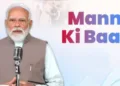
Another example is the Mann Ki Baat programme. This programme has become one of the best mediums for bringing people’s ideas and experiences to the forefront.
PM Modi believes in “Governance through Consensus.” For example, he launched the Samaras Gram Yojana in Gujarat. The objective of this scheme was to encourage villages to elect their village head through mutual consensus in Panchayat elections. There are two benefits of this. First, villages do not get divided into Phulera East and Phulera West. In other words, villages do not get divided into factions. Whoever becomes the village head carries out development work without discrimination. The second benefit is that money spent on elections is saved. This money can be used for development works. Today, when we talk about “One Nation, One Election,” the approach behind it is also to promote continuous development and Good Governance.
Reforms and Results
Before 2014, it was said about our country that Bharat was over-regulated and under-governed. PM Modi has worked to change this view. Today, Bharat is well-regulated and properly governed.
Earlier, people had to get their documents attested by a Gazetted Officer for many Government-related tasks. PM Modi introduced the system of self-attestation. Now, people do not have to make repeated visits to Government officials. They can self-attest their documents. Similarly, the interview system was abolished for Group C and many Group B jobs. This brought an end to the Parchi-Kharchi culture in interviews.
Likewise, for years, the country had many rules and laws that were no longer necessary. For example, if a passenger sat on someone else’s reserved berth, there was a provision for a criminal fine. PM Modi launched a campaign to change and eliminate such outdated rules and laws. Through the Jan Vishwas Reform, several such provisions have been changed, where criminal punishment was prescribed for minor mistakes. In many such cases, civil penalties have now been introduced in place of criminal penalties. In recent years, more than 40,000 compliances have been removed. More than 1,500 outdated and redundant laws have been abolished.
In the process of Good Governance, eliminating over-regulation is as important as creating better institutions and systems. PM Modi has worked to improve this entire process of governance. For example, earlier, a web of indirect taxes was spread across the country. Multiple types of taxes were imposed on the same product. Businesspeople had to understand different tax systems. This increased compliance costs as well as corruption.
PM Modi said that there should be a “One Tax, One Market” system across the country. After that, the GST system was implemented. Today, the tax structure across the country has become much simpler.
Good governance is not beneficial only for the economy. Good governance does not merely improve the “Ease of Doing Business” or enhance the quality of life. Rather, good governance also saves people’s lives. It improves safety and security as well. Before 2014, there were approximately 9,000 unmanned railway crossings in the country. Many accidents used to take place at such locations. Our Government identified this problem and decided to eliminate it in mission mode. Road Over Bridges and Under Bridges were constructed. Its impact was visible in railway safety. Today, compared to the period before 2014, train accidents have decreased by approximately 90 per cent. Similarly, consider the Ujjwala Yojana. Under this scheme, free LPG connections were provided, which reduced pollution. Women were freed from smoke. Their health improved. They received relief from the effort of collecting firewood and cow dung cakes. When they saved time, they started micro-industries.
I would like to give you an example of Good Governance in the Defence Sector. The entire structure of the ordnance factories had been waiting for change for many years. However, the previous government did not take the trouble to change it. Why? Because it was not a populist decision that would earn them votes.
But Modi Ji decided to change this structure. More than 40 Ordnance Factories were reorganised into seven Defence Public Sector Undertakings (PSUs). This decision was not easy. However, Modi Ji’s vision was clear: efficiency in defence production had to be increased, decision-making had to be accelerated, and innovation had to be promoted. Today, the results are before us. In 2025–26, Bharat’s defence production reached a record Rs 1.78 lakh crore. If we compare it with 2014, defence exports have increased 56 times, or, in other words, they have grown by more than 5,500 per cent.
Just think about 5,500 per cent. Not 55, not 550, but 5,500 per cent. Imagine that the country which once looked towards the world for defence equipment is today exporting defence equipment to more than 80 countries across the world.
Security and Development
Today, whether we talk about internal security or external security, under PM Modi’s leadership, security has been made a core priority of governance. Decisive and strict action has been taken against terrorism and Naxalism. Our forces have entered the homes of terrorists and killed them. And Bharat has now also achieved freedom from Naxalite violence. Left-wing extremists and their supporters disseminated a false narrative for a long time that Naxalism spread because of poverty. But the fact is that poverty spread because of Naxalism. Left-wing extremists did not allow development to reach several regions for decades.
Under the PM Modi Government, development is reaching every corner of the country. Work is being carried out in accordance with democracy and the Constitution. And now, the hood of Naxalism has been crushed. An organised ideological system also played a major role in promoting left-wing extremism. Over the past 25 years, this very system also made extensive attempts to create a narrative against PM Modi through astroturfing and gaslighting, that is, false sponsored campaigns. But such people forget that the public understands everything. The public sees everything. When the wheel of development moves on the ground and people’s lives improve, a false narrative cannot succeed.
When a poor person receives a permanent house under the Pradhan Mantri Awas Yojana, when water reaches every household through the Jal Jeevan Mission, when people receive electricity connections through the Saubhagya Yojana, when money reaches farmers’ accounts directly through the Pradhan Mantri Kisan Samman Nidhi, and when the poor receive free treatment through the Ayushman Bharat Yojana, no narrative can succeed. Then, only the work speaks. And when the work speaks, factors such as astroturfing and anti-incumbency are left behind. That is why PM Modi is gaining the trust of the people election after election.
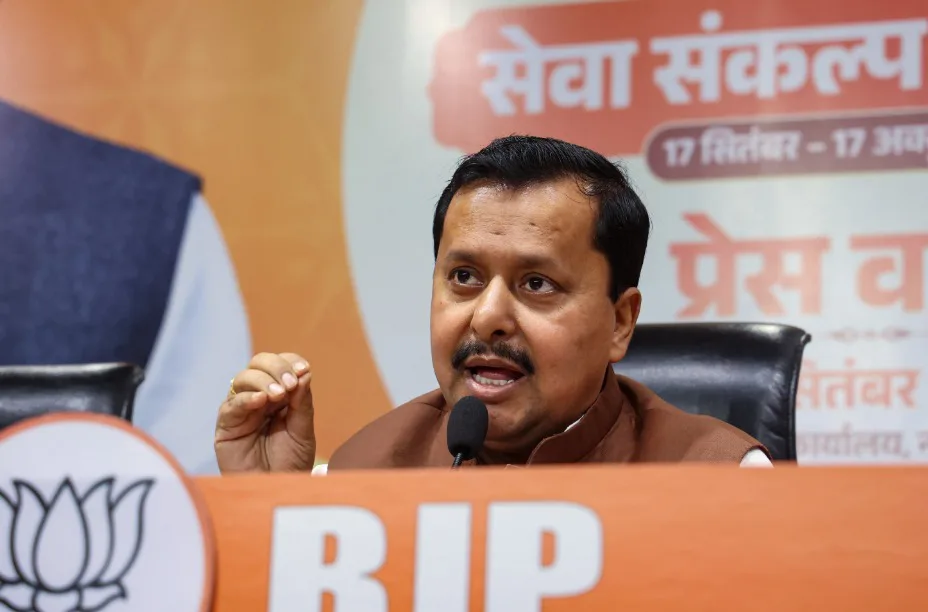
“From September 17, 2026 to October 17, 2026, the “Sewa Sankalp Abhiyan” will be organised. Its beginning will be on 17 September, the birthday of Prime Minister Shri Narendra Modi Ji, as “Sewa Diwas,” which is celebrated every year under “Sewa Pakhwada.” The Hon’ble Prime Minister Shri Narendra Modi Ji, throughout his life, with the spirit of service, has connected society, taken development schemes to the last person, and tried to bring them into the mainstream”
–Nitin Nabin, National President, BJP, on September 9
In Political Science, there is a term called “Soft State.” A Soft State is a country where the Government is afraid to take difficult decisions or lacks the capacity to implement them. For a long time, there was also a perception about Bharat that it was a Soft State. But under PM Modi’s leadership, this perception has completely changed. A major example of this is Article 370. It was said that Article 370 could never be removed. But PM Modi removed the provisions of Article 370 in one stroke. There were no protests in Jammu and Kashmir against this, nor did people engage in stone-pelting. After the removal of Article 370, Jammu and Kashmir is progressing rapidly on the path of development.
For decades after Independence, poverty was greatly glorified in Bharat under the guise of Socialist Economic Philosophy. Instead of talking about wealth creation, people spoke only about wealth distribution. But I want to ask a straightforward question: When wealth creation itself was not taking place, what was being distributed? Why was the private sector, which could have been an equal partner in development, viewed with distrust and mistrust?
We have worked to eliminate this mindset. We believe that wealth creation and social justice are not opposed to each other; rather, they complement each other. The result of this thinking is that when Bharat became the fourth-largest economy, it also became the fourth-most equitable country. As a result, 25 crore people have been lifted out of poverty, and the number of startups has increased from 500 to more than 2 lakh.
Prime Minister Narendra Modi Ji’s governance model is inclusive and holistic. It includes the welfare and empowerment of the poor, as well as opportunities for the youth. It provides better infrastructure for industries and ease of doing business for entrepreneurs. It ensures ease of living for every citizen of the country and equal opportunities.
(Excerpts from the translation of Rakshna Mantri Rajnath Singh’s speech on ‘Understanding Transformative Governance | Modi @ 25’ at an event organised by ‘Rambhau Mhalgi Prabodhini’ in New Delhi on September 12)